Showing posts with label luther. Show all posts

17 April 2017

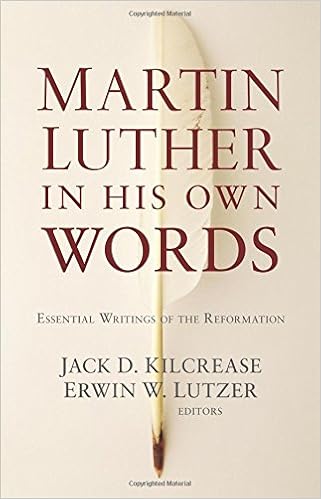
Book Review: Martin Luther in his own words

Martin Luther was undoubtedly one of the most influential theologians in history. An exceptional communicator who was also committed to upholding God's word, he sought to expose the church's abuses. In combination with a restless people and the advent of the printing press, Luther's challenges started a fire that took the world by storm. When Protestantism traces its roots, Luther is undoubtedly a progenitor. In other words, it is not just Lutheranism that traces its roots to Luther, but Protestantism in general.

Despite his profound influence upon Western History generally and church history in particular, I suspect few casual readers have read him, which is unfortunate. Luther was a keen thinker and worth the effort to read. When I tell people that one of my must read books is Luther's Commentary on the Galatians, I am met with glazed eyes that ask, "why would anyone read a commentary for pleasure?"

Perhaps the greatest service that Kilcrease and Lutzer offer to the church in their new book Martin Luther in His Own Words (Baker, 2017) is a sampling of Luther. Those who are new to wine often benefit from attending a sampling; in the same way, those new to Luther also benefit from a sampling.

The authors give us 12 chapters under the heading of the five solas--sola fide, sola gratia, sola scriptura, solus christus, and soli deo gloria. For those unfamiliar with these Latin reformation terms, they mean this: faith alone, grace alone, scripture alone, Christ alone, and to the glory of God alone. Under each heading, Kilcrease offers the reader 2 or 3 chapters pulled directly from Luther and offers them a helpful introduction. Sections from a number of Luther's works were included including: his commentary on Galatians, the larger catechism, and Bondage of the Will to name a few.

In an ideal world, this book will serve as an aperitif for more Luther. If this book stimulates the appetites of even 5% of its readers for his Galatians commentary, it will be an amazing success. Even if it doesn't, however, readers will come to know a man of profound biblical wisdom and insight.

I received a review copy of this book from the Baker Books Blogger program in exchange for a review. I was not required to provide a positive review and the impressions given here are my own.

26 August 2013

One of my favorite Luther quotes


This life therefore is not righteousness, but growth in righteousness, 

not health, but healing,

 not being but becoming, 

not rest, but exercise. 

We are not yet what we shall be, but we are growing toward it, 

the process is not yet finished, but it is going on, 

this is not the end, but it is the road. 

All does not yet gleam in glory, but all is being purified.”


13 October 2011

Book Review: Luther's Commentary on Galatians

Recently, Mike Horton was asked what 5 books besides the Bible every Christian should read.  On the list was Martin Luther's Commentary on Galatians.  I downloaded it for free from Amazon. This book is quite simply spectacular.  It contains Luther's thoughts on the book of Galatians, Paul's epistle written to call a church back to the doctrine of justification by faith alone.  Considering his own predilections, it is not surprising that Luther would have such strong feelings about this book and he expounds upon them well.  I agree with Horton that every Christian should read this book.  It is much more accessible than his similarly excellent The Bondage of the Will.  Although I have underlined much of the book, I will share a few of my favorite quotes from his thoughts about chapters 1 and 2. 

  • We are not to look upon our sins as insignificant trifles. On the other hand, we are not to regard them as so terrible that we must despair. Learn to believe that Christ was given, not for picayune and imaginary transgressions, but for mountainous sins; not for one or two, but for all; not for sins that can be discarded, but for sins that are stubbornly ingrained (in reference to Gal 1:4).  
  • Because my transgressions are multiplied and my own efforts at self-justification rather a hindrance than a furtherance, therefore Christ the Son of God gave Himself into death for my sins. To believe is to have eternal life (Gal 1:4).
  • Every teacher of works righteousness is a troublemaker. (Gal. 1:7).
  • The article of justification is fragile. Not in itself, of course, but in us. I know how quickly a person can forfeit the gospel. I know in what slippery places even those who stand who seem to have a good footing in the matters of the faith. In the midst of the conflict when we should be consoling ourselves with the Gospel, the Law rears up and begins to rage all over our conscience. I say the Gospel is frail because we are frail (Gal. 1:11-12). 
  • The Law terrorizes the conscience. The Law reveals the wrath and judgment of God. The Gospel does not threaten. The Gospel announces that Christ is come to forgive the sins of the world. The Gospel conveys to us the inestimable treasures of God. (Gal. 1:16). 
  • True faith lays hold of Christ and leans on Him alone. (Gal 2:4-5).
  • I must listen to the Gospel. It tells me, not what I must do, but what Jesus Christ, the Son of God, has done for me. (Gal 2:4-5).
  • No person has ever sunk so low that he cannot rise again (Gal 2:11). 
  • This imputation of righteousness we need very much, because we are far from perfect. As long as we have this body, sin will dwell in our flesh. Then too, we sometimes drive away the Holy Spirit; we fall into sin, like Peter, David, and other holy men. Nevertheless we may always take recourse to this fact, "that our sins are covered," and that "God will not lay them against our charge." Sin is not held against us for Christ's sake (Gal 2:16). 
  • Not that we reject good works. Far from it. But we will not allow ourselves to be removed from the anchorage of our salvation. (Gal 2:16). 
  • If we lose sight of Christ and begin to consider our past, we simply go to pieces. (Gal 2:20).
  • What awful presumption to imagine that there is any work good enough to pacify God, when to pacify God required the invaluable price of the death of blood of His own and only Son? (Gal 2:20).
  • Should I be so stupid as to reject the righteousness of Christ which cost me nothing, and slave like a fool to achieve the righteousness of the Law which God disdains? (Gal 2:21).
If you want more, get the book.  It is worth the price. 5 stars.