Showing posts with label masculinity. Show all posts

08 September 2017

Band of Brothers

A friend loves at all times, and a brother is born for adversity.--Proverbs 17:17

A man of many companions may come to ruin, but there is a friend who sticks closer than a brother.--Proverbs 18:24

True friendship is a rare gift, especially among men. In a culture that promotes rugged individualism on the one hand, and allows people to have thousands of "friends" through social media on the other, we have lost our way regarding what friendship means. We read stories in the Bible about friendships between men and the closeness they have may seem surreal to us because they are so different from our everyday experience.

We may have buddies, but often we don't have brothers.

We may have men that we like doing stuff with, but often we don't have men whom we love deeply.

I am grateful that for me, at least, results have not been typical. I want to tell you about two of my friends.

Several years ago, our church held a men's ministry event where "accountability groups" were encouraged. If you've never heard of an accountability group, it is essentially when a group of men get together and confess their sins to one another and pray for one another, usually guided by a list of questions (e.g., did you look at porn this week? Have you managed your money well?). My friend Brad was moved and reached out to a bunch of guys about starting a group. Eric and I, even though we didn't attend the men's ministry event, were the only two that responded. We didn't even really have relationship beforehand, other than a time when I offended Brad. The three of us began meeting at 6:00 on Thursday mornings at Randy's Family restaurant.

We are an unlikely trio. Let me tell you why. Brad runs an office--several actually--that sells bearings and transmissions. He is a whiz at math, has great spatial skills, has administrative capabilities that most only long for, and is a neat freak (perhaps even obsessively so).  Eric is a locksmith by profession, but also has an eye for beauty that many people lack in today's culture. Whether from resin or wood, he is able to craft things that amaze. Eric is also driven and visionary. I am a neuropsychologist and pastor. I love words more than anything requiring spatial skills, something both Eric and Brad would be quick to tell you. I am also decidedly not a neat freak.

Brad likes bikes. Eric likes Dungeons and Dragons. I like books.

As I said, we are an unlikely trio, yet these two men are my brothers. The love I have for them runs deep.

When we began meeting, we used " the list." Each week we would walk through the questions. Some weeks, I would hope that we wouldn't get around to me because I didn't want to tell these guys what a mess I was am.  Week after week we persisted, bonds of friendship forming. Eventually, we put away the list. We didn't need it to guide our conversations any longer because we had developed enough trust in one another to discuss whatever was pressing. We began to understand what it meant to encourage, admonish, help, and love one another. We were willing to dig down with one another and to allow the others to dig beneath our false veneer we put up.

But don't get the wrong impression that deep friendship is always easy. It's not. Every one of us have said something stupid for which we have needed to apologize. Every one of us has been confronted and wounded by the others. We have repeatedly had to apologize and forgive. Every one of us has sinned against the others, often unknowingly.

It would be so easy to live on the surface, to talk about the weather, but never get down to what is beneath. It would be so easy to walk away when conflict arises. It would be so easy to live behind our masks and never let one another see our true selves, but then we would never be truly known and honestly, then we would never grow. My friend Larry says "true growth happens when you look bad in the presence of love." I have that with these men and I regularly thank God for them. In a society that says when things get tough you are totally within your rights to walk away, a brother who sticks close by when things get messy is an unbelievable blessing.

In John 17, perhaps my favorite chapter in the whole Bible, Jesus prays for his brothers. At the end of the prayer, Jesus tells the Father that his desire is that these men would love one another the way that He and the Father love one another and that we would be one in the way that the Trinity is one (verses 21-22). This is not love like the world defines love; it is a radical other-centeredness and commitment to one another's good. Jesus wasn't just praying that this might happen in heaven, but that we might manifest this in our relationships now. I am grateful for two brothers with whom I am able to strive for that goal.

Perhaps as you read this, you are thinking to yourself "yeah, that's unrealistic," but what if it's not? How do you stretch toward this end? First, pray. Ask God to help this type of relationship develop. Second, persist. As I said above, when things get hard, our sinful predisposition is to cut and run rather than persevere in love for one another. Third, patience. Change happens slowly. In our instant society, we need to become people who take the long view, who trust the process of growth and relational sanctification.

Brad, Eric, and I are far from perfect, but we are committed to loving one another over the long haul.

22 March 2017

Disney and corrupted masculine intimacy

I have been thinking a lot about masculinity recently. In preparing a message for this Sunday on sexuality and gender, I have been wrestling to understand what the Bible says. I want to convey biblical truth to our church in plain terms. Thinking about masculinity is a natural extension of a teaching on gender.

The recent Disney release of a live action Beauty and the Beast has also brought masculinity to the forefront of my mind. Ed Vitagliano of the American Family Association wrote an article on March 13 entitled "Protect your children from Disney's gay agenda!", complete with exclamation point to drive home the seriousness of the message. Many Christians will undoubtedly boycott this movie on the warning of Vitiagliano and others with the same message. That choice is each person and each parents prerogative.

I, for one, don't know if Disney was promoting a "gay agenda" with Beauty and the Beast. There are indications that it may have been intended and, if I turn my head and squint my eyes, I can see that. (I will leave it to the pundits, who perceive it's necessity, to wrestle with that question). But as I came away from the movie yesterday (which I loved), I found myself wrestling with another question regarding masculinity. My question was not, "is Disney promoting the 'gay agenda'?", but "what ever became of nonsexual masculine intimacy?"

In today's American culture, men equate physical touch with sexuality. Any suggestion of intimate physical touch--in other words anything except a punch on the shoulder or a high five--suggests sexual desire. To hug another man, face to face, for more than a second, raises questions about motive and repressed homoerotic desire.

American masculinity often eschews deep relationship with women and especially with men. Emotions, apart from anger, are to be quickly suppressed or denied. Men are to be virile, and sexually interested, noticing, and perhaps commenting upon or even having sex with, as many women as possible. Men are supposed to seek power and control. Women and other men are to be used, not loved. In other words, American culture, and too often the American church, wants us to be more like the brutish Gaston from Disney's original Beauty and the Beast than like the sensitive Lafou from the 2017 version.

American men are loners.

But they feel so alone.

Beginning at an early age, boys receive the message that to be masculine is to be tough. Physical touch between fathers and sons all but disappears as they age, if it was ever there to begin with. The judges on the playground court convict boys as gay and sentence them to social isolation if they act contrary to the unwritten rules for masculine touch. Fighting is okay; hugging is not. Confusion ensues and the potential effects are legion.

This macho masculinity is a more recent phenomenon, I believe driven in some ways by a media culture that promotes a strong, even pathologic, male independence that eschews all need for affection and especially physical touch. It hasn't always been that way. Even in the Bible, we see evidences of physical intimacy between men that would make many of us modern men squirm.

  • When Jacob sees his brother Esau, whom he has not seen for a long time, he runs to him, falls on his neck, and kisses him as they both weep. (Genesis 33) 
  • As Paul left the Ephesians and would not see them again, they wept and embraced and kissed him. (Acts 20)
  • Though he didn't need to, Jesus often touched the people he healed.
  • In the New Testament, believers greeted one another with a kiss. 
  • On his last night before the crucifixion, Jesus had an intimate dinner with his disciples that involved not only foot washing, but John leaning back into Jesus at the table. (John 13) 
I don't fully know what recovering biblical masculine intimacy looks like. I do know that one of the most healing moments in my life involved an intimate and extended hug from a man. So in closing, I offer a few thoughts:
  • American men and boys need to be seen, valued, and yes, even touched. 
  • Explore your own assumptions about touch. As you read through this essay, what stirs in you? Are you questioning my agenda, or perhaps my sexuality? 
  • If you don't know where to start, dads you can begin by hugging your sons (and your daughters). Many adults never knew loving touch from their parents growing up. 
  • Don't equate touch with sex. They are not the same thing. 
  • Men, seek intimate relationships with a few other men. 
  • Consider reading this article that a male friend of mine posted: The Lack of Gentle Platonic Touch in Men's Lives is a Killer
Jesus stretched out his hand and touched him.--Luke 5:13

12 October 2015

What would you call a man...

What would you call a man who...
  • Uses touch to heal rather than to harm (Matthew 9:25, 9:29; Mark 1:31; 1:41; Luke 4:40; John 9:6)
  • is a willing servant (Mark 5:24; 10:45; John 13:4)
  • is known for his compassion (Matthew 14:14; 15:32; Mark 6:34)
  • sees children not as a hindrance but a joy (Matthew 18:2; 19:13; Mark 5:41; 10:14; Luke 18:16)
  • Listens to the "undesirables" in society (Matthew 20:31-32; Matthew 26:10; Mark 2:15; 5;34; Luke 5:13; 5:31; Luke 8;2; Luke 19:5; John 4:1)
  • can be sad and troubled (Matthew 26:37; Mark 14:33; John 13:21)
  • cries (Luke 19:41; John 11:35)
  • steps away from a fight (Matthew 26:52; John 18:11)
  • keeps his mouth shut rather than justifying himself (Matthew 26:63; 27:14)
  • feels pain (Matthew 27:50)
  • devotes himself to prayer (Mark 1:35; 9:29; Luke 11:2; John 17)
  • requires rest (Mark 6:31)
  • knows the Scriptures (Luke 4:17; 24:27)
  • speaks of love toward other men (John 13:23; 13:34-35) 
  • Values relationship (all of the Gospels)
You would call that man Jesus. Often our definition of masculinity is formed not by Scripture but by Hollywood. The biblical portrait of Jesus is not one of a hard-edged emotionless, loner. Rather, he is a man of conviction and wisdom who is tender, compassionate, relational and emotional. 

02 December 2014

Practicing Settledness

A couple of weeks ago, I attended the Next Step School of Spiritual Direction in Colorado Springs. Weeks like this are a constant flood of thoughts, feelings, and ideas to be processed. No normal person can process them all; anyway, I can't. Rather, I have learned that it is better to sit with open hands in the flood, eventually grasping onto an idea or two that I can examine more closely once the deluge passes.

One idea that has remained in these last few days is that of "settledness." I do not recall if it was over dinner with Larry or if it was during a group meeting where the term arose. Probably both. Good ideas tend to swirl back around. What really has stirred me is the connection between settledness and masculinity.

As Larry and I have come to know each other a little bit, one of the things that he is helping me to see about myself is my desire to please others. I like to be liked. Unfortunately, because of that desire, I tend to live out of a relational persona that masks my true self. One of his encouragements to me is to live more authentically out of the masculine identity that already resides in me. As a Christian man, my identity is found fully in Christ and the Holy Spirit lives through me. Knowing who, and whose, I am leads to settledness regarding how I relate to others.

I do not need others to appreciate me for my intellect nor my humor. 
I do not need to live to impress.
I do not need to soften my answers to make people happy.

Because my identity is bound up with Christ, I am free to be who God has created me to be.

25 May 2014

Book Review: Men of courage

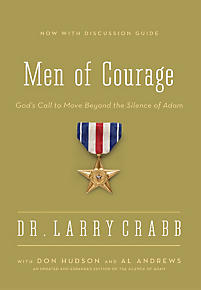
Men of Courage: God's Call to Move Beyond the Silence of Adam (2013) by Larry Crabb is the best book I have read on masculinity. Crabb begins the book with a brief discussion of how Adam remained silent, commenting, "the silence of Adam is the beginning of every man's failure."  Against that backdrop, he spends the rest of the book encouraging men to "remember and move."  In other words, we are to remember what God has said and have the courage to move into darkness, confusion, and chaos.  Unfortunately, in our fallen society men hear a cacophony of voices telling them what it means to be a man, with most voices missing the mark. Though we may enjoy adrenaline pumping activities, we have the tendency as men to stay on the surface, to avoid real risk. Relational risk.  Crabb writes, "Men are called to move into darkness, to keep moving ahead with purpose and strength even when they cannot clearly see the path before them" (p. 70). Most of us are reluctant to do this.

Crabb also argues that "the design of every man is to talk and be talked to" (p. 104). This runs contrary to what many modern notions of manhood imply.  However, it seems to me that our failure to talk is rooted in fear of uncertainty and confusion about who we are. To counteract this trend, Crabb encourages us to get into real relationships--with fathers, with brothers, with other men.

Father's Day is coming soon.  This may be one of the best gifts for men who desire to live a godly life. I would like to get this message out to every man that I know.