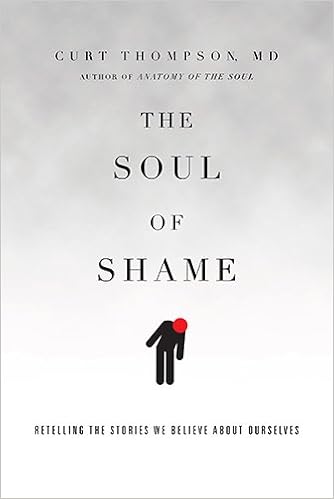
My friend Curt Thompson's sophomore release, The Soul of Shame: Retelling the Stories We Believe About Ourselves (Zondervan, 2015) does not disappoint. He is a Christian psychiatrist deeply influenced by the field of interpersonal neurobiology and particularly the work of Dan Siegel.
My initial exposure to Curt was when I was asked to be a respondent to his first book, Anatomy of the Soul. I read his book with an analytic eye, prepared to offer my critique. Prior to our talk, though, I was blessed to have a three hour dinner with him and another friend. Although I was still left with questions about his ideas, I felt a connection with the man. I have often joked that he is the only person I have ever presented at a conference with whom I hugged when we parted. I have since read his book four times.
Quite some time ago, he told me that he was working on a book on shame and I could not wait. In recent years, I have done quite a bit of reading about shame including Ed Welch's fine book Shame Interrupted as well as the works of Brene Brown. These works have been professional rewarding and personally helpful.
The Soul of Shame is a particular gift to me, however. As a Christian, a neuropsychologist, and someone interested in shame, this book provides a unique intersection. He weaves his personal and professional experiences together with his discussions of vulnerability and developing an integrated mind, particularly in the context of a body of believers. Though written by a psychiatrist specializing in interpersonal neurobiology, it is accessible, interesting, and wise.
Showing posts with label shame. Show all posts
04 October 2015
09 October 2014
Book Review: Daring Greatly
I think that more people need to read Brene Brown. She came to notoriety through a TED talk that she gave and was thrusted into the international spotlight. Brown is a PhD social worker who researches shame, vulnerability, and wholeheartedness. I previously had the chance to read her book, The Gifts of Imperfection, which I thought was quite good. Recently, however, a friend of mine recommended Daring Greatly: How the Courage to be Vulnerable Transforms the Way We Live, Love, Parent, and Lead (2012). As much as I liked her first book, this one was better.
Brown accomplishes what we all hope with our research. She is able to examine her data and personalize it in such a way that it grabs the reader. This book is a perfect example. She describes how she distilled 12 years of research into this book about vulnerability. She shares numerous anecdotes from her own life and the lives of those she has met to animate her thoughts.
This book dives deeply into topics of shame, boundaries, feelings of unworthiness, wholeness, and vulnerability. Brown talks about the toxicity of shame and the benefits of being vulnerable to risk and emotional exposure. I suspect this book will be deeply challenging for many, especially those who deal with shame, but on the other side, there is hope and healing. Don't let that keep you from reading. Indeed, I would like to put this book into the hands of many people that I know.
Brown accomplishes what we all hope with our research. She is able to examine her data and personalize it in such a way that it grabs the reader. This book is a perfect example. She describes how she distilled 12 years of research into this book about vulnerability. She shares numerous anecdotes from her own life and the lives of those she has met to animate her thoughts.
This book dives deeply into topics of shame, boundaries, feelings of unworthiness, wholeness, and vulnerability. Brown talks about the toxicity of shame and the benefits of being vulnerable to risk and emotional exposure. I suspect this book will be deeply challenging for many, especially those who deal with shame, but on the other side, there is hope and healing. Don't let that keep you from reading. Indeed, I would like to put this book into the hands of many people that I know.
17 November 2013
Book Review: Let Hope In by Pete Wilson
Pete Wilson, pastor of Cross Point Church in Nashville, Tennessee wants his readers to rediscover hope and he believes that hope is a choice, or rather the result of a series of choices. He structured the book, Let Hope In (2013) around four choices: choosing to transform instead of transfer, choosing to be okay with not being okay, choosing to trust rather than to please, and choosing to free people rather than hurt them.
The basic message of the book is that Wilson wants people to rediscover the hope of the gospel. Somewhere along the way, the message of Christianity has gotten twisted and his desire is that his readers would find their hope in Christ. There is an early focus on addressing shame, which in turn gives way to hope and freedom. Later in the book, he makes the point that hurt people, hurt people and free people, free people. He wants people to leave the hurt at the cross and rediscover the freedom in Christ.
On the whole, I loved this book. Wilson is a great story teller who has a gift for weaving biblical truths with compelling narrative. He makes the reader believe that he has lived and experienced the things that he writes about.
In the first chapter, he shared a slogan that they have adopted at their church, “Everyone is welcome, because nobody is perfect, but anything is possible.” I appreciated how Wilson helped the reader to see that it is okay to be imperfect. In fact, in our humanity, we are imperfect, he merely calls us to recognize it. From that point, we can move forward. Tied with our hiding is the notion of shame, which is all too often ignored in the church. He rightly desires the church to be a place where it is safe to talk about brokenness and shame and find hope in the gospel. We should be a confessional community who point one another toward Christ and his forgiveness. I have been working my way through several of Larry Crabb’s books and there are certain parallels with his work, which I believe is a good thing, because both authors rethink Christian community.
Wilson landed where I hoped I would. Once we admit our brokenness, it ultimately should lead us to gratitude, grace, and freedom. This is a gospel saturated book. Wilson clearly wanted his readers to see the beauty of Jesus in the midst of our fallenness. I believe he succeeded.
If I had one complaint about the book, it wasn’t always clear to me that he was following the same thread through the book. There were times when I was not sure how one chapter linked to the previous. On the whole, he wove together several threads into a wonderful tapestry, but sometimes, I couldn’t see it.
I would strongly recommend this book. The publisher has provided you with a complimentary copy of this book or advanced reading copy through BookSneeze®
The basic message of the book is that Wilson wants people to rediscover the hope of the gospel. Somewhere along the way, the message of Christianity has gotten twisted and his desire is that his readers would find their hope in Christ. There is an early focus on addressing shame, which in turn gives way to hope and freedom. Later in the book, he makes the point that hurt people, hurt people and free people, free people. He wants people to leave the hurt at the cross and rediscover the freedom in Christ.
On the whole, I loved this book. Wilson is a great story teller who has a gift for weaving biblical truths with compelling narrative. He makes the reader believe that he has lived and experienced the things that he writes about.
In the first chapter, he shared a slogan that they have adopted at their church, “Everyone is welcome, because nobody is perfect, but anything is possible.” I appreciated how Wilson helped the reader to see that it is okay to be imperfect. In fact, in our humanity, we are imperfect, he merely calls us to recognize it. From that point, we can move forward. Tied with our hiding is the notion of shame, which is all too often ignored in the church. He rightly desires the church to be a place where it is safe to talk about brokenness and shame and find hope in the gospel. We should be a confessional community who point one another toward Christ and his forgiveness. I have been working my way through several of Larry Crabb’s books and there are certain parallels with his work, which I believe is a good thing, because both authors rethink Christian community.
Wilson landed where I hoped I would. Once we admit our brokenness, it ultimately should lead us to gratitude, grace, and freedom. This is a gospel saturated book. Wilson clearly wanted his readers to see the beauty of Jesus in the midst of our fallenness. I believe he succeeded.
If I had one complaint about the book, it wasn’t always clear to me that he was following the same thread through the book. There were times when I was not sure how one chapter linked to the previous. On the whole, he wove together several threads into a wonderful tapestry, but sometimes, I couldn’t see it.
I would strongly recommend this book. The publisher has provided you with a complimentary copy of this book or advanced reading copy through BookSneeze®
14 April 2013
Overcoming shame
Here is a message I taught at our church last weekend on the topic of "overcoming shame" based on Zechariah 3.
05 February 2013
Discussion of Sexual Abuse on the White Horse Inn
Michael Horton, host of the White Horse Inn, recently interviewed Justin and Lindsey Holcomb, authors of Rid of My DisGRACE, an excellent book dealing with sexual abuse. This interview is really important for those who have dealt with sexual abuse or even more broadly, the issue of shame.
You can listen to it here.
Subscribe to:
Posts (Atom)