Showing posts with label Christian Psychology. Show all posts

11 October 2017

Altruism, Neuroscience, and Christian Psychology

I was contacted by a magazine editor to offer thoughts on an article from the Proceedings from the National Academy of Sciences a few years ago. I ended up writing a treatise. 

I will try to offer several thoughts, that I hope will be cogent.  The PNAS study is an interesting one. Neuroscience, as you no doubt know, has advanced considerably over the last several years. This seems especially true following the advent of functional neuroimaging, such as fMRI, which allows researchers to get a glimpse of what is happening in a functioning brain. This fMRI research has progressed from understanding motor functioning (e.g., finger tapping) to cognitive tasks (e.g., memory) and now to issues of relationship and morality. Researchers continually push the edge in terms of figuring out how to administer tasks inside the scanner  to try to understand what is going on in the brain. This emotion recognition paradigm is a fascinating one. It is unsurprising that the amygdala shows increased responsiveness in those who are altruistic; the amygdala is one of the brain structures most closely associated with emotional expression, but also emotional memory. So, from a neuropsychological perspective, these results confirm what one might predict. 

As a Christian neuropsychologist, the question of biological markers and altruism is an important one to consider. As you might imagine, for a non-theistic materialist, the assumption might be that the larger amygdala causes increased altruism, but what if the direction is reversed? What if those who exhibit consistently other-centered behaviors develop improved amygdala function? I shared with someone the other day that I believe Jesus, in his humanity, had the most exquisitely integrated brain of any person ever; there was no malfunction, there was no disintegration. His brain functioned the way all of our brains should function. But the New Testament also calls each of us to wholeness. I am particularly fond of John 13 to 17 where Jesus practically demonstrates other centered love and tells us to love one another like he loved us. Then in his prayer, he prayed that “they would be one as he and the Father were one.” Jesus was highly altruistic, the perfect picture of wholeness, and calls us to relational integration or what my friend Larry Crabb might call “relational holiness.” Neuroscientists are increasingly recognizing the brain as not just as the organ to make our bodies move and think, but that it is a relational organ. So when Jesus tells us to love one another like he loves, or when Paul tells us to put on the new self, we are being called into a life not only of greater other centeredness and greater love, but I would argue, deeper neurological integration. 

In terms of the reconciling power of God’s grace and the ongoing work of the Holy Spirit, God absolutely has the ability to change our hearts, but in so doing, he also equips us for greater neuropsychological health and wholeness. Unfortunately, it is all too common that Christians don’t live into that reality and we continue to live disintegrated.


I might also anticipate another question: why is it then that non-believers might be more altruistic, kind, charitable, etc. than non-believers. I would offer a couple of thoughts: first, those one time snapshots fail to account for one’s progressive sanctification. John Newton said once, “I am not what I ought to be, I am not what I want to be, I am not what I hope to be in another world; but still I am not what I once used to be, and by the grace of God I am what I am.” God’s ongoing grace has a role in our sanctification, which I believe includes other-centeredness. The second observation I would offer is that God’s common grace allows remarkable may allow for compassion even amongst non-believers. The question that falls to us as believers, though, is what do I do with the gift that I have been given? Will I choose to live toward wholeness in Christ or not? 

28 April 2016

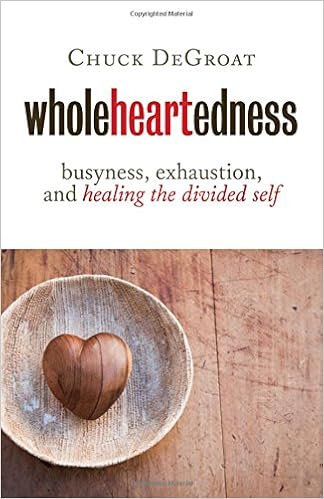
Book Review: Wholeheartedness

Wholeheartedness: Busyness, Exhaustion, and Healing the Divided Self (2016) by Chuck DeGroat is the best non-fiction book I have read this year by far. (I have to say non-fiction because Andrew Peterson's Wingfeather Saga was also exceptionally good, but clearly different).

In Wholeheartedness, DeGroat explores how we too often live "divided" lives rather than the lives of wholeness we were created for. The typical Christian approach to the sense that something is not quite right is to do more and try harder all the while wondering what happened to the rest that Jesus promised. And we feel exhausted.

DeGroat takes a careful look at our dividedness, our failures, and our shame through the lenses of scriptural wisdom, psychology, neurobiology, and poetry to help us see, with greater clarity, God's shalom. On page 98, he wrote "those who are whole are ambassadors of God's shalom, of wholeness." In the final section of the book, he introduces us to how we might experience a growing wholeness. Here, I particularly appreciated his wisdom on union and communion.

Fans of such a broad range of authors such as Dan Siegel, Curt Thompson, Teresa of Avila, Gerard Manly Hopkins, Thomas Merton, and St Augustine will benefit deeply from this book. I have already eagerly recommended it to a patient along with Brene Brown's excellent Gift of Imperfection. Undoubtedly, this will be a book I will savor again and again.

17 February 2016

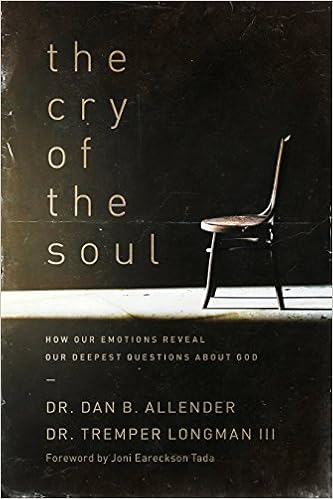
Book Review: Cry of the Soul

Talk of emotion often makes Christians squirm. We may give a nod to emotions, primarily to acknowledge our need to keep them under control. Whether stated or not, too many Christians operate from the assumption that a godly person is one who suppresses negative emotions. Positive emotions are accepted, but only if they are not too extreme.  In other words, for many, the Christian is to be a thinker, not a feeler. But the Bible is a book filled with emotion.

In their excellent book The Cry of the Soul: How Our Emotions Reveal Our Deepest Questions About God (1994), Dan Allender and Tremper Longman III have invited the readers to explore the language of emotion, in our own lives and through the words of Scripture, particularly in the Psalms. They encourage us to look into our shame, and fear, and sadness and ask what those emotions tell us about who God is.

Cry of the Soul is an excellent book. If you wish to develop a deeper understanding of your emotional life and of your relationship with God, this is a great place to begin.

04 October 2015

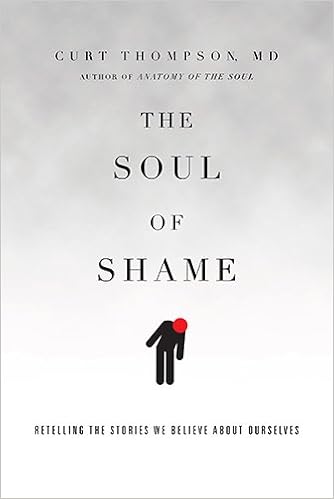
Book Review: Soul of Shame

My friend Curt Thompson's sophomore release, The Soul of Shame: Retelling the Stories We Believe About Ourselves (Zondervan, 2015) does not disappoint. He is a Christian psychiatrist deeply influenced by the field of interpersonal neurobiology and particularly the work of Dan Siegel.

My initial exposure to Curt was when I was asked to be a respondent to his first book, Anatomy of the Soul. I read his book with an analytic eye, prepared to offer my critique. Prior to our talk, though, I was blessed to have a three hour dinner with him and another friend. Although I was still left with questions about his ideas, I felt a connection with the man. I have often joked that he is the only person I have ever presented at a conference with whom I hugged when we parted. I have since read his book four times.

Quite some time ago, he told me that he was working on a book on shame and I could not wait. In recent years, I have done quite a bit of reading about shame including Ed Welch's fine book Shame Interrupted as well as the works of Brene Brown. These works have been professional rewarding and personally helpful.

The Soul of Shame is a particular gift to me, however. As a Christian, a neuropsychologist, and someone interested in shame, this book provides a unique intersection. He weaves his personal and professional experiences together with his discussions of vulnerability and developing an integrated mind, particularly in the context of a body of believers. Though written by a psychiatrist specializing in interpersonal neurobiology, it is accessible, interesting, and wise. 

12 June 2015

Book Review: Toughest People to Love

If I could put this book into the hands of every pastor and leader in the United States I would. Chuck DeGroat's Toughest People to Love: How to Understand, Lead, and Love the Difficult People in Your Life--Including Yourself (2014, Eerdmans) is a useful book on understanding people that has a high Christology and a realistic anthropology.

DeGroat opened the book by discussing the challenges of the pastorate. He pointed out that 80% of new pastors quit within 5 years. As I often say to my friends, people are messy. He discusses the ineffective ways that we tend to lead and why they don't work before he moves on to discuss our deep relationality and how understanding that is the foundation of all good leadership.

One of the terms that DeGroat introduced was "beautiful complexity"--that we are not only sinful, but God's image bearers. We must be careful of simplifying people and trying to fit them into neat theological boxes.

Part 2 which deals with "leading and loving difficult people" is particularly beneficial. Often, I think Christians are leery of psychological categories, but they can be helpful in dealing with people. As his friend Johnny LaLonde said to him, "Labels are helpful when they broaden our ability to understand and empathize with a person. They're destructive when they confine us and cause us to see the person more narrowly." Having said that, DeGroat introduces the reader to terms such as personality disorders (borderline, narcissistic, obsessive-compulsive, and histrionic) as well as addiction and foolishness.

As he continued through the book, he explored the benefit of the dark night of the soul, a call to wholeness, and useful spiritual disciplines. I particularly liked discipline 4: "The freedom to break the rules." I have been offering this piece of wisdom to some rigid folks I know and it helps them to discover a freedom they did not know was available.

Whether you are a pastor or not, whether you are a leader or not, I would strongly recommend this book. I have already recommended it to my pastor and will no doubt recommend it again.

08 April 2015

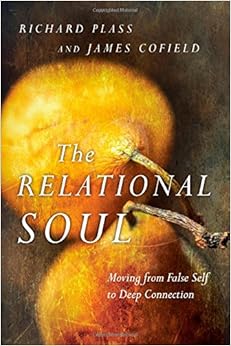
Book Review: The Relational Soul

The Relational Soul: Moving from False Self to Deep Connection (2014, IVP) by Richard Plass and James Cofield is gold. Previously, I have been honored to include each of their submissions in the newsletter I edit for the Society for Christian Psychology, but even knowing a modest amount about their work, this book far exceeded my expectations.

The Relational Soul, as I had hoped, deals with the importance of relationships in human well-being. Drawing upon work in the fields of attachment and interpersonal neurobiology, Plass and Cofield show their readers why relationships are essential to functioning.  In fact, on page 15 they wrote, "All reality is relational." I tend to agree with them, knowing that we are created in the image of the triune Godhead.

I appreciated a great deal about this book. Chapter 3, which deals with the importance of implicit memory with regard to early attachment and relational formation. Too often, it seems to me that much of American Christianity deals with the logical aspects of faith and life and downplays the emotional/relational aspects. The authors encourage their readers to think about both.

As they move on, they spend a lot of time exploring the notion of our false self versus our true self, which reminds me of Larry Crabb's discussions of mask wearing. Relational formation can only occur when we learn to recognize our false selves and grow into our true selves.

The final section I would mention is chapter 8, which deals with community. I do not think it is much of an exaggeration to claim that I underlined half of the chapter. Each paragraph in the chapter on community could stand alone as worth pondering deeply.

If you seek to understand yourself and your relationships on a deeper level, this is the book for you. Fans of authors like Larry Crabb, Curt Thompson, or Dan Siegel are sure to benefit from this book. But if you want to borrow my copy, you may have to wait awhile, there are things I want to read again.

26 February 2015

Book Review: The Happy Christian

I am not naturally a pessimist, though when I saw David Murray's latest book The Happy Christian: Ten Ways to be a Joyful Believer in a Gloomy World (Thomas Nelson, 2015), I was a bit skeptical. To be clear, I have a deep appreciation for Dr Murray and I am a committed fan to his blog. As a Christian psychologist and editor of the newsletter for the Society for Christian Psychology, I believe that Dr Murray is one of the bright lights of the movement. I have put his little book, Christians Get Depressed Too, into the hands of many people. Yet, when I read the the title, "The Happy Christian", I worried. To clarify, I do believe that the Christian faith leads to a joy and happiness that is unparalleled in other worldviews, yet to me, it seems too easy to communicate the message that one must be happy to be a Christian. I do not believe that the biblical record reflects happiness as a requirement for the believer. Still, Murray is a wise man and I was eager to read what he chose to share.

Murray presented 10 ways to be joyful:
  1. Happy Facts: Facts > Feelings
  2. Happy Media: Good News > Bad News
  3. Happy Salvation: Done > Do
  4. Happy Church: Christ > Christians
  5. Happy Future: Future > Past
  6. Happy World: Everywhere Grace > Everywhere Sin
  7. Happy Praise: Praise > Criticism
  8. Happy Giving: Giving > Getting
  9. Happy Work: Work > Play
  10. Happy Differences: Diversity > Uniformity
If I am honest, after the first chapter, my hopes for this book cooled, though in hindsight, I am not sure why. Murray essentially presented a way of examining how we think grounded in a cognitive behavioral model. I think my initial concern was that although extremely beneficial, an exclusively cognitive behavioral approach would be limited. I also had fears that this book would be a recycling of previous writers like Norman Vincent Peale, though Murray quickly set that fear to rest. 

As I continued to read, I was reminded why I like Dr Murray so much. He addresses a broad range of issues and how they can influence the life of the Christian. Briefly, for example, he shows the reader how too much immersion in negative news can be psychologically damaging, how focusing on the past can be problematic, and how giving freely is freedom giving.

Considering how I tend to think, I was particularly drawn to chapter 3, which has to do with Happy Salvation. Murray reminds us, as Christians, that when Jesus said from the cross that it is finished, that he meant it. That has very practical implications for our own happiness. In that chapter he wrote, "What are the ten most disbelieved letters in the Bible? N...O...T...O...F...W...O...R...K...S"  Amen.

Overall, I was very happy with Dr Murray's new book. I would gladly put it into the hands of any believer. It is biblical, practical, and wise.

In exchange for this review, I was provided with a free copy of this book by Thomas Nelson and the Book Look Bloggers Program. I was not required to submit a positive review of this book. 

13 May 2014

Book Review: Pastoral Theology in the Classical Tradition

I am taking my final course for a certificate in biblical counseling through the Christian Counseling and Education Foundation, which is entitled Counseling in the Local Church. Pastoral Theology in the Classical Tradition (2001) by Andrew Purves is one of the required texts.  In this short text, Purves explores pastoral care and what we might now call counseling or soul care through the works of five men separated by over a thousand years: Gregory of Nazianzus, John Chrysostom, Gregory the Great, Martin Bucer, and Richard Baxter. I suspect that even most well-read evangelicals have little knowledge of these men, except perhaps Richard Baxter.

In each case, Purves provides a short biographical sketch and then explores aspects of their works that contribute to pastoral care and shepherding. Although there was wisdom in each, I was particularly drawn to Gregory of Nazianzus, the earliest of them. Purves wrote, "according to Gregory, the pastor is a healer, even more so than the physician for the pastor treats a sickness that is a deeply subtle foe of healing a sickness of the soul" (p. 17).

Also, in the chapter on Gregory, Purves makes this point: "the godly pastor is not only a psychologist and rhetorician, but above all else also must be a theologian" (page 22). I would love to see this wisdom penetrate the pastoral office today.

23 April 2014

Book Review: Connecting

When I was having dinner with Dr Crabb at the School of Spiritual Direction a few weeks ago, I remember during our conversation that I wondered aloud whether I was going through some of the same professional transition that he went through many years before as a professional psychologist. It felt arrogant saying it, and in no way would I imply that I am similarly brilliant, but it seemed that many of his struggles of 20 years ago are things that I struggle with.  His book Connecting (1997) has strengthened that impression. In fact, on page 42, he wrote, "Was I afraid to just be with this man (a client), to take off the Dr Crabb white coat, to stop being an expert, and offer myself as a person?" This statement so closely mirrors what he told me--"I have no interest in knowing Dr Kanz, but I would really like to know Jason"--I wonder if he had this section in mind. 

Peppered throughout the book are references to the inadequacy of the professional model of helping for soul healing. Of course professionals can, and often do help, but what people often desire is connection, not professional therapy or legalistic moralism.  In this book, Crabb discusses what connection may look like in relationships with one another. 

True connection, what Curt Thompson calls the desire to "be known", is at the heart of healing and soul work. We are relational beings created by a relational God, but as a result of the fall, we struggle to relate well.  This book may provide some wisdom as to what it might look like to start down the path of connecting with one another.  Highly recommended.

20 April 2014

Book Review: Soul Keeping

I have been familiar with John Ortberg's work through talks he has given at the American Association for Christian Counselors and his book The Life You Always Wanted, which surprisingly is not a book of prosperity theology.  Because I have been favorably impressed with his work in the past, I was eager to read Soul Keeping: Caring for the Most Important Part of You (2014). 

Ortberg is a pastor at Menlo Park Presbyterian Church in California, though he also trained as a clinical psychologist.  Each of those facts are important background in this book about caring for the soul.  Additionally, Ortberg was profoundly influenced by the work of Dallas Willard who in May last year.  In many regards, this book is a festschrift to Willard. Not only are Willard's influences deeply felt, Ortberg went out of his way to weave many stories about the man, a welcome addition. 

Essentially, this short book is a study in how we care for the most important part of us our souls.  At the outset, Ortberg seeks to define the soul so that the reader is able to proceed from a place of common understanding.  Once he establishes what the soul is, he moves on to reviewing what the soul needs and eventually how the soul is restored. 

There were a few things that I particularly appreciated about this book.  First, Ortberg does a commendable job of differentiating between the soul and the self.  So often in modern thinking about mental health, we think only about the self, which Ortberg suggests is misguided.  Rather, we should focus on the soul, which defines who we are in relation to God. In the world of Christian psychology where I do some reading and writing, this is an important distinction. 

Second, Ortberg effectively weaves in his understanding of the importance of spiritual disciplines. As one deeply influenced by Willard and involved in the Renovare conferences, he views disciplines as important. He discusses these in more depth in his book The Life You Always Wanted, though here they find an organic place. 

Finally, I really liked the last two chapters.  Essentially, these deal with his final interactions with Dallas Willard. He discusses suffering and what he thinks it looks like to die well, looking at Willard as a model. 

On the whole, I would strongly recommend this book.  I wish more "Christian psychology" and soul care would look like this book. It is deeply relational, hopeful, and grounded in the truth of the gospel. 

I received this book free from the publisher through the Book Look Bloggers book review bloggers program. I was not required to write a positive review. The opinions I have expressed are my own. I am disclosing this in accordance with the Federal Trade Commission’s 16 CFR, Part 255: “Guides Concerning the Use of Endorsements and Testimonials in Advertising.”

08 April 2014

Flourishing in Prayer and Meditation

Yesterday, I posted a link to a video of my friend Curt Thompson.  This is my friend Eric Johnson who, more than possibly anyone, has influenced how I think about soul care and psychology.  He is intelligent, wise, humble, and compassionate.  I want to be like him when I grow up. 

07 April 2014

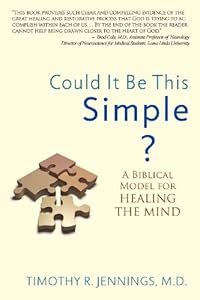
Book Review: Could it Be This Simple?

I received a free copy of Could it Be This Simple? A Biblical Model for Healing the Mind (2012) by Timothy Jennings MD at last year's world conference for the American Association of Christian Counseling. As a Christian and a neuropsychologist, I was eager to read what he had to say.

Replete with examples from everyday life and from his clinical experience, Jennings describes a model of "healing the mind."  In the early chapters, he laid out the link between our spiritual natures, conscience, will, reason, feelings, thoughts, and physical functioning in influencing our mind.  He then set out to show how our minds functioned before sin entered the picture and then subsequently, how sin affected us.

There is much to commend about this book. Jennings is a clear and engaging communicator. This was an simple, though not simplistic, book to read.  I appreciated his recognition of the multiple elements of how the mind functions. Too often, it seems that we focus on one area (e.g., thoughts, relationships) to the exclusion of others. Dr Jennings seems to find that balance reasonably well.  He recognizes that God created us as thinking, feeling, volitional, relational beings and that each of those areas--as well as others-- were affected by the fall. 

Near the center of the book, he took time to develop his thoughts about the laws of liberty and of love as well as their counterfeits. I think that, for the most part, he is right especially as he talked about what right, biblical love looks like.  In chapter 12, his discussion of forgiveness and its associated myths are worth reading.

Despite much to commend about this book early on, the book took a decided turn for me on page 129.  Prior to that, I had some concerns that he was developing a model of healing based upon the law of linearity that Larry Crabb talks about.  In others words, if I have problem A, and I apply treatment B, good things will happen.  If-then Christianity.  Because there was much that was good, I was happy to set that aside.  However, then came page 129.  Under the heading "a false gospel", he essentially dismisses penal substitutionary atonement as a "wolf in sheep's clothing". He argues that Christ did not come to appease God's wrath toward sin and that we need to be cautious with phrases such as "being clothed in Christ's righteousness."  He wrote, "far from what it professes, this false view is actually a candy-coated, rotten-apple theory."  At best, his description is incomplete; at worst, it is heretical.  It may be that I am misreading what he wrote in this section, though I don't think I am.  Having read it several times, he seems to reject the biblical notion of propitiation. He appears to favor a semi-pelagian view of salvation rather than salvation based purely upon the free gift of grace offered through Christ, the sacrificial lamb, which is well-described in Hebrews. 

Finally, at the end of the book, it was hard for me to determine his views of eternal life. On page 136, he wrote, "if we utilize our reason, we would realize that God cannot be the loving Father and the threatening destroyer at the same time...If God is not threatening to destroy the unrepentant, then what will he do to those who reject Him? It is very simple, really. He takes the only loving action He can: He lets them go, and when the Life-giver lets go, they die." This section, and those following make Jennings sound like an annihilationist (like the late John Stott), though I was never entirely sure.

In the end, there are many good elements to this book and some that are strikingly concerning. I believe a discerning reader could wade through the concerns, but unfortunately, this book is not targeted to the theologically sophisticated. Having said that, I humbly acknowledge that I hope it is my own limited understanding and not false theology that raises concerns for me.  I would be eager to hear any corrections from Dr Jennings if I am misrepresenting his work.

Spirituality and Neuroplasticity

This is a video of my friend Curt Thompson. Curt has brought together his Christian faith with his work in psychiatry and interpersonal neurobiology.  I would love to receive supervision from him in this area because, to me, it is quite cutting edge. If you get a chance, you should also read his excellent book, Anatomy of the Soul. I've read it 4 times and I like it better each time. 

03 April 2014

New Way Ministries School of Spiritual Direction

Dr Crabb and Me.  I am a giant.
Last week, I attended the School of Spiritual Direction in Asheville, North Carolina. This week long school is offered by Larry Crabb and New Way Ministries. Dr Crabb is a clinical psychologist who is a popular speaker and author. About 20 years ago, he had a significant change in his thinking about what constituted helping or "soul care."

Dr Crabb has shifted from a counselor/counselee model to a focus on "conversations that matter" that can, and should, occur between believers. He describes wise conversations between pilgrim's on the way. There are none who have arrived in and of themselves; each faces his or her own brokenness.  Along with about 30 other people, we learned about what it meant to have conversations that matter.

I wasn't sure what to expect, but it is fair to say that I have not experienced anything quite like this event. We were given a binder full of notes, but we rarely looked at it. Dr Crabb encouraged us not to get bogged down in taking notes. Rather, I would describe the week as a series of conversations--sometimes with the whole group and sometimes one on one.

Over the week, each day had a rhythm of sorts. After breakfast, we would meet as a group from 9 until noon. This time involved worship, devotional thoughts from Dr Crabb, and his explanation of how he envisions having these conversations. His approach is very conversational, engaging the class with his stories and ours. He was very good at drawing people out.

The afternoons consisted of work in small groups of 3 or 4 where we were able to share one another's stories on most days. One afternoon was dedicated to meeting with Dr Crabb or one of the other directors. I had the pleasure of meeting with Dr Crabb a couple of times, which was helpful in understanding how he approaches spiritual direction. Meeting with 3 others, though was equally useful.

In the evenings, Dr Crabb would spend some more time talking through his model.  Though I would get tired, I always looked forward to the next session. And I never skipped any, which was unique from any other conference that I have attended.

The in between times were spent walking in the woods, visiting with new friends, or resting and relaxing. The beauty of the mountains is unparalleled.

More personally, I wish it were possible to explain the shift in my soul that I experienced when I was there. Spending time meditating on what Dr Crabb shared with me individually and what he talked about in the group has shaken up my thinking, in a positive way. I am eager to see how it affects relationships. Dr Crabb said, "spiritual formation is relational formation."

If you want to talk specifically about the school, or if you have questions, let me know. I would be eager to sit down with you and have a conversation that matters.

24 March 2014

Book Review: The Gift of Being Yourself

The Gift of Being Yourself (2004) by David Benner is a useful little book for those interested in understanding themselves. Benner is a professor of psychology and spirituality who is interested in understanding more than just behavioral change. In this book, he explores John Calvin's dual maxim that as Christians we must come to know God and come to know ourselves. Although this book dedicates a chapter to the former as a necessary requisite for the latter, the majority of the book is committed to helping the reader explore issues of self understanding, which is best accomplished by knowing how we relate to God. In particular, there is a clear call to knowing yourself as one deeply loved by God. Once you realize yourself as one deeply loved, you can then begin to explore your true self--not the self you want others to see--but who you truly are.  This book provides some practical ways to begin this journey. It is readable, engaging, and important.

04 March 2014

A video about teenage depression

Here is another winner from David Murray. 


27 February 2014

Book Review: Understanding People

Understanding people: Why we long for relationship (1987/2013) by Larry Crabb is an excellent book essentially dealing with anthropology. The book is divided into three sections. The first, entitled "A Sufficient Bible" begins by exploring how people come to know things and then Crabb moves on to an argument for the sufficiency of scripture, rightly conceived.  He effectively addressed the common ways in which people tend to treat the Bible when it comes to psychological difficulties: 1) it has no place because it doesn't directly address every human problem, 2) it is our only focus because it does answer questions, and 3) it is sufficient because it provides categories for thinking and conceptualizing.

Having made his argument that the Bible is a sufficient guide for relational living--again, rightly conceived--in the second section he addressed the issue of anthropology on a deeper level, with specific attention to how he understands what it means to be made in the image of God. After some more theoretical and foundational writing, he comes to the point where he describes all people as personal beings who long deeply, rational beings who think, volitional beings who choose, and emotional beings who feel. Too often, various segments of the church downplay some of these aspects rather than trying to keep them in right balance. He concluded the book with a short third section discussing the evidence and essence of Christian maturity.

Overall, I really appreciated this book.  I read one reviewer who lamented that earlier sections of the book were too academic or theoretical, but I admit I didn't see that at all. Understanding people, as Crabb clearly suggests, cannot be accomplished by 5 easy steps. He effectively described an effective model for understanding God's image bearers.  

19 February 2014

Are you depressed?

David Murray is, in my opinion, one of the wisest, most balanced pastors writing today when it comes to issues of mental illness and particularly depression.  He wrote a book entitled Christians Get Depressed Too that you should check out.  They are releasing a set of videos associated with the book.  This is the first one.


If you have struggled with depression, I would commend it to you.  If you don't know what depression is, I would commend it to you. If you are not sure if you are depressed or if you believe Christians cannot or should not get depressed, I would especially commend it to you. 

23 January 2014

Great Counsel on Depression Medications

The more I read of David Murray, the more I appreciate him.  He is a pastor and professor (Old Testament and Practical Theology) who writes wisely about depression.  Today, he offered this excellent counsel to someone who has decided to go on medications for depression. 

He begins:
So sorry to hear you are still suffering in this way. But I’m very happy to hear that you are going to the doctor’s today. I know you are nervous but I wouldn’t worry about the visit – you will probably be just one of a dozen depressed people the doctor will see that week. He’s used to it.

I’m glad you are willing to consider the meds. The side-effects are usually minimal for most people and are often greatly exaggerated by opponents of medications.

Please take the time to read this piece. Also, if you are feeling depressed or anxious, please talk to someone--a pastor, a friend, or your doctor.  

29 December 2013

John Piper on Depression

This morning, I was reading from John Piper's book Future Grace (1995) and he was writing about despondency. I appreciated this quote:

And it could be that brain research is in such infancy that even though we know a little bit about how chemicals can produce emotional states, we know almost nothing about the ways emotional and spiritual may produce healing chemicals? Could anyone disprove the possibility that being satisfied with all that God is for us in Jesus has no physical effect on the body's production of natural antidepressants? Why should we not assume that the powerful affection of faith in future grace promotes even physical means of mental health? My own conviction is that when we get to heaven we will learn some astonishing things about the profound connection between sound faith and sound minds.

Some of this is indeed finding fruition in the neuroscience world. We are increasingly discovering ways in which  thinking does change neurochemistry. These findings are more and more robust.  I am eager to see how this changes with advances in neuroscience applied to the spiritual life. 


I have also benefited from this dialog between Justin Taylor, John MacArthur, and John Piper on the issue of discouragement. Not to discount MacArthur's experience, but I think that Piper's is more consistent with reality.