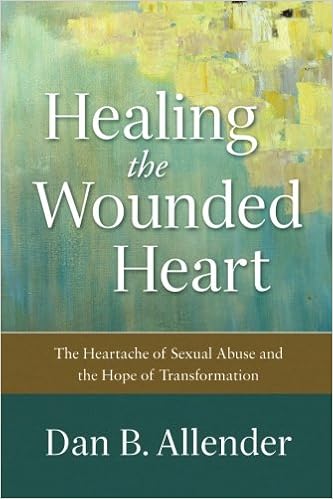
Dan Allender, author of many wonderful books, is perhaps best known for his book The Wounded Heart, first published over 20 years ago. The Wounded Heart was a compassionate and wise book about sexual abuse. Now, in 2016, he again shared his wisdom and compassion in Healing the Wounded Heart: The Heartache of Sexual Abuse and the Hope of Transformation (Baker, 2016).
Although the sin of sexual abuse is not new, Dr Allender writes at the outset of the new face of sexual abuse. Increased "sexual liberation", pornography, and the hook-up culture have led in many regards to deep harm. He wrote, "Bottom line: sexual harm has been normalized in a sexually indulgent and demeaning age" (page 29). Yet the more things change, the more things stay the same. Girls and boys, women and men continue to experience the fallout from sexual abuse. The author explores the many ways this trauma presents--physically, psychologically, and relationally.
In the second half of the book, Allender begins to shine a light on "the healing path" a path that also deals with emotion, relationship, and body. Having dedicated his life to this work, Allender is not naive; he is fully aware of the hard work, but he is also a ambassador of hope.
A copy of this book was provided to me by Baker Books in exchange for this review. I was not required to provide a positive review. The viewpoints discussed are my own.
30 April 2016
28 April 2016
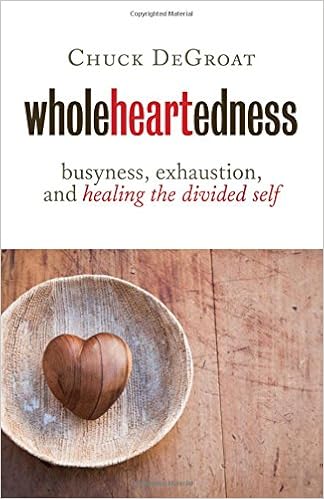
Book Review: Wholeheartedness
Wholeheartedness: Busyness, Exhaustion, and Healing the Divided Self (2016) by Chuck DeGroat is the best non-fiction book I have read this year by far. (I have to say non-fiction because Andrew Peterson's Wingfeather Saga was also exceptionally good, but clearly different).In Wholeheartedness, DeGroat explores how we too often live "divided" lives rather than the lives of wholeness we were created for. The typical Christian approach to the sense that something is not quite right is to do more and try harder all the while wondering what happened to the rest that Jesus promised. And we feel exhausted.
DeGroat takes a careful look at our dividedness, our failures, and our shame through the lenses of scriptural wisdom, psychology, neurobiology, and poetry to help us see, with greater clarity, God's shalom. On page 98, he wrote "those who are whole are ambassadors of God's shalom, of wholeness." In the final section of the book, he introduces us to how we might experience a growing wholeness. Here, I particularly appreciated his wisdom on union and communion.
Fans of such a broad range of authors such as Dan Siegel, Curt Thompson, Teresa of Avila, Gerard Manly Hopkins, Thomas Merton, and St Augustine will benefit deeply from this book. I have already eagerly recommended it to a patient along with Brene Brown's excellent Gift of Imperfection. Undoubtedly, this will be a book I will savor again and again.
Labels:
books,
Christian Psychology,
spiritual formation
20 April 2016
Who I am--expanded
If you are in Christ, remind yourself of this list regularly. You are not what you once were.
Compiled
from Neil Anderson’s Victory Over Darkness and Ken Boa’s
Conformed to His Image
- I am a child of God. (John 1:12)
- I am a branch of the true vine, and a conduit of Christ’s life. (John 15:1,5)
- I am a friend of Jesus. (John 15:15)
- I have been justified and redeemed. (Rom 3:24)
- I am at peace with God. (Rom 5:1)
- My old self was crucified with Christ, and I died to the power of sin’s rule over my life. The life I am now living is Christ’s life. (Rom 6:6, Gal 2:20)
- I am free forever from God’s condemnation. (Rom 8:1)
- I have been set free from the law of sin and death. (Rom 8:2)
- As a child of God, I am a fellow heir with Christ. (Rom 8:17)
- I am welcomed and accepted by Christ. (Rom 15:7)
- I am a saint. (1 Cor 1:2, Eph 1:1, Phil 1:1, Col 1:2)
- In Christ Jesus, I have wisdom, righteousness, sanctification, and redemption. (1 Cor 1:30)
- I have been given the mind of Christ. (1 Cor 2:16)
- My body is a temple of the Holy Spirit, who dwells in me. (1 Cor 3:16, 1 Cor 6:19)
- I am joined to the Lord and am one spirit with him. (1 Cor 6:17)
- I have been established, anointed, and sealed by God in Christ, and I have been given the Holy Spirit as a pledge guaranteeing my inheritance. (2 Cor 1:21, Eph 1:13-14)
- God leads me in the triumph and knowledge of Christ. (2 Cor. 2:14)
- The hardening of my mind has been removed in Christ. (2 Cor. 3:14)
- I am a new creature in Christ. (2 Cor 5:17)
- I have become the righteousness of God in Christ. (2 Cor 5:21)
- I have been made one with all who are in Christ Jesus. (Gal 3:28)
- I am no longer a slave, but an heir. (Gal. 4:7)
- I have been set free in Christ. (Gal 5:1)
- I have been blessed with every spiritual blessing in the heavenly places. (Eph 1:3)
- I am chosen, holy, and blameless before God. (Eph 1:4)
- I was chosen to be adopted as God’s child. (Eph 1:5)
- I am redeemed and forgiven by the grace of Christ. (Eph 1:7)
- I am a recipient of God’s lavish grace. (Eph 1:8)
- I have been predestined by God to obtain an inheritance. (Eph 1:10-11)
- Because of God’s mercy and love, I have been made alive with Christ. (Eph 2:4-5)
- I am seated in the heavenly places with Christ. (Eph 2:6)
- I am God’s workmanship created to produce good works. (Eph 2:10)
- I have been brought near to God by the blood of Christ. (Eph 2:13)
- I have direct access to God through the Spirit. (Eph 2:18)
- I am bold, free, and confident to approach God. (Eph 3:12)
- I am a member of Christ’s body and a partaker of his promise. (Eph 3:6, 5:30)
- I have boldness and confident access to God through faith in Christ. (Eph 3:12)
- My new self is righteous and holy. (Eph 4:24)
- I was formerly darkness, but now I am light in the Lord. (Eph 5:8)
- I am a citizen of heaven. (Phil 3:20)
- The peace of God guards my heart and mind. (Phil 4:7)
- God supplies all my needs. (Phil 4:19)
- I have been rescued from Satan and transferred to Christ’s kingdom. (Col 1:13)
- I have been redeemed and forgiven of all my sins. The debt is canceled. (Col 1:14)
- Christ himself is in me. (Col 1:27)
- I have been made complete in Christ. (Col 2:10)
- I have been made alive with Christ. (Col 2:13)
- I have been raised up with Christ. (Col 3:1)
- My life is hidden with Christ in God. (Col 3:3)
- Christ is my life, and I will be revealed with him in glory. (Col 3:4)
- I have been chosen of God, and I am holy and beloved. (Col 3:12)
- God loves me and has chosen me. (1 Thes 1:4)
- I have been given a spirit of power and self-discipline. (2 Tim 1:7)
- I have been saved and set apart by God’s doing. (2 Tim 1:9; Titus 3:5)
- God is not afraid to call me his brother or sister. (Heb 2:11)
- I have the right to come boldly before the throne of God to find mercy and grace in time of need. (Heb 4:16)
12 April 2016
We All Bear Growth Rings
I am grateful that the Bible is full of agricultural metaphors, stories, and parables. We read of mustard-seed faith, abiding in the vine, and bruised reeds. Why am I grateful? Agricultural metaphors capture the realities of the sanctification process. Farmers, florists, arborists, and botanists will tell you that plants take time to mature. There are seasons of flourishing, seasons of drought, and seasons of damage.
Have you ever looked at a cross section of a tree? The rings provide a striking visual representation of the tree's development. When you look, you can see seasons of great growth and flourishing. But you can also see seasons where there appears to be almost no appreciable growth. Indeed, there are seasons of disease and infestation and fire that permanently scar the tree, yet often it continues to grow.
I think God gave us so much botanical imagery because he wanted us to understand that Christian growth is a lifelong process, marked by times of seemingly unrelenting growth, times of stagnation, and times of damage, but God, by His Spirit, continues to grow and mature His children.
I wrote this poem yesterday as I was thanking God for His persistence in my sanctification.
an acorn planted
becomes a mighty giant
...but not today
05 April 2016
Trotting Out the Table Turner
For a long time, I have given thought to Christian character. I believe that how we present ourselves as Christians is as important as the truth that we proclaim. I am not the first to give thought to this question. In recent times, a term has emerged that reflects this concern: cage-stage Calvinism. R.C. Sproul describes this phenomenon as "those newly minted Reformed believers who are so aggressive and impatient that they should be locked in a cage for a little while so that they can cool down a little and mature a little in the faith." Though Reformed believers seem to have a particular proclivity toward impatience, it is certainly not exclusive to them. Often there also seems to be a lack of awareness of these traits in oneself.
A related phenomenon that I have witnessed is the tendency to "trot out the table turner" for lack of a better term. When confronted with a lack of gentleness or kindness, too many believers choose to bring up the table-turning Jesus. For reference, John 2:15 says, "And making a whip of cords, he drove them all out of the temple, with the sheep and the oxen. And he poured out the coins of the money changers and overturned their tables." Somehow, it seems like zealous Christians view this as permission to act like a jerk. Consider the meme below.
I want to offer a few thoughts. First, I am fully aware that Jesus was zealous for his Father's house and for truth. In several instances, he confronted people and even flipped their tables. Typically, his strongest words were reserved for the self-righteous, such as the Pharisees. The parable of the Pharisee and the tax collector in Luke 18 helps us to see the difference. Second, "trotting out the table turner" ignores much of the rest of the biblical narrative about how Christ responds. In the same way that it would be inappropriate to only focus on the story of the woman at the well as who Jesus was, it is inappropriate to always trot this image out. Like us, as someone who was fully human, Jesus experienced and expressed all emotion, which brings me to the third point. Unlike us, Jesus was without sin in his anger and zeal, which allowed him to respond to circumstances perfectly. We do not. Too often, I fear, we view the image of Jesus becoming angry through our own fleshly lenses, using it as permission to treat others disrespectfully. I believe that we have to be very cautious about doing so.
1 Peter 3:15 tells us to "be prepared to give an answer to anyone who asks of us, but to do so with gentleness and respect." Too many of us are aching to give an answer with no thought for how to do so. We are more interested in being right than in being loving and that needs to change.
"But the fruit of the Spirit is love, joy, peace, patience, kindness, goodness, faithfulness, gentleness, and self-control." -Galatians 5:22-23. Before flipping tables, ask yourself, am I being fruitful?
04 April 2016
We worship God, not subjective experience
I came across an excellent little section in Eugene Peterson's book Five Smooth Stones for Pastoral Work wherein he contrasts the worship of Baal and the worship of Yahweh as seen in modern Christianity. Peterson writes,
"The phrase 'let's have a worship experience' is Baalism's substitute for 'let us worship God.' The difference is between cultivating something that makes sense to an individual and acting in response to what makes sense to God. In a 'worship experience,' a person sees something that excites interest and tries to put religious wrappings around it. A person experiences something in the realm of dependency, anxiety, love, and a connection is made with the ultimate. Worship is a movement from what a person sees, or experiences, or hears, to prayer or celebration or discussion in a religious atmosphere. Subjectivity is encouraged.
"But neither the Bible nor church uses the word 'worship' as a description of experience. Pastors hear this adjectival usage in sentences like, 'I can have a worship experience with God on the golf course.' That means, 'I have religious feelings reminding me of good things, awesome things, beautiful things nearly any place.' Which is true enough. The only thing wrong with the statement is its ignorance, thinking that such experiences make up what the church calls 'worship.' The biblical usage is very different. It talks of worship as a response to God's word in the context of the community of God's people. Worship is neither subjective only nor private only. It is not what I feel when I am by myself; it is how I act toward God in responsible relation with God's people. Worship, in the biblical sources and in liturgical history, is not something a person experiences, it is something we do, regardless of how we feel about it, or whether we feel anything about it at all. Experience develops out of worship."
Christians, we are to worship God and not worship the experience.
03 April 2016
Practice Humility, Not Haughtiness
Pride goes before destruction, and a haughty spirit before a fall.-Proverbs 16:18
If someone is described as haughty, it means that they are arrogantly proud and in ways feel superior to others. The Bible warns against treating others with haughtiness and arrogance, but too often Christians do. In light of God's graciousness toward us, we should be amongst the most humble and loving people, but we are not. We look down upon nonbelievers who don't really understand the way the world works. We also feel smugly superior to other believers who don't understand the depths and the nuances of the faith quite like we do. I recently scanned a couple of articles criticizing a popular Christian movie that was recently released. One was titled "I'm a Christian and I hate Christian movies."
In some ways, I understand the sentiment. The longer I am a Christian, the more I desire to see beauty expressed artistically, including through movies. Christian fiction often lacks grit, is too black and white, and is subpar entertainment. I am glad for conversations that explore truth through various fields, not the least of which is art. I am glad for conversations that explore the redemptive themes of "secular" movies, books, and music.
However, as believers, I think we need to be thoughtful, humble, and cautious about how we respond to how other believers who do things differently than we do. When we look down our noses at other believers, it has the potential of showing the non-believing world that we are much more interested in squabbling than in loving other-centeredness.
1 Peter 3:15 tells us to be prepared to give an answer to anyone who asks, but to do so with gentleness and respect. Haughtiness towards others--believers or not--lacks gentleness and respect. We need to think humbly and lovingly about how to discuss these concerns when they arise. Christ told his disciples that the world has the right to judge Christians based upon how we love one another (see Francis Schaeffer's Mark of the Christian).
So when you differ, make sure to check your pride at the door.
09 March 2016
Dancing at the edge of expectation
More than half my life has been lived as a Christian and, Lord willing, I will have many years yet to explore the vistas of God's grace. I am filled with anxious wonder about what God will reveal next. I have frequently said that in the nearly 30 years since "I was ambushed by Jesus", to steal a phrase from Brennan Manning, I have learned much more about the Bible and yet I know much less about God. His vastness is never ending. The boxes in which I previously tried to contain Him I keep finding too small.
Over the years, I have been interested in the development of Christians. How is it that we come to believe certain things? How do our beliefs mature over our lives? God knows.
Today I came upon a few paragraphs in Eugene Peterson's book Travelling Light (1988). He wrote, "The word Christian means different things to different people. To one person, it means a stiff, uptight, inflexible way of life, colorless and unbending. To another it means a risky, surprise filled venture, lived tiptoe at the edge of expectation.
"Either of these pictures can be supported with evidence. There are numberless illustrations for either position in congregations all over the world. But if we restrict ourselves to biblical evidence, only the second image can be supported: the image of a person living zestfully, exploring every experience--pain and joy, enigma and insight, fulfillment and frustration--as a dimension of human freedom, searching through each for sense and grace. If we get our information from the biblical material, there is no doubt that the Christian life is a dancing, leaping, daring life" (p. 57).
In my experience and observation, the early Christian life often represents the former, inflexible way. The focus is often on sinfulness, and particularly the sinfulness of others who do not seem to be pursuing righteousness quite as zealously as the young believer thinks is appropriate. They stay far from the edge of the cliff and cast critical gazes at those who do not.
But with life lived and daily infusions of God's unending grace, we begin to discover the robustness of the Christian life for all circumstances and that the Spirit goes with us as we go. When we begin to understand that he will never leave or forsake us, our feet start tapping and we begin to dare to dance at the edge of expectation.
07 March 2016
Believer, you still need the gospel
Beginning on page 20 of his book The Discipline of Grace, Jerry Bridges wrote the following few paragraphs. I have abbreviated some, though the gist remains the same.
What one word describes the message you most needed to hear as an unbeliever? I suggest that the word is gospel. It is the gospel that is the power of God for salvation. We need to hear that Jesus died for sinners and that if we come to him in faith, we will receive the forgiveness of our sins and the gift of eternal life.
What one word describes the message we most need to hear as believers? I get a lot of different answers to that question, but most of them can be summed up with one word, discipleship.
But there is something more basic than discipleship, something that actually provides the necessary atmosphere in which discipleship can be practiced. The one word that describes what we must continue to hear is gospel.
We need to continue to hear the gospel every day of our Christian lives. Only a continuous reminder of the gospel of God's grace through Christ will keep us from falling into good day--bad day thinking, wherein we think our daily relationship with God is based on how good we've been.
It is only the joy of hearing the gospel and being reminded that our sins are forgiven in Christ that will keep the demands of discipleship from becoming drudgery. It is only gratitude and love to God that comes from knowing that He no longer counts our sins against us that provides the proper motive for responding to the claims of discipleship.
29 February 2016
Flying into the sunshine
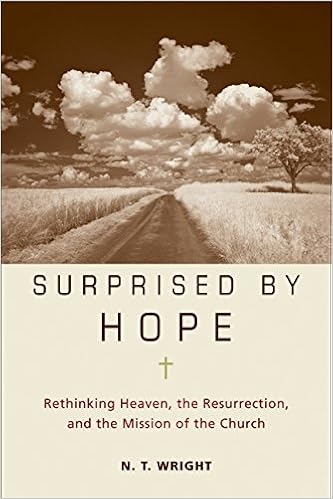
I just finished NT Wright's book, Surprised by Hope. His final paragraph is worth reproducing here.
In our incomplete world God's gentle offer and demand press upon us as fearful things, almost threatening. God in his gentle love longs to set us free from the prison we have stumbled into--the loveless prison where we refuse both the offer and the demand of forgiveness. We are like a frightened bird before him, shrinking away lest this demand crush us completely. But when we eventually yield--when he corners us and finally takes us in his hand--we find to our astonishment that he is infinitely gentle and that his only aim is to release us from our prison, to set us free to be the people he made us to be. But when we fly out into the sunshine, how can we not then offer the same gentle gift of freedom, of forgiveness, to those around us? That is the truth of the resurrection, turned into prayer, turned into forgiveness and remission of debts, turned into love. It is constantly surprising, constantly full of hope, constantly coming back to us from God's future to shape us into the people through whom God can carry out the work in the world.--NT Wright, Surprised by Hope, page 289.
This also calls to mind a verse upon which I have been meditating today: "As a prisoner of the Lord, I urge you: Live a life that is worthy of the calling He has graciously extended to you. Be humble. Be gentle. Be patient. Tolerate one another in an atmosphere thick with love.-Ephesians 4:1-2 (The Voice)
Subscribe to:
Posts (Atom)