The Gospel of Mark, chapter 7, tells the story of the Syrophoenician woman. I don't know about you, but every time I have read this story, it's almost like hitting an unexpected dip in the road. The kind that makes your car bottom out and you think to yourself, I hope I didn't break anything. Up until this point, Jesus is loving, serving, teaching, and healing. He's comforting the afflicted and confronting the Pharisees. Even a few chapters earlier, a conflict arises between Jesus and the religious leaders over the washing of hands and Jesus confronts them for putting tradition ahead of love. That makes sense. This is the Jesus we know and love.
But then comes the passage beginning at verse 24. He and the disciples go to a house, hoping not to be found. Too many people around all the time gets to be exhausting. But in verse 25, we learn that a woman finds Jesus and falls at his feet. It seems her daughter has an unclean spirit. She came to Jesus to beg him to cast the demon out. Perfect. This is just what Jesus came for! But then there's this little detail. "Now the woman was a Gentile, a Syrophoenician by birth" (v. 26). We think to ourselves, no big deal, Jesus can heal anyone he wishes.
So after she pleads with Jesus to heal her daughter, we come to verse 27 "Let the children be fed first, for it is not right to take the children's bread and throw it to the dogs."
K-LUNK!
Wait what? Did Jesus just refuse a desperate woman because she was of the wrong birth? Did he just call her a dog, a mongrel? What are we supposed with that?
Here's what I think. Jesus was always teaching his disciples; this time was no different. Taken at face value, Jesus' response was remarkably harsh. It doesn't fit his character. So how are we to take this? We could assume that he was being harsh, Pharisaical, and clinging to tradition...or he was using this woman as a living parable. I think it was the second.
Trying to put myself in the scene, I envision Jesus and his disciples heading to Tyre and Sidon, trying to find rest. The small band of brothers no doubt talking about the recent interactions with the Pharisees. Along comes this woman, full of faith, but of the wrong tradition. She asks Jesus to free her daughter from a demon.
Jesus looks first at the woman and then at his disciples. They've all be raised in this tradition. It flows through their bloodstreams. I suspect that for some of them at least, they looked upon this woman with disgust. Some probably physically distanced themselves from her. They were simply responding to their upbringing. So Jesus, seeing them, offers the response they're all thinking but not saying. "You're no Jew. Go away you dog." He kept watching the disciples. Judas subtly nods. Peter too.
But she persists; she is desperate but faithful. She will take whatever he may offer her. Now, he looks at her, tears welling in her eyes, and in his. "For saying this, you may go. I have healed your daughter." Faith, not tradition; heart, not behavior.
I wonder what shifted in the disciples. Jesus was using misdirection. He was leading them down one path, but then doubles back to his
main message. Faith, not tradition; heart, not behavior. Jesus not only told them parables, in this case, he showed them.
Jesus still surprises me. I read stories like this one that for years don't make any sense and then one day...clunk...the pieces fall into place. When you are reading and something is puzzling or doesn't seem to fit the narrative of the story or the character of God, it probably doesn't. Slow down and pay attention. Notice what is happening in the surrounding verses. This passage makes much more sense when set against the earlier story line in Mark 7.
God is good. All the time.

Showing posts with label discipleship. Show all posts
Showing posts with label discipleship. Show all posts
14 September 2017

21 July 2017
Growing in Christlikeness--a book list.
A few days ago, I texted my friend Mark--a fellow bibliophile--and I said to him, "Today's mental gymnastics have to do with coming up with a list of books [outside of the Bible] that would help one grow in Christlikeness. If you had 12 books, say one per month, what would you include? Thinking about it, I would want enough breadth to cover a variety of topics, but enough depth to promote growth."
Mark was the first to construct his list, which he sent with the clarification that these are in no particular order:
1) Inside Out--Larry Crabb
2) Ragamuffin Gospel--Brennan Manning
3) Abba's Child--Brennan Manning
4) Sacred Romance--Brent Curtis and John Eldridge
5) Transforming Grace--Jerry Bridges
6) The Last Addiction--Sharon Hersh
7) Brokenness--Nancy Leigh DeMoss
8) So, You Want to be Like Christ?--Chuck Swindoll
9) Descending into Greatness--Bill Hybels
10) The Life You Always Wanted--John Ortberg
11) Knowing God--JI Packer
12) Disciplines of a Godly Man--Kent Hughes
He must have also had some conversation at home, because his insightful wife Peggy added three more:
1) Soul Talk--Larry Crabb
2) Crucial Conversations--Kerry Patterson and Joseph Grenny
3) Emotionally Healthy Spirituality--Pete Scazzero
I've read half of these books and they are an excellent list. In fact, Ortberg's book is one of my favorites.
After realizing Mark decided to actually put a list together, I realized that I probably needed to as well. I looked through my Goodreads profile where I have logged over 600 books since late 2011.
Here was my list, also in no particular order.
1) Confessions--St Augustine
2) Renovation of the Heart--Dallas Willard
3) Conformed to His Image--Ken Boa
4) Soul Keeping--John Ortberg
5) A Different Kind of Happiness--Larry Crabb
6) Life Together--Dietrich Bonhoeffer
7) A Long Obedience in the Same Direction--Eugene Peterson
8) True Spirituality--Francis Schaeffer
9) A Loving Life--Paul Miller
10) Practice Resurrection--Eugene Peterson
11) Abba's Child--Brennan Manning
12) The Letters of John Newton
I was a bit surprised about how little we overlapped; indeed, only one book.
Readers, I am curious what you would include? What did Mark, Peggy, and I miss?
Mark was the first to construct his list, which he sent with the clarification that these are in no particular order:
1) Inside Out--Larry Crabb
2) Ragamuffin Gospel--Brennan Manning
3) Abba's Child--Brennan Manning
4) Sacred Romance--Brent Curtis and John Eldridge
5) Transforming Grace--Jerry Bridges
6) The Last Addiction--Sharon Hersh
7) Brokenness--Nancy Leigh DeMoss
8) So, You Want to be Like Christ?--Chuck Swindoll
9) Descending into Greatness--Bill Hybels
10) The Life You Always Wanted--John Ortberg
11) Knowing God--JI Packer
12) Disciplines of a Godly Man--Kent Hughes
He must have also had some conversation at home, because his insightful wife Peggy added three more:
1) Soul Talk--Larry Crabb
2) Crucial Conversations--Kerry Patterson and Joseph Grenny
3) Emotionally Healthy Spirituality--Pete Scazzero
I've read half of these books and they are an excellent list. In fact, Ortberg's book is one of my favorites.
After realizing Mark decided to actually put a list together, I realized that I probably needed to as well. I looked through my Goodreads profile where I have logged over 600 books since late 2011.
Here was my list, also in no particular order.
1) Confessions--St Augustine
2) Renovation of the Heart--Dallas Willard
3) Conformed to His Image--Ken Boa
4) Soul Keeping--John Ortberg
5) A Different Kind of Happiness--Larry Crabb
6) Life Together--Dietrich Bonhoeffer
7) A Long Obedience in the Same Direction--Eugene Peterson
8) True Spirituality--Francis Schaeffer
9) A Loving Life--Paul Miller
10) Practice Resurrection--Eugene Peterson
11) Abba's Child--Brennan Manning
12) The Letters of John Newton
I was a bit surprised about how little we overlapped; indeed, only one book.
Readers, I am curious what you would include? What did Mark, Peggy, and I miss?
04 May 2017
Book Review: The Imperfect Disciple

The Imperfect Disciple did not disappoint. It is a book about Christian discipleship, but it didn't read that way. The signs were there--references to prayer and quiet times, mentions of Dallas Willard and John Ortberg--but it felt different, more Wilson that Willard. Wilson employs captivating writing that showcases justification, grace, and a big Christ. Wilson has the remarkable skill of sharing his own (often painful) narrative in a way that highlights not him, but Jesus.
I was particularly fond of chapter 3, "staring at the glory until you see it." He writes about learning how to behold the glory of Jesus and its superiority to simple behavior change. Chapter 6 (The Revolution Will Not Be Instagrammed) was also particularly good. It dealt with what Christian community could be, a place of confession, grace, prayer, and real life.
But chapter 9 wrecked me. In chapter 9, Wilson dealt with living in the midst of suffering and disappointment, showing us that God's grace meets us in the depths of our pain. But it was second paragraph on page 210 that did me in:
"When you are in the pit of suffering--on the verge of death, even--Jesus isn't up in heaven simply blasting you down below with some ethereal virtues. He's not "sending good thoughts"--or worse, "good vibes"--your way. No, when you are laid low in the dark well of despair, when the whole world seems to be crashing down on you, when your next breath seems sure to be your last, Christ Jesus is down in the void with you, holding you. He keeps your hand between his own. He offers his breast for your weary head. He whispers the words of comfort a whisker's breadth from your ear: 'And behold, I am with you always" (Matthew 28:20, emphasis added). Grace is all-sufficient for weakness and for suffering because Jesus is all-sufficient."
I don't remember the last time I began crying reading a non-fiction book, but reading that paragraph, I did. Jesus is with me always. Wilson has the ability, rarely matched, to make me rest in Jesus' arms.
I received a free copy of this book in exchange for my review from Baker Books. I was not required to submit a positive review. The views expressed here are my own.
29 November 2016
Athletae Dei

What does it mean to be a Christian? What does it mean to be a disciple of Christ? What is sanctification? What does growth in Christlikeness involve? What is the link between salvation and works? These questions occupy a great deal of my day-to-day thought life. Let me offer a few rambling thoughts and conclude with a parable/metaphor that came to me on my morning commute.
First, I am utterly convinced that salvation is a free gift of God. There is nothing that anyone can do to earn salvation nor even to improve their standing with God. Ephesians 2:8-9 reminds us: "for it is by grace you have been saved, through faith, and this is not your own doing, it is the gift of God." Christ's favor is unmerited. Whoever places their faith in Christ will be saved. Period.
But, unlike the thief on the cross (Luke 23:43), most of us are not immediately headed for glory upon our good confession. God leaves most of us here for some time. In light of that, we are wise to ask, what shall we do with time we are given? How shall we live? These questions place us squarely in the domain of discipleship.
To be a disciple means that we seek to learn from a teacher, in the case of Christianity, Jesus. Disciples try to shape their lives to be more like Christ wants them to be, which he demonstrated by his life and teachings. In other words, they seek to grow in Christlikeness. Although stated above, this point is important enough to be restated: these attempts to grow in Christlikeness do not merit favor with God. Those who have placed their faith in Christ are as approved as they will ever be, which is to say fully approved.
However, even though salvation is by grace alone through faith alone, it does not mean that works are inherently bad or evil. Dallas Willard has famously said, "grace is opposed to earning, not to effort." Indeed, the words of the apostle Paul routinely commend us to to strive for growth in holiness. Why should we do this? Not to earn God's favor, but because it is the best way to live.
Let's see if this story clarifies this thought.
A Parable
Following up on their New Year's resolutions to get healthier, two men joined a gym. Taking advantage of New Year's offering, the first man signed up for the whole year, intent on becoming healthy and strong. The first few weeks, he showed up faithfully. Though he didn't really know what he was doing, he would run on the treadmill and do a few reps on the weight machines. After those first few weeks, life got in the way. His work was busy and after work, he just wanted to come home and crash in front of the TV for a few hours before going to bed.
Also wanting to be healthier, the second man signed up for the whole year. He had chosen his gym after doing quite a bit of research and weighing out the pros and cons. He knew that the gym he joined not only had a variety of exercise options, there were also staff and more experienced athletes who were able to help him to reach his goals. He knew that in order to be successful, he would need to prioritize his time at the gym. In the upcoming year, he developed strong habits. He consistently came to the gym several times a week. If he missed for any reason, he would get back at it, not shaming himself for missing, but keeping his goals in mind. He sought advice from a personal trainer who also helped him to stay motivated and reach his goals.
At the end of the year, the first man gained 15 pounds. He regularly complained of new aches and pains. He felt tired all the time. The second man lost 15 pounds. He felt healthier and better able to handle the daily stresses of life. In the Fall, he reached a long time goal of completing a 5K race. Others took notice of his improved health and he found himself instructing and encouraging others.
Both of these men remained gym members. They both had access to all of the rights and privileges of being a member of the gym. They could take advantage of any of the resources at any time.
But only one became a disciple.
Like most parables, the parallels to real life are imperfect and clumsy at times. Yet, they often make a larger point, in this case, the importance of being a disciple. Jesus was the only one to ever live his life perfectly. Dallas Willard argued that Jesus is the smartest, wisest man who ever lived. If we believe that, we believe that Jesus knows what constitutes the best life because he lived it. If then that is true, it would be unwise for us to merely give assent to his claims without also seeking to live a certain way, Jesus' way.
In 1 Corinthians 9, Paul encourages his readers to become Athletae Dei--athletes for God. Athletes, at least those who want to be successful, go into training. They begin to shape their lives to succeed at their sport. They know that progressive training will be essential to continued success. No one wakes up one Saturday morning and plans to win a marathon that day without training for it. No matter how hard they try, they won't succeed. Training is more essential than trying.
The same holds true for those of us who desire to grow in Christlikeness. We begin to train ourselves to be more and more like Jesus in our thought, word, and deed. We become his students. No one expects an overweight middle age guy to run a marathon, but knows that with training, he probably can. As our teacher, Jesus also knows that we are far from living perfectly, but he is eager to teach us his ways.
Do you not know that in a race all the runners run but only one receives the prize? So run that you may obtain it. Every athlete exercises self-control in all things. They do it to receive an imperishable wreath, but we an imperishable. So I do not run aimlessly; I do not box as one beating the air. But I discipline my body and keep it under control, lest after preaching to others I myself should be disqualified.-1 Corinthians 9:24-27 (ESV)
10 December 2013
Book Review: The Spiritual Mentor
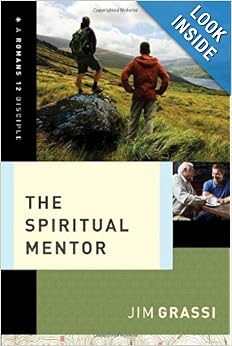
In his book,
The Spiritual Mentor (2013), Jim Grassi lays out a model for disciple building,
specifically as it applies to men, though many of the lessons he shares could be
applied in ways to women. At the outset,
he addresses the downfall of masculinity within the church and within the world
and issues a clarion call for men to step up and be men. Having established the existing problems with
modern masculinity, he moves on to provide suggestions for how the church might
step up and raise up a new generation of leaders.
The Positives
First, Grassi
is an effective communicator of important biblical truth. I agree
wholeheartedly with his assessment that the lack of male presence within the
church is concerning. We further see this with the continued redefinition of
masculinity in the world. The call he
issues is much needed and cannot be heard often enough.
Second, the
book is laid out well and Grassi is an effective communicator. He speaks
plainly and provides a number of practical examples to bolster the points he is
trying to make. He gave a nod to several people whom he has learned from, one
of whom was Charles Swindoll and the influence is evident.
Third, the ideas
he shares are grounded in biblical truth. He ensures that the ideas are not
just his own, but are grounded in the Bible.
The
negatives
On the
whole, this was a good book, but there were a couple of concerns. The first,
which is relatively minor, is that that the book is subtitled “A Romans 12
Disciple,” but I saw very little mention of Romans 12 until halfway through the
book. In fact, I made a note on page 109 reading, “finally Romans 12.” It is possible that he gave a nod to Romans
12 earlier, but it certainly did not seem to be a prominent theme as I
anticipated from the cover.
Second, like
so many of the books on discipleship, there is a tendency to focus on following
the imperatives—in other words, what we must do. He appears to view the Beatitudes as a to-do
list, but it is so much more. In some ways, Christ shared the Beatitudes to convincingly
establish our inability to live out all that he would call us to. For example,
Matthew 5:48 says that we must be perfect as our Father in heaven is
perfect. Viewing that as a command will
lead to a lot of hopeless disciples. We must get the indicatives—who we are as
believers in Christ—before the imperatives.
Finally, it
the fishing metaphors seemed overwrought to me. Grassi was a professional bass
fisherman and so these metaphors are unsurprising and no doubt provide a
framework for thinking through discipleship, but I did not find it
helpful. On the other hand, I have
several friends who would very much appreciate his presentation.
On the whole, The Spiritual Mentor will be a useful, practical book for men. I can already think of several men to whom I will recommend it. I pray that more men like Grassi will step up and heed the call to “go and make disciples.”
I received this book free from the publisher through the BookSneeze.com® book review bloggers program. I was not required to write a positive review. The opinions I have expressed are my own. I am disclosing this in accordance with the Federal Trade Commission’s 16 CFR, Part 255: “Guides Concerning the Use of Endorsements and Testimonials in Advertising.”
01 January 2010
New Year's Introspection
The dawn of a new year inevitably brings about self-reflection. For me, this year is no different. My introspection has meandered through a range of topics, but seems to have taken a rather extended break with regard to authentic Christianity and one's my calling.
A recent interaction with a young man I count as a brother has again brought to a head these thoughts. He is passionate about Jesus and about faith lived out. He has a particular heart for the poor and working with those less fortunate. He is concerned about the complacency of American Christianity toward poverty and he is passionate to live Christ in all.
So, what does this have to do with me? I believe in Jesus Christ with all of my heart. Lately, it seems I think about Him non-stop. I read stories of the apostles giving all for Christ. I read about martyrs, both ancient and contemporary, giving their lives in service to Jesus. I listen to sermons by men like Francis Chan, John Piper, and more recently Paul Washer who passionately call attention to the discrepancy between the gospel and American Christianity.
Then, I look around. I live in a beautiful home in a safe neighborhood. I have an amazing job that pays well. I own 2 cars. I own 3 TVs. I own more than 1 pair of shoes, which on a global scope, marks me as exceedingly wealthy.
I could enumerate the ways in which I feel as though I give of myself, but I am always left with the question, am I giving enough? Am I giving all? Thoughts intrude.
student loans
mortgage
family
breast cancer
responsibilities
How do I reconcile my internal struggle to leave all for the sake of the gospel (Mark 10:29) with my sense of duty to care for the responsibilities that I feel God has entrusted to me (I Timothy 5:8)? How do I deal with the understanding that a well-paying job may be God's way of allowing me to minister to others? If all Christians go to Samaria (e.g., the inner city) or the ends of the earth (e.g., Honduras), who will stay in Judea (e.g., Eau Claire)? If everyone is a missionary, who supports the missionaries?
Where I stop at the end of the day is the same place I always do. Praying for forgiveness for my worldliness. Praying for God's will. Praying for effective witness for those who stay and those who go. Praying that in all things, Christ would be made much of, not in my American or protestant or white worldview, but as the glorified savior of all who would come to Him. Tomorrow, I will again read God's word, praying that this sinful man who wants to know Him desperately can discern His still, small voice amidst the cacophony of my life.
A recent interaction with a young man I count as a brother has again brought to a head these thoughts. He is passionate about Jesus and about faith lived out. He has a particular heart for the poor and working with those less fortunate. He is concerned about the complacency of American Christianity toward poverty and he is passionate to live Christ in all.
So, what does this have to do with me? I believe in Jesus Christ with all of my heart. Lately, it seems I think about Him non-stop. I read stories of the apostles giving all for Christ. I read about martyrs, both ancient and contemporary, giving their lives in service to Jesus. I listen to sermons by men like Francis Chan, John Piper, and more recently Paul Washer who passionately call attention to the discrepancy between the gospel and American Christianity.
Then, I look around. I live in a beautiful home in a safe neighborhood. I have an amazing job that pays well. I own 2 cars. I own 3 TVs. I own more than 1 pair of shoes, which on a global scope, marks me as exceedingly wealthy.
I could enumerate the ways in which I feel as though I give of myself, but I am always left with the question, am I giving enough? Am I giving all? Thoughts intrude.
student loans
mortgage
family
breast cancer
responsibilities
How do I reconcile my internal struggle to leave all for the sake of the gospel (Mark 10:29) with my sense of duty to care for the responsibilities that I feel God has entrusted to me (I Timothy 5:8)? How do I deal with the understanding that a well-paying job may be God's way of allowing me to minister to others? If all Christians go to Samaria (e.g., the inner city) or the ends of the earth (e.g., Honduras), who will stay in Judea (e.g., Eau Claire)? If everyone is a missionary, who supports the missionaries?
Where I stop at the end of the day is the same place I always do. Praying for forgiveness for my worldliness. Praying for God's will. Praying for effective witness for those who stay and those who go. Praying that in all things, Christ would be made much of, not in my American or protestant or white worldview, but as the glorified savior of all who would come to Him. Tomorrow, I will again read God's word, praying that this sinful man who wants to know Him desperately can discern His still, small voice amidst the cacophony of my life.
24 December 2009
Reposted emails: The Mark of a Christian?
Okay, I admit it. I sometimes get annoyed by the dozens of emails I receive telling me that I have to forward a post to at least 12 people or I am not a real Christian or that I am ashamed of Jesus. Today, someone's facebook status read:
"They may want to take Christ out of Christmas, but they can never take Christ out of me. If you are proud to be a Christian and are not ashamed of Christ then post this as your status for 1 day as a light to the world. Most people will be to (sic) ashamed or scared to do this. This was posted by a friend. If you agree, copy and paste to your wall."
Before I go on, let me state a few things clearly. I am exceedingly grateful for the gift God offered me that first Christmas. I know that I am nothing apart from Christ. However, on principle, I never forward these types of posts. Here is the reason; forwarding an email or reposting a facebook status is not the mark of a Christian; rather, it is love for others (John 13:34-35).
Francis Schaeffer, who wrote the brief, but influential, "The Mark of the Christian" stated it this way, "What then shall we conclude but that as the Samaritan loved the wounded man, we as Christians are called upon to love all men as neighbors, loving them as ourselves. Second, that we are to love all true Christian brothers in a way that the world may observe. This means showing love to our brother in the midst of our differences — great or small — loving our brothers when it costs us something, loving them even under times of tremendous emotional tension, loving them in a way the world can see. In short, we are to practice and exhibit the holiness of God and the love of God, for without this we grieve the Holy Spirit.
Love — and the unity it attests to — is the mark Christ gave Christians to wear before the world. Only with this mark may the world know that Christians are indeed Christians and that Jesus was sent by the Father."
"They may want to take Christ out of Christmas, but they can never take Christ out of me. If you are proud to be a Christian and are not ashamed of Christ then post this as your status for 1 day as a light to the world. Most people will be to (sic) ashamed or scared to do this. This was posted by a friend. If you agree, copy and paste to your wall."
Before I go on, let me state a few things clearly. I am exceedingly grateful for the gift God offered me that first Christmas. I know that I am nothing apart from Christ. However, on principle, I never forward these types of posts. Here is the reason; forwarding an email or reposting a facebook status is not the mark of a Christian; rather, it is love for others (John 13:34-35).
Francis Schaeffer, who wrote the brief, but influential, "The Mark of the Christian" stated it this way, "What then shall we conclude but that as the Samaritan loved the wounded man, we as Christians are called upon to love all men as neighbors, loving them as ourselves. Second, that we are to love all true Christian brothers in a way that the world may observe. This means showing love to our brother in the midst of our differences — great or small — loving our brothers when it costs us something, loving them even under times of tremendous emotional tension, loving them in a way the world can see. In short, we are to practice and exhibit the holiness of God and the love of God, for without this we grieve the Holy Spirit.
Love — and the unity it attests to — is the mark Christ gave Christians to wear before the world. Only with this mark may the world know that Christians are indeed Christians and that Jesus was sent by the Father."
So, rather than forwarding that email, bring a meal for a co-worker you really don't like, go shovel your neighbor's walk, or spend some time at a youth center. I promise these activities will be more luminous to the world than a mass email.
You can read The Mark of the Christian here.
22 July 2009
I'm looking forward to this book
Jared Wilson authored "Your Jesus is Too Safe." It is definitely on my list to read.
Here is a quote from a recent interview with I-monk:
"I like to call this a two-fisted gospel. If you aren’t articulating the gospel of the kingdom regularly and also seeking to live the kingdom out, you aren’t discipling anyone in the way of Jesus.
The danger for most folks of my sort is that we really become admirers of the gospel, not treasurers of it. And admiring it is not really centering on it. When it’s got you forgiving your cheating spouse or serving people in the ghetto or even mowing your neighbor’s yard, it’s changed you."
You can read the rest of it here.
Subscribe to:
Posts (Atom)