Showing posts with label gospel. Show all posts

24 September 2015

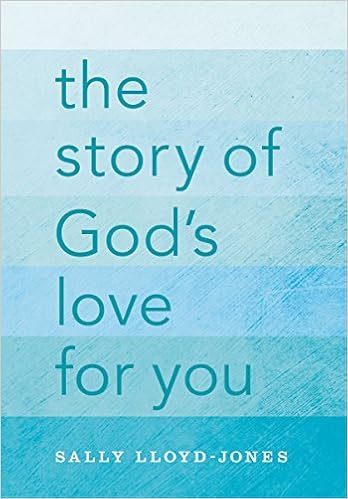
Book Review: The Story of God's Love for You

One of the most remarkable books that has come out in the last several years was actually a children's Bible. Together with incomparable artwork of Jago, Sally Lloyd-Jones wrote the award-winning Jesus Storybook Bible.  Too often, children's Bibles are presented as lessons in moralism, rather than being grounded in the work of Christ. Lloyd-Jones masterfully pointed to the work of Jesus through 44 short vignettes drawn from Genesis through Revelation.

I once heard Tullian Tchvidjian say that the Jesus Storybook Bible would be great prerequisite reading to diving into the Bible itself because it weaves together the whole story of God and His redemptive work through Jesus Christ.  A friend of mine who works at a Christian bookstore said that they routinely sell out of the Jesus Storybook Bible because she tells everyone about it. 

But this is actually a review of The Story of God's Love for You (2015, Zondervan), which is a repackaged version of the Jesus Storybook Bible geared for adults. The words are the same, minus the vibrochromatic artwork of Jago present in the children' version.

There are a couple of apparent advantages to this book. First, it is more compact than its predecessor and could be more easily tossed into a bag or a small pocket. Second, for those who feel a bit sheepish about reading a children's Bible, this is a nice alternative (though admittedly, Jago's artwork is rather remarkable).

On the whole, I would echo the recommendation of Tchvidjian. Lloyd-Jones's book provides a wonderful introduction and overview to the redemptive work of Christ so whether new to the Bible or infinitely familiar with it, you will likely benefit from this book.

I received a free copy of this book from the BookLook Bloggers book review program in exchange for this review. I was not required to submit a positive review. The impression from this review are my own. 

20 August 2015

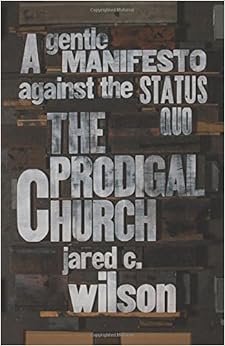
Book Review: The Prodigal Church

I have read most of the books authored by Jared Wilson and each time, I am convinced that his voice needs to be heard by the church. His passion for the gospel is an unquenchable fire. His most recent book, The Prodigal Church: A Gentle Manifesto Against the Status Quo (2015, Crossway) is no different.

The Prodigal Church reflects Wilson's heartbeat. In essence, he writes with conviction to encourage the church to return to its gospel roots, again and again. He rightly shows how the response to legalism in the church can not be an attractional model, but one grounded completely in the finished work of Christ. The church exists not to beat people up, not to glorify the self, and not (primarily) to provide tips for self-improvement.  The church exists to glorify God and make much of Jesus and his finished work.

Although the whole book is a clarion call for "gospel wakefulness", to draw from another Wilson book, the fourth chapter, "the Bible is not an instruction manual", was my favorite. In this particular chapter, he shows the reader that the primary purpose of the Bible is not a manual for better living. It is a story of a God who relentless pursues His children, ultimately bringing them to Himself through His son Jesus.  On page 80, Wilson wrote, "I will go so far as to suggest to you that not to preach Christ is not to preach a Christian sermon. If you preach from the Bible, but do not proclaim the finished work of Christ, you may as well be preaching at a Jewish synagogue or a Mormon Temple. Ask yourself, as you look over your sermon outline or manuscript, 'could this message be preached in a Unitarian church?' Ask, 'did Jesus have to die and rise again for the stuff to be true?'" This one quote represents the lifeblood of this book. 

The message of salvation by grace alone through faith alone in the finished work of Christ alone must be the heartbeat of the church. We have no hope in programs or personalities. Wilson understands that and communicates it wonderfully in this important book. 

02 June 2015

Book Review: Law and Gospel--A Theology for Sinners and Saints

On February 20, 2010 a major shift occurred in my life. The pastor of my church read Romans 5:20-21 which says “Now the law came in to increase the trespass, but where sin increased, grace abounded all the more, so that, as sin reigned in death, grace also might reign through righteousness leading to eternal life through Jesus Christ our Lord.” I sat in the front of the church and wept. I think that was the day that I began to understand the difference between Law and Gospel. 

If you have no idea what I am talking about, a new book, Law and Gospel: A Theology for Sinners and Saints, by William McDavid, Ethan Richardson, and David Zahl will provide a great introduction to the distinction. Briefly, God gave us both the law and the gospel but they have different roles. The law was never given as a means of salvation, the law was given to show each of us our absolute inability to live up to God’s perfect standard. It is the gospel, the good news that Jesus Christ came to earth, lived a sinless life, was crucified on the cross, and was raised again to new life on my behalf that provides the power to save. It is Jesus who did the saving.

The first half of the book is dedicated to exploring the role of the law and how it has overtaken many churches. From pulpits all over America, we hear messages of do more/try harder/pull yourself up by your bootstraps. But we fail, again and again. The law tells us what to do, but it is impossible for us to do it and so we stand accused. When people recognize their utter inability, lots of people give up.

But, like good sermons should do, the book begins with the crushing power of the law, but finishes with the life giving power of the gospel. The authors show us that because of Christ’s love for us, he alone accomplished our salvation as a free gift. Then, in my favorite part of the book, they looked at the fruits of the gospel, of what Jesus did. The fruits they listed include: humility, receptivity, gratitude, spontaneity, humor, and freedom.

If you have struggled to understand what Paul was talking about when he said that we are free in Christ, or what I mean when I saw the law/gospel distinction, please get this book.  

18 August 2014

Foundational Ideas: The Gospel Affects Everything


As sin affected everything, so the Gospel will restore everything. God makes all things new. In the midst of our depravity, there was quite literally nothing we could do to save ourselves from continued descent. Only Christ, who came to redeem sinners, offers any hope. But we must not be so short sighted as to think that Christ’s only job was to rescue sinners.   No doubt that was a massive part of what he came to do, but he came to usher in his kingdom. There will be a day, because of his ongoing redemptive work that he will wipe every tear from every eye, when there will be no more crying, no more pain, and no more sorrow. He will restore what needed restoration.

We are called to participate in God’s redemptive work today. We should bloom where we are planted. When we love others, when we work for cultural renewal, when we promote a biblical worldview, we serve to improve the world around us. As believers, Christ’s work for us was much broader than we could ever have imagined. For further information, anything by Chuck Colson would be appropriate, though I also liked Matt Chandler’s book “TheExplicit Gospel” for understanding this Kingdom vision.

20 May 2014

Book Review: The Gospel--How the Church Portrays the Beauty of Christ

I really like Ray Ortlund Jr. I have appreciated the gospel saturated wisdom that I read on his blog and that I have heard in his teachings, so I was excited to read The Gospel: How the Church Portrays the Beauty of Christ (2014, Crossway). This short book is exactly what I would have expected from Ortlund--a cool, refreshing drink of the gospel.

In this book, he explores the themes of gospel doctrine and gospel culture as equally essential. In the introduction, he writes, "if a message so good lies at the defining center of our churches, why do we see such bad things in those same churches--ranging from active strife to sheer exhaustion? Where is the saving power of the gospel? Why don't we see more of Tyndale's singing, dancing, and leaping for joy in our churches, if the good news is setting the tone?" (page 16) This question, it seems to me, is exactly the right one.  Why are our churches not more routinely thought of as joy-stations?  A few pages later, he sets forth his thesis: "the need of our times is nothing less than the re-Christianization of our churches, according to the gospel alone, in both doctrine and culture, by Christ himself" (page 19).

Ortlund moves out with the gospel in concentric circles, starting with its importance to the self, then the church, and eventually "for everything". He rightly argues that the gospel transforms at each of these levels.  In other words, Christ's redeeming work is not just for the individual soul, though it is assuredly for that, but it is also for the whole world.

One of the things that I very much appreciate about Ortlund and which was evident in this book is how my spiritual hero, Francis Schaeffer, leaves his mark. For a small man, Schaeffer was a giant of evangelicalism in the late 20th century who valued doctrine, sound thinking, and loving people. On page 66, he quoted Schaeffer: "if we do not show beauty in the way we treat each other, then in the eyes of the world and in the eyes of our children, we are destroying the truth we proclaim."  Indeed, chapter 4 bore many similarities to Schaeffer's well known The Mark of the Christian, and these two would do well paired together.

I loved this book.  Ortlund is a clear communicator who writes about the most important truth we can consider.  I would recommend this book to church leaders, apologists, worldview teachers, evangelists, disciplers, sinners, and saints.

I received this book free from the publisher through the Crossway Beyond the Page Bloggers book review bloggers program. I was not required to write a positive review. The opinions I have expressed are my own. I am disclosing this in accordance with the Federal Trade Commission’s 16 CFR, Part 255: “Guides Concerning the Use of Endorsements and Testimonials in Advertising.”

20 January 2014

Of First Importance

Things that are not of first importance:
  • How long it took for God to create the world.
  • How God created the universe.
  • What type of music churches play.
  • The role of women in the church.
  • The size of your congregation.
  • Your political persuasion.
  • Ten million other things.
What is of first importance:

For I delivered to you as of first importance what I also received: that Christ died for our sins in accordance with the Scriptures, that he was buried, that he was raised on the third day in accordance with the Scriptures, (1 Corinthians 15:3-4, ESV)

Now if Christ is proclaimed as raised from the dead, how can some of you say that there is no resurrection of the dead? But if there is no resurrection of the dead, then not even Christ has been raised. And if Christ has not been raised, then our preaching is in vain and your faith is in vain. We are even found to be misrepresenting God, because we testified about God that he raised Christ, whom he did not raise if it is true that the dead are not raised. For if the dead are not raised, not even Christ has been raised. And if Christ has not been raised, your faith is futile and you are still in your sins. Then those also who have fallen asleep in Christ have perished. If in Christ we have hope in this life only, we are of all people most to be pitied. (1 Corinthians 15:12-19, ESV)

02 January 2013

Book Review: Because He Loves Me

In the last couple of years, I read three of Elyse Fitzpatrick's other books, Counsel from the Cross, Comforts from the Cross, and Give Them Grace (co-authored with her daughter) and was impressed with her love for the gospel.  I discovered Because He Loves Me (Paperback Edition): How Christ Transforms Our Daily Life (2008) on the suggested readings link at the Liberate website. 

This is the fourth book of Fitzpatrick's that I have read. I also watched her speak twice on the Liberate 2012 conference DVDs.  This sampling of her work convinces me that she rather narrowly focused.  Again and again, she goes back to the same topic.  One might think that would be a drawback, but its not, because the topic she continually addresses is the gospel of Jesus Christ.  She seems to side with the apostle Paul who said that he vowed to know nothing except Christ and him crucified (1 Cor 2:2). 

Specifically, Fitzpatrick dedicates 200 pages to helping her readers to understand how the gospel--Christ's "incarnation, sinless life, substitutionary death, burial, bodily resurrection, ascension, and eternal reign" (p. 36)--matter in the every day lives of believers.  I know that for me, I am at a time in my life when I cannot read enough books about the gospel. I love how different authors talk about Christ's justifying, sanctifying, adopting love for me.  I pray that I never get tired of the gospel.  This book was one excellent example of that type of reading.  I just pray that Fitzpatrick's one track mind stays on track. 

As of this writing, the Kindle version of this book is only $3.99, which is a no-brainer as far as I am concerned.

06 December 2012

The Greatest Story by the Greatest Author

Matt Papa with a spoken poem--the Story of God.  It is worth ten minutes of your time, twenty if you watch it twice. 


01 September 2012

Book Review: The Transforming Power of the Gospel

A few months ago, this book was a free offering on Kindle.  I told many of you about it and I hope you got it for yourself.  Jerry Bridges is one of my favorite authors and this book of his is no exception. In The Transforming Power of the Gospel (2011), bridges discusses how growth in holiness is deeply rooted in the Gospel and he seems to be close to the right balance between God's grace and personal responsibility, in my opinion.  Many authors that I like (e.g., John MacArthur, Francis Chan) are strong proponents of personal holiness as a mark of faith.  Although they talk about the importance of grace, what comes across is a strong call to holiness.  On the other end of the spectrum are writers, who I also deeply respect, like Rod Rosenblatt and Tullian Tchvidjian, who focus deeply on grace and seem to address personal holiness to a lesser degree. Recently, I have been talking with a good friend of mine that neither end of this spectrum seems to get it quite right.  Bridges, as he does in many of his books, discusses the importance of holiness and spiritual transformation, but clearly grounds it in the gospel of grace and the ongoing work of the Holy Spirit.  I think all of the authors mentioned above also believe this, but the message comes through more clearly in Bridges' work. 

I want to concluded with two of the closing paragraphs from his book.  Bridges writes, "If you commit yourself to the pursuit of Christlikeness, you will discover an increasing tension between your desire to know and do the will of God and your perceived progress in doing it. This increased tension can become discouraging and demotivating. The solution to this dilemma is to keep in mind that, in our standing before God, He sees us clothed in the perfect obedience of Christ. This standing never changes, regardless of whether we are having a good day or a bad day. In Him, we are always holy and blameless. In Him, we are always perfectly righteous as He was in His sinless Humanity.

"This is the way we should resolve the tension between what we desire to be and what we see of ourselves in our daily experience. We should look more at our standing before God in Christ than we do at our actual experience, and that continual looking to who we are in Him will motivate us to become more like Him in our experience. To do this, of course, means we must daily embrace the gospel."

24 August 2012

Is it always "the Gospel?"

Thabiti Anyabwile's mini-rant about using the Gospel hammer for every nail is worth considering.

He writes, "Of course, I’m not tired of hearing the actual gospel.  Let us all determine to know nothing but Jesus Christ and Him crucified.  But let us also learn that the apostle taught a lot of things about Jesus Christ, His crucifixion and resurrection without lackadaisically tossing out a few cliched references to 'the gospel'.  He meditated on and expanded the message of God’s redemption through His Son in many varied arguments, tropes, and statements.  But that’s not what’s trotted out in today’s situations of human need.  We’re not getting deep reflections on the Person of Christ–His offices, nature, and work.  We’re not given robust explanations of the cosmic renewal of all things in Christ as the grounds of hope and joy no matter the circumstance.  We’re not having very many conversations that explore the dynamics of repentance and faith when we’re tempted to blast our mechanic.  Too many Christians lazily tell us we need 'the gospel' the way little kids answer every spiritual question with a reflexive 'Jesus.'"

Read the rest here.  

17 August 2012

Don't get your Christianity from Television

Pat Robertson, who a few months back told a husband to divorce his wife diagnosed with Alzheimer's disease, now it seems has been openly critical of international adoption. He is quoted as saying, "after all, you never know about adopted children; they might have brain damage and 'grow up weird.'"

In his ever gracious style Russell Moore, himself an adoptive father, takes on Robertson's hatred with compassion.  Moore writes,

"The issue here isn’t just that Robertson is, with cruel and callous language, dismissing the Christian mandate to care for the widows and orphans in their distress. The issue is that his disregard is part of a larger worldview. The prosperity and power gospel Robertson has preached fits perfectly well with the kind of counsel he’s giving in recent years. Give China a pass on their murderous policies; we’ve got business interests there. Divorce your weak wife; she can’t do anything for you anymore. Those adopted kids might have brain damage; they’re 'weird.' What matters is health and wealth and power. But that’s not the gospel of Jesus Christ. For too long, we’ve let our leaders replace the cross with an Asherah pole. Enough is enough.

"Jesus was, after all, one of those adopted kids. Joseph of Nazareth was faced with a pregnant woman he could easily have abandoned. He knew this child wasn’t his, and all he had to go on was her word and a dream. He could have dismissed either. But he strapped on his cross, provided for his wife, and protected her child. Indeed, he became a father to her child. God called this righteous. The child Jesus seemed to be a colossal risk. His own family and neighbors and villagers thought he’d turned out 'weird' (Mark 3:20-21). Maybe he was demon-possessed, they speculated, or maybe even 'brain damaged.'"

Moore goes on to conclude, "I say to my non-Christian friends and neighbors, if you want to see the gospel of Christ, the gospel that has energized this church for two thousand years, turn off the television. The grinning cartoon characters who claim to speak for Christ don’t speak for him. Find the followers who do what Jesus did. Find the people who risk their lives to carry a beaten stranger to safety. Find the houses opened to unwed mothers and their babies in crisis. Find the men who are man enough to be a father to troubled children of multiple ethnicity and backgrounds.

"And find a Sunday School class filled with children with Down Syndrome and cerebral palsy and fetal alcohol syndrome. Find a place where no one considers them 'weird' or 'defective,' but where they joyfully sing, 'Jesus loves the little children, all the children of the world.'

"That might not have the polish of television talk-show theme music, but that’s the sound of bloody cross gospel."

12 June 2012

Gospel Centered Parenting

Luma Simms shares thoughts on Gospel-centered parenting:

If we stop to consider the motivations of our hearts—what is driving us as parents—we can gain important insight into the discipleship of our children. The driver behind gospel-centered discipleship is the glory of Christ. The driver behind child-centered discipleship is the glory of our children, and by extension, our own glory. In order to understand my own motives, I’ve learned to ask myself: Do I want my children to know God, to rest in the person and work of Christ, to have their many, many sins washed in the blood of the Lamb, and to eternally glorify Him? Or rather do I want my children to be “good,” to scrupulously avoid sin and follow biblical injunctions, to avoid bad consequences in this life? Obviously, these are not mutually exclusive, but where does Christ ask us to put our emphasis? My answers to these questions revealed some very selfish desires. I have lived with fear and anxiety over my children’s sins, and I’ve come to realize what was in my heart. I was not offended by their sins for the sake of God’s reputation, nor was I offended because sin is rebellion and an affront to the person of Christ himself. No, I feared sin in my children’s lives because I cared more about all the earthly consequences of sin. For example, a little over eight years ago, I grabbed hold of Deuteronomy 6 and started rattling it like a sword in a battle cry for homeschooling. I had convinced myself that this was the only type of schooling capable of producing godly children. At the heart of my child-centered thinking, was the belief that I, as a parent—not Christ, as our Lord—must do everything to protect my children from the world and sin.

By pure grace, almost two years ago, I was convicted that I had valued my children’s well-being more than I had valued Jesus. I trembled at the realization that the comfort and safety (even the spiritual safety) of my children, had become more important to me than the person of Christ. Their “godliness” was a higher priority in my own life than was Christ’s glory. For all my talk about holy living, I was unwilling to follow Abraham’s spiritual example. I had denied Christ’s call to forsake all else and follow Him. Instead, I had attempted to supplant the Holy Spirt, to save and sanctify my children by my good works. This is the sad truth of child-centered discipleship—at its core it is self-centered legalism, even rebellion.

Read the rest here

27 January 2012

Gospel + Safety + Time

"It’s what everyone needs.  Everyone.  Gospel + safety + time.  A lot of gospel + a lot of safety + a lot of time" writes Ray Ortlund. Read why here

20 January 2012

Free From Everything

Because of Christ's work on your behalf, God doesn't dwell on your sin the way you do.-Tullian Tchvidjian

Since you have become a Christian, you put on the right face and you say the right words. You tell people that Christianity is all about faith and grace and Jesus. You tell others that your life has been transformed by him. Sometimes, you actually believe that. Other times, though, you struggle to believe. You wonder how your life could still be such a mess. The thought begins to creep in, am I really saved? You begin to question if your feeble faith is really enough for someone like you, someone who cannot seem to stop sinning.

And so you try harder. You work to prove yourself to God and, I suppose, to yourself. You want to show yourself to be worthy before God. You want to live the "Christian life". You want to kick in your fair share to your salvation and so you work harder.

But then you fall again.

And become discouraged again.

The message of the gospel frees you from always trying harder to prove yourself. If you are a Christian, you have been proven worthy in Christ. There is no doubt that your life will continue to be transformed, but that transformation comes not from working harder at following the law, but from knowing Christ more intimately.

Acts 13:39 reads, "and by him everyone who believes is freed from everything from which you could not be freed by the law of Moses." Savor the words of that verse.

"By him everyone". That means you, if you believe in Christ. Read it again, that means you.

"Is freed from everything". Christian, God does not free you part way. He does not remove some of the burden and then leave you to clean up the rest. You are "freed from everything" that following the law could not free you from.

Free. From. Everything.
  
Daily Reading: Matthew 28, Numbers 31, 1 Corinthians 15, Revelation 12, Job 6, Psalm 3, Proverbs 3, 2 Chronicles 6, Hosea 1, Acts 13

06 January 2012

Yes, the cross, but...

Ideas are everywhere. Advertisers seek to sell us the best new thing. Scientists seek for the latest discovery, hoping to add another reference to their curriculum vitae. Drug users seek the next greatest high.  Always the message is, "give me something new."

Churches too have been affected, or perhaps infected, by this mentality. Seeking to fill people's next temporal whim, they continually tinker with their programming, music, and even their preaching to give the people what they claim to want. The seeker-sensitive church movement, though their formative intentions were probably right and noble, have often drifted from the message they loved at first trading the precious jewels of the gospel for trinkets from a gumball machine. Unfortunately, many of the "seekers" have realized that the trinkets these churches offer in place of the gospel are just bits of garbage sold for a quarter.  Who wants that?

What was Paul's message? Always, always the gospel.  Even when he spoke of other things it was with the gospel clearly in sight. He understood that the only hope for Jews and Gentiles was through the power of the cross.  In 1 Corinthians 1:20-25, Paul writes, "Where is the one who is wise? Where is the scribe? Where is the debater of this age? Has not God made foolish the wisdom of the world? For since, in the wisdom of God, the world did not know God through wisdom, it pleased God through the folly of what we preach to save those who believe. For Jews demand signs and Greeks seek wisdom, but we preach Christ crucified, a stumbling block to Jews and folly to Gentiles, but to those who are called, both Jews and Greeks, Christ the power of God and the wisdom of God. For the foolishness of God is wiser than men, and the weakness of God is stronger than men."

The church doesn't need something new. It needs the cross. It may seem foolish, but God is pleased to use it's message.  The most successful church planter in history understood that, perhaps the rest of us should too.  
   
Daily Reading: Matthew 14, Numbers 17, 1 Corinthians 1, 2 John, Ecclesiastes 12, Psalm 139, Proverbs 20, 1 Chronicles 21, Ezekiel 47, Romans 15

05 January 2012

Book Review-Gospel Wakefulness

I've been waiting a while to read this book--since well before it was released actually. Gospel Wakefulness (2011) by Jared Wilson is one of several recent books calling Christians back to the gospel.  Wilson is a good writer. He's combines his wisdom with a writing style that makes him fun to read. In this book, he also shares his heart, which adds richness to the book. 

Starting at the books conclusion, his friend said to him, "I feel like all this gospel-centered this and gospel-centered that is just our version of 'smurfy'". Wilson doesn't think so and I hope he is right. This book demonstrates the centrality of the gospel in all things.  I never get tired of it and it is clear that Wilson does not either.

The influences of Luther, Piper, and Edwards come through in this book. (At times, perhaps Brother Lawrence as well). Wilson is clearly a student of Calvinism, but not just any Calvinism--the Calvinism that beholds the majesty of God, basking in the wonder of his never ending glory. He writes, "there are only two steps to gospel wakefulness: be utterly broken and utterly awed. But neither of these things are things you can really do. They are things only God can do for you" (p. 35).  His gospel wakefulness has a necessary dependence upon a gracious God.

Wilson also suggests "one of the marks of gospel wakefulness is the failure of anything else to thrill the soul like the gospel" (p. 59). I know where he is coming from.  The gospel fills my thoughts--it fills my affections--yet I long for a deeper and deeper filling of God.

Another aspect of this book that I really enjoyed were the stories from his gospel wakened friends. "Andrew's Story" was particularly moving (p. 162ff). Andrew is a young man who has suffered with a deep depression. He reflects on the the holy week.  He writes, "I'm so afraid. The thought of my God asphyxiating on a Roman cross is too much. The image of him lifeless, wrapped in a burial shroud--the blood is not even wet--hurts so much that I can barely breathe. Man himself has killed his only hope. To see all-surpassing Love and to beat it without mercy, to nail it senselessly to a slab of poorly fashioned wood--what is despair if it is not that? It's sickening. When Love is gone, what is there left to believe in?

"But Easter Sunday always comes. It comes while the world sleeps. It comes with the gentle fury that only God almighty could bring to pass. In the twilight of the world's end, we have the subversion of death itself. It happened here on this earth. No one even knew.

"I cannot grasp it. It is too unbelievable, to unreal, to imagine. To bring life out of nothingness. It cuts me so deep. Hope resounds even in the darkest corners of the earth. That Love could defeat cruelty, misery, fear, suffering--can you believe that?

"Even the darkest night will turn to morning.  The sun is always rising. Even the worst sinners can be made clean. Evil--Death itself--obliterated by Love. Saturday is over, Sunday is here."

Does this move you? Does the gospel rock your world? Or do you find yourself racing through your quiet time so that you can "get on" with your day? Do you wish the pastor would hurry up so you can start watching the game?  Do you skip out on singing at church or are you holding back the tears, contemplating the wonder of the gospel? 

That's what this book is about.  5 stars.

27 October 2010

Sharing the Gospel with your Children

When I was at the Desiring God 2010 National Conference, I happened across a small, spiral bound book entitled, Helping Children Understand the Gospel.  I thought it might be worthwhile to share a few thoughts from the book as I happen upon them. 
  • As God's sowers, we are called to: 1) Pray for the hearts of children, because without the Spirit of God working in them they cannot be saved (1 Corinthians 3:5-7), 2) Teach the Word of God diligently all the time, in all places, under all circumstances (Deuteronomy 6:7), and 3) Model a life of faith evidencing that we love the LORD our God with all our heart, all our soul, and all our might (Deuteronomy 6:5).
  • When presenting the gospel to children, it is important to emphasize that salvation is not based on anything they do, but on what Jesus accomplished on the cross.  In the Introduction to the Firm Foundations curriculum, Trevor McIlwain explains it this way:  "The Gospel is not man accepting Jesus as his savior, but that God accepted the Lord Jesus as the perfect and only Savior two thousand years ago.  The Gospel is not man giving his heart to Jesus, but that Christ gave His life, His whole being, in the place of sinners.  [...] The sinner is only to trust what has already been done on his behalf." 
  • There are genuine conversion of young children, but many times we confuse spiritual interest with saving faith.  It is easy to confuse childhood curiosity with conviction. [...] We need to impress upon children that the person who is truly trusting in Jesus will continue to trust in Jesus.  [...] Persevering faith is a sign of genuine faith. 
  • The job of the sower is to keep the Gospel in front of the child--to keep sowing the Word of God upon every opportunity; to break up clumps of soil with discipline and training; and to water the seed with unceasing prayer. 
  • We must also be intentional in cultivating the soil when sowing spiritual seed.  If we want the Gospel message to be understood and embraced, we should create an environment where the Gospel will flourish.  A child without rules or discipline will have trouble embracing the Gospel.  He has not learned that rules are non-negotiable, that there are consequences to actions, or that authority must be respected.  Why would he ever believe that God is sovereign over all His creation?  Or that the Ten Commandments are God's absolute rules of conduct?  Or even that wrongdoing results in punishment--that he needs a Savior because hell is real?  We are so afraid of being labeled "legalistic" or "fundamentalistic" that we don't give children behavioral expectations or even moral standards. 
  • Chlidren will never love the atoning work of Christ on the cross if they don't understand how much they need a Savior. 
  • In days gone by, children learned the commandments before they learned John 3:16, because only then did John 3:16 have real meaning for them. 
  • A big mistake that many Christian parents make is to jump too quickly to the Gospel without giving the child time to grasp the implications of God's holiness and his sin. 
  • Remember that conversion does not always happen instantaneously but often involves a journey of questioning, evaluating, struggling, and learning to trust.  Conversion is a process.  The struggle is good--the ugliness of the human heart needs to be experienced and grieved over. 
  • Conversion is a process, not an event. 
  • The danger we need to be wary of is assuming that a child is saved because he articulates a knowledge of God and the Gospel.  [...]At times we may not know for sure whether faith is genuine or not.  We can have a reasonable hope that a child may be truly converted, but if we do not know, we should continue to present the truths of the Gospel. 
  • We do have hypocrites among the children of our churches.  For those who think they are saved but show no evidence of saving faith, we need to lovingly discern whether there are evidences of saving faith and challenge them to examine their hearts and lives. 
  • Embracing the Gospel is not simply a one-time decision.  The truths of the Gospel should embrace all of life.  We must therefore teach the Gospel diligently--when we sit down at home or walk along the way, lie down, or rise. 
  • Ultimately, saving faith is not determined by our presentation of the message, or the manner in which we present it.  We are called to be faithful and "acquaint" our children with the sacred writings, but it is God alone who brings about saving faith.  We can prepare the soil of a child's heart.  We can plant the seed of the Gospel.  We can water the Gospel by explaining and reviewing its amazing truths.  But that Gospel seed will lie dormant in the heart of a child until God, if He wills it, by the power of the Holy Spirit causes that seed to burst forth into newness of life. 
The authors conclude by going through 10 devotionals for presenting the gospel to your children.  If you are interested in obtaining a copy, you can get it here for $7.50.