Reflecting upon Psalm 1, John Ortberg said,
"Now, what is the counsel of the ungodly? I grew up in a Baptist church, so I would think the counsel of the ungodly is someone encouraging me to go smoke a cigarette or have sex or be an atheist or something like that. Dallas [Willard] says that the counsel of the ungodly is just the way most people talk. It is the counsel to live as though it were not true that you are unceasing spiritual being with an eternal destiny in God's glorious universe. The counsel of the ungodly is 'Live as if it matters what people think of you.' The counsel of the ungodly is 'Live as if the outcomes of your life are on your shoulders and you control them.' The counsel of the ungodly is 'Live as if aging is something to worry about.' The counsel of the ungodly is 'Live as if satisfying your desires and appetites is central to your well-being and a wise strategy for living.' That's the counsel of the ungodly. It goes on all the time, and we rarely even see it."
--Living in Christ's Presence, page 46

Showing posts with label wisdom. Show all posts
Showing posts with label wisdom. Show all posts
06 September 2016

01 May 2014
Book Review: The Solomon Seduction

In The Solomon seduction: What you can learn from the wisest fool in the Bible (2014), Mark Atteberry explores these themes in depth. By examining Solomon's life, the author issues 10 wake up calls men in the church should heed carefully: 1) sin seems like a good idea, 2) God's commands seem out of touch, 3) your glory is more important than God's glory, 4) you're more influenced by enticements than warnings, 5) sin management seems like a better choice than repentance, 6) your faithful friends are troubled by your behavior, 7) your drinking glasses cost more than some people's houses, 8) there are a thousand women lined up outside your bathroom, 9) the throne of your heart goes from being a chair to a sofa to a sectional, and 10) God draws a bull's-eye on your chest. Atteberry is gifted at identifying themes in the life of Solomon and repackaging them into practical wisdom taking into account current culture, the brokenness of our flesh, and the reality of Satan's continued work.
Under the heading of the first wake up call, he discusses Satan's strategy of making sin seem like a good idea. As 21st century people, we tend to gloss over, or even glorify, certain things such as privacy or moderation. Indeed, maybe they are good, but it often leads to a slippery slope. Once he identified the potential landmines, he also offers solutions on how to address them with particular attention to the word of God. He, I believe rightly, surmises that men in the church lack biblical literacy and therefore lack the ability to fight against Satan's best, most seductive work. In fact, under wake up call #2, he wrote, "all of Satan's various attempts at seducing believers must include an attempt to undermine Scripture" (page 18). Yes and amen.
I was also particularly drawn to wake up call #5, which discusses the notion of sin management. Our churches are filled with many men who think they can manage their sins. They do this by compartmentalizing, misrepresenting or rationalizing sin. This is a dangerous, and all too common thing. On the heels of this, he issues a stern call to repent and turn back to our gracious God.
Overall, this is a good book. Atteberry offers practical advice in an accessible style. Men who are put off by theology won't be put off by this book. He writes in such a way that he speaks effectively to wear people are at. This book seem most directed to men, though I suspect women would benefit from it as well. There were a few places where he came across as legalistic, though the overall message of the book is well worth considering.
I received this book free from the publisher through the Book Look Bloggers book review bloggers program. I was not required to write a positive review. The opinions I have expressed are my own. I am disclosing this in accordance with the Federal Trade Commission’s 16 CFR, Part 255: “Guides Concerning the Use of Endorsements and Testimonials in Advertising.”
28 December 2013
Book Review: The End of Our Exploring
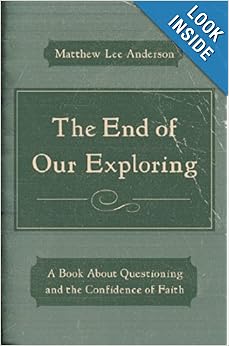
As I began diving into this book, I wondered how I would describe it. At its base, it is a book about wisdom. To clarify, Anderson does not specifically set out to examine what wisdom is, though I would be at the front of the line for that book. Rather, he examines what it means to question well, which it seems to me is a hallmark of a wise person.
Christians, particularly those of the evangelical or fundamentalist variety, seem fearful of questions. We want answers only and move quickly to shut down any serious inquiry. It seems safer that way. Just give us the answer key so that we don't need to engage in critical thought. This tendency to short circuit the process of sincere questioning is a deterrent to true Christian growth.
Books that I read often have a rhythm to them. Some begin on a high note and fade through the pages. Some begin high and keep their intensity throughout. Others, unfortunately, begin weakly and never improve. Anderson's book crescendos. I found it enjoyable at the outset, but it continued to build until the final pages, getting better and better as it proceeded. So, if you read this book, keep at it. It will not disappoint.
I suspect that this book will unsettle many of its readers. As I said, we prefer pat answers and questioning makes us feel insecure. My hope is that if you tackle this book you will see that questioning is not so much a threat as a path to wisdom.
27 January 2012
Proverbs are not promises
I often hear people talking about the Proverbs as if they were assured promises. So what is a person to do if he follows the teaching of a proverb and the outcome fails to arrive?
From the Desiring God website, "Passages like these have been taken as indicating that Christian families experience blessings and loss from God, quid pro quo. We believe that God promises a wonderful family life to those who obey his commands.
"Now, we need to be clear here. The proverbs commend certain paths to family members because they reflect the ways God ordinarily distributes his blessings. But ordinarily does not mean necessarily. Excellent wives have good reason to expect honor from their husbands and children. Fathers with integrity often enjoy seeing God’s blessings on their children. Parents who train their children in the fear of the Lord follow the path that frequently brings children to saving faith.
"But excellent wives, faithful husbands, and conscientious parents often endure terrible hardship in their homes because proverbs are not promises. They are adages that direct us toward general principles that must be applied carefully in a fallen world where life is always somewhat out of kilter."
From the Desiring God website, "Passages like these have been taken as indicating that Christian families experience blessings and loss from God, quid pro quo. We believe that God promises a wonderful family life to those who obey his commands.
"Now, we need to be clear here. The proverbs commend certain paths to family members because they reflect the ways God ordinarily distributes his blessings. But ordinarily does not mean necessarily. Excellent wives have good reason to expect honor from their husbands and children. Fathers with integrity often enjoy seeing God’s blessings on their children. Parents who train their children in the fear of the Lord follow the path that frequently brings children to saving faith.
"But excellent wives, faithful husbands, and conscientious parents often endure terrible hardship in their homes because proverbs are not promises. They are adages that direct us toward general principles that must be applied carefully in a fallen world where life is always somewhat out of kilter."
22 October 2011
Passion of Youth, Wisdom of Age
The glory of young men is their strength, but the splendor of old men is their gray hair.-Proverbs 20:29
Despite the increasing concerns in the media regarding the apathy of young people, particularly young men, I am encouraged by many of the young believers I see around me. They demonstrate a desire to know God and scripture more deeply. They want to grow in godly character. They interact with one another and with many Christian pastors through YouTube, blogs, and Twitter.
Older believers have walked the road for a longer time. Their reputations among younger believers are often of having lost touch, of not really understanding the Gospel, or attending church for its own sake. But older believers have the wisdom of age. They have endured seasons of hardship and blessing, continuing to walk with God.
Younger believers are a fresh blaze. They burn brightly, but haven't developed glowing coals. Older believers are glowing coals, but the flames may appear to have died down. Flames are unstable, coals are consistent. Flames are bright, but coals are hot. The flames look upon the coals as unexciting, dying out. The coals view the flames as lacking substance.
To the younger believers:
Despite the increasing concerns in the media regarding the apathy of young people, particularly young men, I am encouraged by many of the young believers I see around me. They demonstrate a desire to know God and scripture more deeply. They want to grow in godly character. They interact with one another and with many Christian pastors through YouTube, blogs, and Twitter.
Older believers have walked the road for a longer time. Their reputations among younger believers are often of having lost touch, of not really understanding the Gospel, or attending church for its own sake. But older believers have the wisdom of age. They have endured seasons of hardship and blessing, continuing to walk with God.
Younger believers are a fresh blaze. They burn brightly, but haven't developed glowing coals. Older believers are glowing coals, but the flames may appear to have died down. Flames are unstable, coals are consistent. Flames are bright, but coals are hot. The flames look upon the coals as unexciting, dying out. The coals view the flames as lacking substance.
To the younger believers:
- Read Scripture more than you listen to online teachers--significantly more. Although men like John Piper, Mark Driscoll, Paul Washer and Tim Keller may be able to offer wise counsel, they are fallible. Just because one of them says something, it does not make it Gospel. What you learn from them must be balanced against and ultimately submit to Scripture, which you must swim in daily.
- Become a part of a local Bible-believing church. YouTube is not church. Reading books by Famous Christian Guys is not church. Joining a congregation of believers who are as fallible as you are, sitting under Godly preaching, glorifying God, and loving one another in the brotherhood is church. Learn from the men and women who have walked the road much longer than you have--real men and women whom you see on a weekly basis.
- Don't assume that because you read books about theology that you have a better developed sense of the Bible than others in the church. Theology is important, but it is not all-important. Theology, in wise hands, can be a wonderful tool for knowing and loving God more deeply. In immature hands, it may be a dangerous weapon. If you haven't read Kevin DeYoung's "A Tale of Two Corners", I would encourage you to do so right now. It should be required for all young believers.
- Grow in character. Pursue holiness. Be self-controlled and disciplined. Pray for humility and practice it.
- Don't lose your flame; that's how you develop coals.
- Listen to the younger believers. Their passion leads to legitimate questions. Don't be quick to dismiss them. Although Elihu was arrogant (Job 32 and following), he was accurate in many respects. Allow younger believers to fan the flame of your faith.
- Be sound in faith (Titus 2:2). This may involve studying theology, pushing yourself to chew on some of the more difficult meat of Scripture. Just like I said above, if you haven't read Kevin DeYoung's "A Tale of Two Corners", do so now. It should be required reading for all older believers.
- Don't flaunt your experience. It had nothing to do with you. God has kept you by his grace even when you were a smoldering wick or a bruised reed.
- Mentor younger believers. They will benefit from your experience of having walked the road.
- Fan your flames, that's how your coals become hotter still.
12 October 2011
Am I obtuse?
Surely I am too stupid to be a man. I have not the understanding of a man.-Proverbs 30:2
I like words. I like ideas. I spend a lot of time reading words and ideas that allow me to formulate thoughts about a wide variety of topics, though particularly related to Christian theology. Because I have spent a lot of time reading deeply, people often ask my opinions regarding various matters. Sometimes, I even share my opinions without being asked. Despite my affinity for well-crafted arguments, I realized today that in my desire to share my knowledge, I sometimes entirely miss the person with whom I am communicating.
Too often, I am obtuse. To be obtuse is to be lack tact or to be slow to understand. Twice recently, I could have been labeled obtuse (though it could be more; an unfortunate condition of being obtuse is not always knowing that you are). In each of these instances, I crafted my arguments well, but I missed the person. In the first case, I missed the sense of loss the person was experiencing; in the second, I was insensitive to his feelings.
A well constructed exposition is meaningless if it misses the audience. If I unintentionally hurt someone by my words, even if I believe that they are logically informed, the relationship is the worse for it. I suspect growth in wisdom is not only accruing knowledge, but learning to use it to patiently and humbly love others.
The heart of the wise makes his speech judicious and adds persuasiveness to his lips.-Proverbs 16:23
I like words. I like ideas. I spend a lot of time reading words and ideas that allow me to formulate thoughts about a wide variety of topics, though particularly related to Christian theology. Because I have spent a lot of time reading deeply, people often ask my opinions regarding various matters. Sometimes, I even share my opinions without being asked. Despite my affinity for well-crafted arguments, I realized today that in my desire to share my knowledge, I sometimes entirely miss the person with whom I am communicating.
Too often, I am obtuse. To be obtuse is to be lack tact or to be slow to understand. Twice recently, I could have been labeled obtuse (though it could be more; an unfortunate condition of being obtuse is not always knowing that you are). In each of these instances, I crafted my arguments well, but I missed the person. In the first case, I missed the sense of loss the person was experiencing; in the second, I was insensitive to his feelings.
A well constructed exposition is meaningless if it misses the audience. If I unintentionally hurt someone by my words, even if I believe that they are logically informed, the relationship is the worse for it. I suspect growth in wisdom is not only accruing knowledge, but learning to use it to patiently and humbly love others.
The heart of the wise makes his speech judicious and adds persuasiveness to his lips.-Proverbs 16:23
01 August 2011
Are you a Diver or a Dabbler?
Where is the wisdom we have lost in knowledge?
Where is the knowledge we have lost in information?
The cycles of Heaven in twenty centuries
Brings us farther from God and nearer to the Dust.
-TS Eliot
I don't know a lot about ducks, but I do know that there are 2 primary types: the diving duck and the dabbling duck. Diving ducks, such as canvasbacks, are strong swimmers who go deep beneath the surface to feed. They are often found on large bodies of water. Dabbling ducks, like mallards, feed along the surface. They awkwardly tip into the water before bobbing back out. They rarely dive and tend to limit themselves to small bodies of water like ponds. Interestingly, dabbling ducks also tend to be very vocal birds.
I think many of us in our Christian lives may tend toward dabbling. For example, if you have come to know me at all in the past few years, you probably know that I enjoy reading. I spend a good deal of time reading books, but perhaps in even greater measure, I read blogs. I use a program called Google reader, which allows me to catalog dozens of different, interesting blogs. Every day, this provides me with perhaps 75-100 different articles to "read". I also check in on the Drudge Report a few times per day, a website that catalogs various news headlines. Unfortunately, this leaves me a bit like a dabbling duck, not going deeply to feed, but rather skimming the surface, scooping up bits and pieces here and there.
I think this tendency to dabble is a dangerous trend among modern evangelicals. Young Christians are much more likely to be heard saying, "Mark Driscoll said..." or "I read ... on Piper's blog" or "Rick Warren Tweeted..." (For what it is worth, it is to my shame that I can easily identify with any of these sayings). I can envision several possible consequences.
- This schizophrenic form of reading will leave us a mile wide and and inch thick--in other words, dabblers. We may be able to share great theological soundbites without really having wrestled through the nuanced implications of theology, or on a more basic level the Bible. In a paraphrase of the Eliot quote above, one must ask, "Where is the Bible we have lost in books? Where are the books we have lost in blogs?" Our capacity for growth in knowledge and wisdom is progressively usurped by disjointed information presented on 10,000 webpages and podcasts.
- Our failure to grapple with theologically complex material on our own and instead to listen to the talking heads of the day leaves us unsure of what to believe. I think too often, we envision our disjointed, electronic lives as a way of growing in virtue and character when what really happens is that we are left knowing what Paul Washer said, rather than what God's word has to say. In other words we may be freakishly big-headed with no Biblical foundation of support, which makes us unsteady and prone to fall.
- It may create in us a sense of hagiography, which Justin Taylor defined as "the uncritical and adulatory description of the life of a hero of the faith". Those who line up for autographs from your favorite Christian celebrity (think musicians or celebrity pastors) may be guilty of hagiography. For me, the thought of lunch with John Piper would make me excited and nervous (okay, giddy) and this raises significant concerns for me. This form of celebrity worship is dangerous because it is idolatry.
Is there anything to be done about this?
- First, I think it is important to acknowledge that the desire to learn about God is good and right. I believe that for most of us, the goal of reading blogs and watching celebrity pastors is to learn more about God. Indeed, I have learned a great deal from men like Mark Driscoll, John MacArthur, John Piper, and Francis Chan. However, we need to remember that these men are not the be all end all. They don't know you and you don't really know them, which leads to the second point.
- Find a Bible-believing church and commit to being involved. For most of us, Paul Washer is not your pastor. He is unable to speak into your life in any meaningful way. He may have some great, convicting thoughts, but he is not your shepherd. You do not have the opportunity to watch his life unfold and neither can he watch yours. The way to accomplish that is to find a church, fellowship with other believers, and mutually submit with others there. The New Testament makes no mention of lone gun Christianity--we are called to be a part of a body of believers. Paul established churches, where teaching, fellowship, encouragement and discipline happen.
- Repent of any hagiography to which you may be prone. If you find yourself worshipping evangelical leaders rather than God, you are engaged in a form of idolatry.
- Look at your reading and prayer habits. Do you race through your Bible reading so you can listen to another sermon? Do you read the Bible at all? Do you pray? If the amount of time you spend reading and meditating upon God's word is disproportionately overshadowed by the time you spend listening to sermons, your balance is likely off. The other Christian material we read should serve to deepen our understanding of God and His Word and should not be an end in and of itself.
- Wrestle with actual books rather than listening to podcasted sermons. As Travis Allen wrote, "learn about them (e.g., Puritans) through big, thick books, not blog articles." Perhaps focus on learning more deeply about a given topic (e.g., church history) or given person (e.g., John Calvin) rather than on a disconnected set of ideas. Another option is to listen to audio books or online classes. These options should develop a more connected thinking.
- When you do encounter the teaching of others, allow it to drive you back to scripture and see if what you are reading fits. Take notes. Write out your thoughts and pray about it. This will help to solidify thinking.
- Go out and talk to other people. Find out what is going on in their lives. When opportunity presents, talk about God and His work. You will gain much more traction living real life with real people than listening to all of the sermons that MacArthur ever preached (there are over 3000, if you are keeping track).
07 October 2009
Parenting on the razor's edge
To know wisdom and instruction, to understand words of insight, to receive instruction in wise dealing, in righteousness, justice, and equity;to give prudence to the simple, knowledge and discretion to the youth--Let the wise hear and increase in learning, and the one who understands obtain guidance, to understand a proverb and a saying, the words of the wise and their riddles. The fear of the LORD is the beginning of knowledge; fools despise wisdom and instruction.--Proverbs 1:2-7
Over the past week or so, a confluence of factors has led me to think specifically about how I present Christ to my children. One of those factors was Michael Spencer, the i-monk. I once emailed Mr Spencer and told him that he was the blogger that I hate to love because although I don't always agree with him, he often makes me think deeply about my faith. Over the past few days, he has done a series of posts on young earth creationism, atheism, and abandoning the faith. This post today prompted me to write. Briefly, his essay tells of a young man who walked away from the God of his youth because there was no freedom to think independently or creatively under the umbrella of fundamentalism.
At times, when I read stories like this, I feel absolutely frozen inside. I believe there is no more important decision that my children can make than the decision for Christ, but how do I help them on that journey? Too much inflexibility and legalism can lead to rebellion. Too little guidance and structure can lead to a poorly calibrated moral compass. As I perch precariously along this narrow blade, I fear falling one way or the other, jeopardizing my children's eternal future.
As I think about these issues, I come to a place of wanting to teach my children to think for themselves from a Christian worldview by modeling that very thing in myself. I want them to see me deeply reflecting about issues in the world or in my faith and, through prayerful consideration and scriptural contemplation, coming to what I believe is a Biblical conclusion. When they approach me with questions, I want to provide guidance and wise counsel, but also encourage them to think through the questions for themselves with no hint of judgment in their process. If they arrive at a conclusion that is different from mine, I want to be able to ask myself whether their conclusion jeopardizes their salvation. If it does, I pray God gives me the words as I encourage them to seek Him. If it does not, I pray that I can demonstrate grace and parental pride in their ability to think for themselves.
Above all, I pray that God grants me the wisdom and the courage to teach my children what is truly important--the Gospel of Jesus Christ. Discussions about how the earth was created, whether homosexuality is a sin, or whether Bono is actually a Christian are infinitesimally unimportant relative to the Good News. I also pray for freedom from anxiety about whether I am "doing it right" instead trusting that if God seeks my children, they will be found by Him. I desire for myself and my children to be overwhelmed by the grace of Christ, to love others, and seek God with all of our hearts, souls, minds, and strength.
Over the past week or so, a confluence of factors has led me to think specifically about how I present Christ to my children. One of those factors was Michael Spencer, the i-monk. I once emailed Mr Spencer and told him that he was the blogger that I hate to love because although I don't always agree with him, he often makes me think deeply about my faith. Over the past few days, he has done a series of posts on young earth creationism, atheism, and abandoning the faith. This post today prompted me to write. Briefly, his essay tells of a young man who walked away from the God of his youth because there was no freedom to think independently or creatively under the umbrella of fundamentalism.
At times, when I read stories like this, I feel absolutely frozen inside. I believe there is no more important decision that my children can make than the decision for Christ, but how do I help them on that journey? Too much inflexibility and legalism can lead to rebellion. Too little guidance and structure can lead to a poorly calibrated moral compass. As I perch precariously along this narrow blade, I fear falling one way or the other, jeopardizing my children's eternal future.
As I think about these issues, I come to a place of wanting to teach my children to think for themselves from a Christian worldview by modeling that very thing in myself. I want them to see me deeply reflecting about issues in the world or in my faith and, through prayerful consideration and scriptural contemplation, coming to what I believe is a Biblical conclusion. When they approach me with questions, I want to provide guidance and wise counsel, but also encourage them to think through the questions for themselves with no hint of judgment in their process. If they arrive at a conclusion that is different from mine, I want to be able to ask myself whether their conclusion jeopardizes their salvation. If it does, I pray God gives me the words as I encourage them to seek Him. If it does not, I pray that I can demonstrate grace and parental pride in their ability to think for themselves.
Above all, I pray that God grants me the wisdom and the courage to teach my children what is truly important--the Gospel of Jesus Christ. Discussions about how the earth was created, whether homosexuality is a sin, or whether Bono is actually a Christian are infinitesimally unimportant relative to the Good News. I also pray for freedom from anxiety about whether I am "doing it right" instead trusting that if God seeks my children, they will be found by Him. I desire for myself and my children to be overwhelmed by the grace of Christ, to love others, and seek God with all of our hearts, souls, minds, and strength.
11 August 2009
Crisis of Faith in Psychology
When I was in college, I don't think I asked the right questions about what it meant to be a clinical psychologist. I pursued psychology for a host of reasons, I suppose. The desire to figure myself out, insightful and caring faculty, or perhaps a draw to understand people may have been the genesis of the decision. Whatever the reasons, I found myself proceeding in a stepwise fashion from bachelor's to master's to doctorate, all with the intended goal of helping people, but without the needed exercise of introspection. I think I lacked the reasoning required for such self-examination at the time. In particular, I prematurely concluded that the goals of psychology and faith were similar. What I failed to process was that although they both deal with soul care on some level, their methods may be diametrically opposed.
So now I sit, ensconced in my career as a neuropsychologist, pondering. The methods of neuropsychology are different from psychotherapy and are, in many ways, easier to reconcile with faith. Yet, when I work with patients where there is not a clear organic process, spiritual issues often surface. How I deal with those issues as a psychologist is frequently quite different from how I would deal with them as a Christian and therein lies the rub.
I contacted 2 former advisors, Christian psychologists themselves, to seek guidance. The first, my dissertation advisor, directed me to a web resource, which essentially said, the goals of cognitive therapy and Christianity are not contradictory, yet failed to address the issues I struggle with. Next, I sought counsel from my undergraduate mentor as well, and the conversation was much more cerebral and esoteric, as might be expected from someone who studies the psychology of wisdom. I think his perspective is that of an evangelical (I'm not sure he would still describe himself that way) whose systems of thought have morphed over time, such that he is both more reserved and more confident about both his theology and his psychology. In other words, he seems confident in not knowing. He cautioned me against accepting counsel from people who are sure of the truth.
Needless to say, that leaves me in a place of uncertainty regarding the intersection between my faith and my career. I pray for truth. I pray that regardless of the counsel I receive from others, God reveals Himself. I pray for His patience with me and patience with myself. I pray that God provides wisdom to my unsettled soul. I pray that God helps me to ask the right questions even if, for the rest of my life, I never come to know the answers to them.
Proverbs 2:3-7
if you call out for insight
and raise your voice for understanding,
if you seek it like silver
and search for it as for hidden treasures,
then you will understand the fear of the Lord
and find the knowledge of God.
For the Lord gives wisdom;
from his mouth come knowledge and understanding;
he stores up sound wisdom for the upright;
So now I sit, ensconced in my career as a neuropsychologist, pondering. The methods of neuropsychology are different from psychotherapy and are, in many ways, easier to reconcile with faith. Yet, when I work with patients where there is not a clear organic process, spiritual issues often surface. How I deal with those issues as a psychologist is frequently quite different from how I would deal with them as a Christian and therein lies the rub.
I contacted 2 former advisors, Christian psychologists themselves, to seek guidance. The first, my dissertation advisor, directed me to a web resource, which essentially said, the goals of cognitive therapy and Christianity are not contradictory, yet failed to address the issues I struggle with. Next, I sought counsel from my undergraduate mentor as well, and the conversation was much more cerebral and esoteric, as might be expected from someone who studies the psychology of wisdom. I think his perspective is that of an evangelical (I'm not sure he would still describe himself that way) whose systems of thought have morphed over time, such that he is both more reserved and more confident about both his theology and his psychology. In other words, he seems confident in not knowing. He cautioned me against accepting counsel from people who are sure of the truth.
Needless to say, that leaves me in a place of uncertainty regarding the intersection between my faith and my career. I pray for truth. I pray that regardless of the counsel I receive from others, God reveals Himself. I pray for His patience with me and patience with myself. I pray that God provides wisdom to my unsettled soul. I pray that God helps me to ask the right questions even if, for the rest of my life, I never come to know the answers to them.
Proverbs 2:3-7
if you call out for insight
and raise your voice for understanding,
if you seek it like silver
and search for it as for hidden treasures,
then you will understand the fear of the Lord
and find the knowledge of God.
For the Lord gives wisdom;
from his mouth come knowledge and understanding;
he stores up sound wisdom for the upright;
Subscribe to:
Posts (Atom)