Showing posts with label neuroscience. Show all posts

11 October 2017

Altruism, Neuroscience, and Christian Psychology

I was contacted by a magazine editor to offer thoughts on an article from the Proceedings from the National Academy of Sciences a few years ago. I ended up writing a treatise. 

I will try to offer several thoughts, that I hope will be cogent.  The PNAS study is an interesting one. Neuroscience, as you no doubt know, has advanced considerably over the last several years. This seems especially true following the advent of functional neuroimaging, such as fMRI, which allows researchers to get a glimpse of what is happening in a functioning brain. This fMRI research has progressed from understanding motor functioning (e.g., finger tapping) to cognitive tasks (e.g., memory) and now to issues of relationship and morality. Researchers continually push the edge in terms of figuring out how to administer tasks inside the scanner  to try to understand what is going on in the brain. This emotion recognition paradigm is a fascinating one. It is unsurprising that the amygdala shows increased responsiveness in those who are altruistic; the amygdala is one of the brain structures most closely associated with emotional expression, but also emotional memory. So, from a neuropsychological perspective, these results confirm what one might predict. 

As a Christian neuropsychologist, the question of biological markers and altruism is an important one to consider. As you might imagine, for a non-theistic materialist, the assumption might be that the larger amygdala causes increased altruism, but what if the direction is reversed? What if those who exhibit consistently other-centered behaviors develop improved amygdala function? I shared with someone the other day that I believe Jesus, in his humanity, had the most exquisitely integrated brain of any person ever; there was no malfunction, there was no disintegration. His brain functioned the way all of our brains should function. But the New Testament also calls each of us to wholeness. I am particularly fond of John 13 to 17 where Jesus practically demonstrates other centered love and tells us to love one another like he loved us. Then in his prayer, he prayed that “they would be one as he and the Father were one.” Jesus was highly altruistic, the perfect picture of wholeness, and calls us to relational integration or what my friend Larry Crabb might call “relational holiness.” Neuroscientists are increasingly recognizing the brain as not just as the organ to make our bodies move and think, but that it is a relational organ. So when Jesus tells us to love one another like he loves, or when Paul tells us to put on the new self, we are being called into a life not only of greater other centeredness and greater love, but I would argue, deeper neurological integration. 

In terms of the reconciling power of God’s grace and the ongoing work of the Holy Spirit, God absolutely has the ability to change our hearts, but in so doing, he also equips us for greater neuropsychological health and wholeness. Unfortunately, it is all too common that Christians don’t live into that reality and we continue to live disintegrated.


I might also anticipate another question: why is it then that non-believers might be more altruistic, kind, charitable, etc. than non-believers. I would offer a couple of thoughts: first, those one time snapshots fail to account for one’s progressive sanctification. John Newton said once, “I am not what I ought to be, I am not what I want to be, I am not what I hope to be in another world; but still I am not what I once used to be, and by the grace of God I am what I am.” God’s ongoing grace has a role in our sanctification, which I believe includes other-centeredness. The second observation I would offer is that God’s common grace allows remarkable may allow for compassion even amongst non-believers. The question that falls to us as believers, though, is what do I do with the gift that I have been given? Will I choose to live toward wholeness in Christ or not? 

07 April 2014

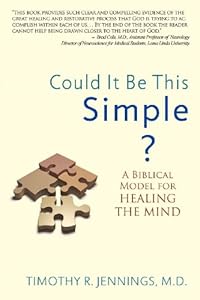
Book Review: Could it Be This Simple?

I received a free copy of Could it Be This Simple? A Biblical Model for Healing the Mind (2012) by Timothy Jennings MD at last year's world conference for the American Association of Christian Counseling. As a Christian and a neuropsychologist, I was eager to read what he had to say.

Replete with examples from everyday life and from his clinical experience, Jennings describes a model of "healing the mind."  In the early chapters, he laid out the link between our spiritual natures, conscience, will, reason, feelings, thoughts, and physical functioning in influencing our mind.  He then set out to show how our minds functioned before sin entered the picture and then subsequently, how sin affected us.

There is much to commend about this book. Jennings is a clear and engaging communicator. This was an simple, though not simplistic, book to read.  I appreciated his recognition of the multiple elements of how the mind functions. Too often, it seems that we focus on one area (e.g., thoughts, relationships) to the exclusion of others. Dr Jennings seems to find that balance reasonably well.  He recognizes that God created us as thinking, feeling, volitional, relational beings and that each of those areas--as well as others-- were affected by the fall. 

Near the center of the book, he took time to develop his thoughts about the laws of liberty and of love as well as their counterfeits. I think that, for the most part, he is right especially as he talked about what right, biblical love looks like.  In chapter 12, his discussion of forgiveness and its associated myths are worth reading.

Despite much to commend about this book early on, the book took a decided turn for me on page 129.  Prior to that, I had some concerns that he was developing a model of healing based upon the law of linearity that Larry Crabb talks about.  In others words, if I have problem A, and I apply treatment B, good things will happen.  If-then Christianity.  Because there was much that was good, I was happy to set that aside.  However, then came page 129.  Under the heading "a false gospel", he essentially dismisses penal substitutionary atonement as a "wolf in sheep's clothing". He argues that Christ did not come to appease God's wrath toward sin and that we need to be cautious with phrases such as "being clothed in Christ's righteousness."  He wrote, "far from what it professes, this false view is actually a candy-coated, rotten-apple theory."  At best, his description is incomplete; at worst, it is heretical.  It may be that I am misreading what he wrote in this section, though I don't think I am.  Having read it several times, he seems to reject the biblical notion of propitiation. He appears to favor a semi-pelagian view of salvation rather than salvation based purely upon the free gift of grace offered through Christ, the sacrificial lamb, which is well-described in Hebrews. 

Finally, at the end of the book, it was hard for me to determine his views of eternal life. On page 136, he wrote, "if we utilize our reason, we would realize that God cannot be the loving Father and the threatening destroyer at the same time...If God is not threatening to destroy the unrepentant, then what will he do to those who reject Him? It is very simple, really. He takes the only loving action He can: He lets them go, and when the Life-giver lets go, they die." This section, and those following make Jennings sound like an annihilationist (like the late John Stott), though I was never entirely sure.

In the end, there are many good elements to this book and some that are strikingly concerning. I believe a discerning reader could wade through the concerns, but unfortunately, this book is not targeted to the theologically sophisticated. Having said that, I humbly acknowledge that I hope it is my own limited understanding and not false theology that raises concerns for me.  I would be eager to hear any corrections from Dr Jennings if I am misrepresenting his work.

Spirituality and Neuroplasticity

This is a video of my friend Curt Thompson. Curt has brought together his Christian faith with his work in psychiatry and interpersonal neurobiology.  I would love to receive supervision from him in this area because, to me, it is quite cutting edge. If you get a chance, you should also read his excellent book, Anatomy of the Soul. I've read it 4 times and I like it better each time. 

06 December 2013

Book Review: The Physical Nature of the Christian Life


Brown and Strawn's short book, The Physical Nature of the Christian Life, is a good little volume. I have had the pleasure of hearing Dr Brown speak on similar issues on the past. First, let me state the positives of this book. Part III of the book, which deals with the embodied Christian life and the church was excellent. The authors did a commendable job of examining church life and our embeddedness within the community. I also appreciated the way in which they tied together themes of attachment theory and neuroscience in their observations. It was reminiscent of Curt Thompson's excellent "Anatom of the Soul" in that regard. I found their commitment to growth in community to be such an important thing that is often missing in the modern church. Additionally, their review of the neuroscience literature was was well-written and accessible, even to a non-neuroscientist.

I did have concerns however. I agree with another Amazon reviewer who mentioned that the authors have trouble arriving at their conclusions by asserting that a monistic viewpoint is the only way to get there. I am probably a rarity, but I am neuropsychologist and a dualist, in part because I find the philosophical and biblical arguments more compelling, and relevant here, do not negate the importance of church life. Many of the suggestions that they make do not require a monistic point of view. Furthermore, they seemed to tie together too closely dualism and gnosticism, a leap that I fear they made too blindly.

As an aside, there seemed to be a hint of social constructivism informing their view of church, such that truth is constructed by the group itself, rather than being an objective entity outside of the group. This leans toward postmodernism and I believe is in error. Perhaps that was not the authorial intent, but it did seem in places to come through.

Finally, I wish they would have acknowledged some of the limitations of their own position and provided responses to them. There are compelling arguments from a philosophical perspective in favor of dualism. They failed to deal with the work of people like JP Moreland or Keith Ward. It seems that too often, when people disagree with some aspect of orthodox theology, they revert to the idea that the church fathers were simply too much influenced by the Greeks, Romans, etc. and then go on to say what the biblical authors really meant. I do not think they can make that leap.

On the whole this is a well written, accessible book, but I am afraid their excellent conclusions do not match their weaker presuppositions.