I try so hard
To follow God
Hoping He’ll approve;
I fail and fail
Day after day
Condemned by this proof.
“You are welcome.
You are my child.”
Jesus says to me.
“You belong
No matter what.
I’m your identity.
I choose to live
For God above
Not to gain His praise,
I serve Him well
As oft I can
Because He’s given me grace.

Showing posts with label grace. Show all posts
Showing posts with label grace. Show all posts
18 September 2017

17 June 2017
A Poem: Peace and Grace
Grace and peace
peace and grace,
fill up my life
with Jesus's ways.
Pour out Your grace
in spite of my sin,
make me gracious toward others
when they fail me again.
Give me Your peace
when my world is a storm,
with the ballast of Christ
unshakable form.
peace and grace,
fill up my life
with Jesus's ways.
Pour out Your grace
in spite of my sin,
make me gracious toward others
when they fail me again.
Give me Your peace
when my world is a storm,
with the ballast of Christ
unshakable form.
24 May 2017
Live as People Who are Free
I wonder if we believers give enough thought to our identity in Christ. Though we cognitively assent to our justification by grace alone in Christ alone, I wonder if that truth has taken up residence in our hearts. Our fears often get the best of us. We are burdened by the judgments of others, threatened by their words. Our own thoughts may accuse us as well, telling us that we are somehow less than others, so we try to hide. Even if we claim to be Christian, we imagine God shaking His head in disappointment at how messed up we are.
The belief that we are not enough affects how we view ourselves and how we relate with others. Because we don't feel the freedom of justification, we respond in relationally distancing ways. Some of us are conflict avoiders. When interpersonal difficulties and conflict arise, we seek escape, preferring to sidestep--and even flee--any relational discomfort. Others of us are fighters. When we face criticism or strife, we fight back with anger, sarcasm, or blame-casting. In both cases, fight or flight, we look for ways to justify ourselves and our responses.
Christians have another option open to them. We are not limited to fight and flight; we have the option of living out our freedom in Christ. Romans 8:1 reminds us that for those who are in Christ, there is no more condemnation. We are fully approved by God and nothing can take that away. Because of our union with Christ, the Father is able to look at us and say, "That's my boy. That's my girl. I am so pleased with that one." Because of Jesus's finished work, we no longer have to avoid conflict with others. We don't have to resort to sarcasm, or anger, or attack, or deception even when we are being treated poorly. We don't have to respond to haughtiness with anger; nor do we have to respond to anger with haughtiness. We can live with true other-centeredness because we have already been set free in Christ--radically free.
The apostle Paul knew this freedom. He told the Corinthians, "It is a very small thing that I should be judged by you or by any human court. In fact, I don't even judge myself. For I am not aware of anything against myself, but I am not thereby acquitted. It is the Lord who judges me" (1 Corinthians 4:3-4). How was he able to take comfort in the fact that it was God who judged him? Because he knew that the judgment had already taken place and that Jesus bore the entire penalty for his sins and failures. In other words, he was free--gloriously free.
What would our relationships look like if our identity in Christ truly took hold of us? Perhaps we would show a sacred curiosity about others, entering their suffering and their celebration without feeling threatened. Perhaps we could serve others with our words and our works without grumbling about their apparent lack of appreciation. Perhaps we would address conflict humbly and directly without fear of retribution because we know who we are. Perhaps we wouldn't feel the need to justify ourselves based on our education, our possessions, our appearance, or anything else because we are already fully justified in Christ. Perhaps we would not feel the need to make too much or too little of ourselves. We could simply rest in the knowledge that we are Christ's.
Live as people who are free. -1 Peter 2:16
If you are interested in exploring this concept more deeply, consider Tim Keller's brief, but excellent, The Freedom of Self Forgetfulness.
The belief that we are not enough affects how we view ourselves and how we relate with others. Because we don't feel the freedom of justification, we respond in relationally distancing ways. Some of us are conflict avoiders. When interpersonal difficulties and conflict arise, we seek escape, preferring to sidestep--and even flee--any relational discomfort. Others of us are fighters. When we face criticism or strife, we fight back with anger, sarcasm, or blame-casting. In both cases, fight or flight, we look for ways to justify ourselves and our responses.
Christians have another option open to them. We are not limited to fight and flight; we have the option of living out our freedom in Christ. Romans 8:1 reminds us that for those who are in Christ, there is no more condemnation. We are fully approved by God and nothing can take that away. Because of our union with Christ, the Father is able to look at us and say, "That's my boy. That's my girl. I am so pleased with that one." Because of Jesus's finished work, we no longer have to avoid conflict with others. We don't have to resort to sarcasm, or anger, or attack, or deception even when we are being treated poorly. We don't have to respond to haughtiness with anger; nor do we have to respond to anger with haughtiness. We can live with true other-centeredness because we have already been set free in Christ--radically free.
The apostle Paul knew this freedom. He told the Corinthians, "It is a very small thing that I should be judged by you or by any human court. In fact, I don't even judge myself. For I am not aware of anything against myself, but I am not thereby acquitted. It is the Lord who judges me" (1 Corinthians 4:3-4). How was he able to take comfort in the fact that it was God who judged him? Because he knew that the judgment had already taken place and that Jesus bore the entire penalty for his sins and failures. In other words, he was free--gloriously free.
What would our relationships look like if our identity in Christ truly took hold of us? Perhaps we would show a sacred curiosity about others, entering their suffering and their celebration without feeling threatened. Perhaps we could serve others with our words and our works without grumbling about their apparent lack of appreciation. Perhaps we would address conflict humbly and directly without fear of retribution because we know who we are. Perhaps we wouldn't feel the need to justify ourselves based on our education, our possessions, our appearance, or anything else because we are already fully justified in Christ. Perhaps we would not feel the need to make too much or too little of ourselves. We could simply rest in the knowledge that we are Christ's.
Live as people who are free. -1 Peter 2:16
If you are interested in exploring this concept more deeply, consider Tim Keller's brief, but excellent, The Freedom of Self Forgetfulness.
04 May 2017
Book Review: The Imperfect Disciple
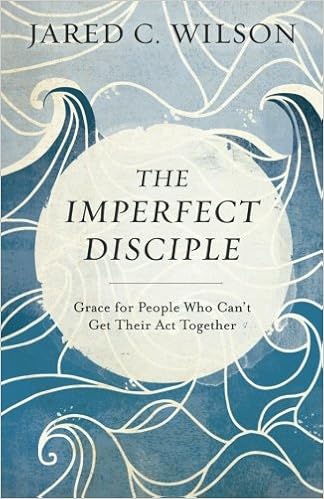
The Imperfect Disciple did not disappoint. It is a book about Christian discipleship, but it didn't read that way. The signs were there--references to prayer and quiet times, mentions of Dallas Willard and John Ortberg--but it felt different, more Wilson that Willard. Wilson employs captivating writing that showcases justification, grace, and a big Christ. Wilson has the remarkable skill of sharing his own (often painful) narrative in a way that highlights not him, but Jesus.
I was particularly fond of chapter 3, "staring at the glory until you see it." He writes about learning how to behold the glory of Jesus and its superiority to simple behavior change. Chapter 6 (The Revolution Will Not Be Instagrammed) was also particularly good. It dealt with what Christian community could be, a place of confession, grace, prayer, and real life.
But chapter 9 wrecked me. In chapter 9, Wilson dealt with living in the midst of suffering and disappointment, showing us that God's grace meets us in the depths of our pain. But it was second paragraph on page 210 that did me in:
"When you are in the pit of suffering--on the verge of death, even--Jesus isn't up in heaven simply blasting you down below with some ethereal virtues. He's not "sending good thoughts"--or worse, "good vibes"--your way. No, when you are laid low in the dark well of despair, when the whole world seems to be crashing down on you, when your next breath seems sure to be your last, Christ Jesus is down in the void with you, holding you. He keeps your hand between his own. He offers his breast for your weary head. He whispers the words of comfort a whisker's breadth from your ear: 'And behold, I am with you always" (Matthew 28:20, emphasis added). Grace is all-sufficient for weakness and for suffering because Jesus is all-sufficient."
I don't remember the last time I began crying reading a non-fiction book, but reading that paragraph, I did. Jesus is with me always. Wilson has the ability, rarely matched, to make me rest in Jesus' arms.
I received a free copy of this book in exchange for my review from Baker Books. I was not required to submit a positive review. The views expressed here are my own.
05 May 2016
Book Review: Unparalleled
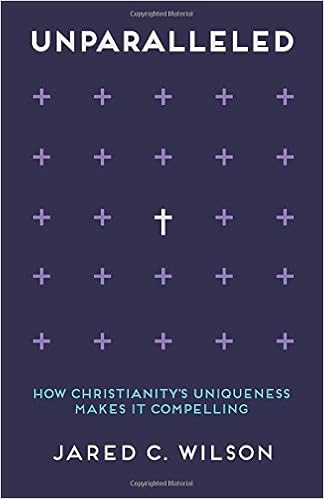
But how to describe Unparalleled: How Christianity's Uniqueness Makes it Compelling (Baker, 2016)? As of now, it is the #1 new release in "comparative religion" on Amazon. Wilson also described it as an apologetics book. Yet, Unparalleled defies easy categorization. As I read it, my first thought was that it belongs in a class with books such as CS Lewis's Mere Christianity, Chuck Colson's The Faith, and NT Wright's Simply Christian in that it is an "apologetic" for the Christian faith. Wilson lays out why Christianity is unique and, therefore, compelling.
Weaving together his gospel-saturated prose, careful thinking, and honest narrative examples, Wilson draws us into Christianity's unique story. Specifically, he addresses God's relationality, the beautiful necessity of the Trinity, the sanctity of all human life, as well as the exclusiveness of Christ's life, death, and resurrection to name just a few topics.
This book is part theology, part apologetics, and part storytelling, but it is all Wilson and that is a very good thing. Though I would compare Unparalleled to other well-vetted Christian classics, this book is unique enough on its own to merit my emphatic recommendation to believers and non-believers alike. In a word, Unparalleled is...well..."unparalleled."
I was provided a review copy of this book from Baker Books in exchange for this review. I was not required to write a positive review of this book. The viewpoints presented here are my own.
09 March 2016
Dancing at the edge of expectation
More than half my life has been lived as a Christian and, Lord willing, I will have many years yet to explore the vistas of God's grace. I am filled with anxious wonder about what God will reveal next. I have frequently said that in the nearly 30 years since "I was ambushed by Jesus", to steal a phrase from Brennan Manning, I have learned much more about the Bible and yet I know much less about God. His vastness is never ending. The boxes in which I previously tried to contain Him I keep finding too small.
Over the years, I have been interested in the development of Christians. How is it that we come to believe certain things? How do our beliefs mature over our lives? God knows.
Today I came upon a few paragraphs in Eugene Peterson's book Travelling Light (1988). He wrote, "The word Christian means different things to different people. To one person, it means a stiff, uptight, inflexible way of life, colorless and unbending. To another it means a risky, surprise filled venture, lived tiptoe at the edge of expectation.
"Either of these pictures can be supported with evidence. There are numberless illustrations for either position in congregations all over the world. But if we restrict ourselves to biblical evidence, only the second image can be supported: the image of a person living zestfully, exploring every experience--pain and joy, enigma and insight, fulfillment and frustration--as a dimension of human freedom, searching through each for sense and grace. If we get our information from the biblical material, there is no doubt that the Christian life is a dancing, leaping, daring life" (p. 57).
In my experience and observation, the early Christian life often represents the former, inflexible way. The focus is often on sinfulness, and particularly the sinfulness of others who do not seem to be pursuing righteousness quite as zealously as the young believer thinks is appropriate. They stay far from the edge of the cliff and cast critical gazes at those who do not.
But with life lived and daily infusions of God's unending grace, we begin to discover the robustness of the Christian life for all circumstances and that the Spirit goes with us as we go. When we begin to understand that he will never leave or forsake us, our feet start tapping and we begin to dare to dance at the edge of expectation.
Over the years, I have been interested in the development of Christians. How is it that we come to believe certain things? How do our beliefs mature over our lives? God knows.
Today I came upon a few paragraphs in Eugene Peterson's book Travelling Light (1988). He wrote, "The word Christian means different things to different people. To one person, it means a stiff, uptight, inflexible way of life, colorless and unbending. To another it means a risky, surprise filled venture, lived tiptoe at the edge of expectation.
"Either of these pictures can be supported with evidence. There are numberless illustrations for either position in congregations all over the world. But if we restrict ourselves to biblical evidence, only the second image can be supported: the image of a person living zestfully, exploring every experience--pain and joy, enigma and insight, fulfillment and frustration--as a dimension of human freedom, searching through each for sense and grace. If we get our information from the biblical material, there is no doubt that the Christian life is a dancing, leaping, daring life" (p. 57).
In my experience and observation, the early Christian life often represents the former, inflexible way. The focus is often on sinfulness, and particularly the sinfulness of others who do not seem to be pursuing righteousness quite as zealously as the young believer thinks is appropriate. They stay far from the edge of the cliff and cast critical gazes at those who do not.
But with life lived and daily infusions of God's unending grace, we begin to discover the robustness of the Christian life for all circumstances and that the Spirit goes with us as we go. When we begin to understand that he will never leave or forsake us, our feet start tapping and we begin to dare to dance at the edge of expectation.
08 October 2015
Reflections from a Pensive Heart
I have felt weepy today
Emotive clouds pregnant
Eager to give birth to tears.
Yet they are not gloomy and gray.
They are tall and billowing and white.
Contentedly basking in the light of day
Ready at a moment's notice to conspire with the sun
to mingle rain drops and sun drops
to paint beauty in the sky.
I partly blame...or perhaps thank...Andrew Peterson for today's speculative mood. I listened to his new song, Be Kind to Yourself, perhaps a dozen times this morning. His lyrics and mood affected my mood and lyrics today. Let me share a few of my rambling thoughts.
++++++++++++++
The Beauty of God's grace is my heartbeat. Thoughts of it occupy my mind many times a day. Grace marvels me. That God would lavish His love on me is difficult to comprehend. Today, though, I have been struck by mercy, grace's mirror image twin. Mercy is beauty. Because of the blood of His son, and His incomparable love, God stays His hand.
++++++++++++++
Though Lewis's Mere Christianity is a matchless book, Christianity isn't merely anything, a point Lewis rightly made. In whatever ways I might conceptualize Christianity, it is more, always more. It is too easy to allow Christianity to be assent to a set of doctrines, or a way of living, or even a feeling. Christianity is more. In The Message, Eugene Peterson paraphrased part of Mark 12 as "love the Lord God with all your passion and prayer and intelligence and energy." Christianity is not merely attending church on Sunday morning. It is not merely saying yes to Jesus. It is not merely preaching the good news. It is not merely serving the poor. Christianity is all of life. Christ is present in my dinner table conversations, my walks on a crisp day, and my love of my wife. He is present in my laughter, my sorrows, and my pain. God does not exist above the everyday, He enters it. True faith is both ruddy and transcendent. I marvel at them both.
++++++++++++++
My mind tends to run ahead, always thinking, thinking, thinking. Cogwheels whirring, manipulating ideas and formulating thoughts. I want to learn to be attentive to the moment. To quiet my soul enough to listen for God. To be present with people.
Father, train my ears to listen carefully for Your indwelling breath. Sharpen my eyes to see flickers of Your majesty.
27 August 2015
Ashley Madison and Our Self-Righteous Indignation
God looks down from heaven
on the children of man
to see if there are any who understand,
who seek after God.
They have all fallen away;
together they have become corrupt;
there is none who does good,
not even one.
-Psalm 53:-2-3
In recent weeks, the depravity of the human heart has been on display in the wake of the Ashley Madison scandal. If, by some inexplicable reason, you are not aware of what has been happening, the database for the website Ashley Madison was hacked and names were released. Ashley Madison exists for the sole purpose of arrangingdiscrete affairs for those involved in committed relationships. The story went from big to gargantuan when it was revealed that Josh Duggar was one of the people signed up on the website.
People have reacted with shock that 1) such a website even exists, 2) that so many people were registered, and 3) that those championing family values would be involved. On the one hand, I understand this reaction. Each of us has a sense of moral right and wrong, largely because the word of God is written on our hearts. If truth and morality were relative, we wouldn't give Ashley Madison a second thought. But we do, because right and wrong are real, objective things.
What strikes me even more deeply is the sense of righteous indignation that seems to accompany the shock. As a society we seemingly cannot believe that there are people who would do such a thing. In other words, we distance ourselves from their sin. We pretend like we would never do anything like that! Yet, I think Alexander Solzhenitsyn was right when he wrote, "if only it were all so simple! If only there were evil people somewhere insidiously committing evil deeds, and it were necessary only to separate them from the rest of us and destroy them. But the line dividing good and evil cuts through the heart of every human being." We fail to acknowledge that apart from the restraining grace of God, every...single...one of us is capable of adultery or murder or a host of other sins. We also seem to forget that all of us commit sin enough every day to separate us from God. That includes the sin of our self-righteousness. In fact, Isaiah 64:6 says that all of our righteous deeds are like filthy rags (literally polluted menstrual garments). Romans 3:23 says all have sinned and fall short of God's glory.
You. Me. All of us.
So as you hear details about Ashley Madison, Josh Duggar, and the people involved, search your heart. Pray that every one of them may receive God's mercy available through Christ alone. Pray also that God would not only make you aware of the depths of your own sinful heart, but of His grace, which goes deeper still.
-Psalm 53:-2-3
In recent weeks, the depravity of the human heart has been on display in the wake of the Ashley Madison scandal. If, by some inexplicable reason, you are not aware of what has been happening, the database for the website Ashley Madison was hacked and names were released. Ashley Madison exists for the sole purpose of arranging
People have reacted with shock that 1) such a website even exists, 2) that so many people were registered, and 3) that those championing family values would be involved. On the one hand, I understand this reaction. Each of us has a sense of moral right and wrong, largely because the word of God is written on our hearts. If truth and morality were relative, we wouldn't give Ashley Madison a second thought. But we do, because right and wrong are real, objective things.
What strikes me even more deeply is the sense of righteous indignation that seems to accompany the shock. As a society we seemingly cannot believe that there are people who would do such a thing. In other words, we distance ourselves from their sin. We pretend like we would never do anything like that! Yet, I think Alexander Solzhenitsyn was right when he wrote, "if only it were all so simple! If only there were evil people somewhere insidiously committing evil deeds, and it were necessary only to separate them from the rest of us and destroy them. But the line dividing good and evil cuts through the heart of every human being." We fail to acknowledge that apart from the restraining grace of God, every...single...one of us is capable of adultery or murder or a host of other sins. We also seem to forget that all of us commit sin enough every day to separate us from God. That includes the sin of our self-righteousness. In fact, Isaiah 64:6 says that all of our righteous deeds are like filthy rags (literally polluted menstrual garments). Romans 3:23 says all have sinned and fall short of God's glory.
You. Me. All of us.
So as you hear details about Ashley Madison, Josh Duggar, and the people involved, search your heart. Pray that every one of them may receive God's mercy available through Christ alone. Pray also that God would not only make you aware of the depths of your own sinful heart, but of His grace, which goes deeper still.
22 June 2015
Move deeper in: some thoughts on Tullian
What if some were unfaithful? Does their faithlessness nullify the faithfulness of God? By no means! Let God be true though every one were a liar.-Romans 3:3-4
Yesterday, the news came down that one of my spiritual heroes, Tullian Tchvidjian, stepped down from his pastorate at Coral Ridge Presbyterian Church after admitting an "inappropriate relationship." I grieve for him. I grieve for his family. I grieve for Coral Ridge. I grieve for all of the people whose lives have been radically transformed by the message of God's one way love.
 Here's the thing: lots of naysayers are going to come out of the woodwork now, not only condemning Tullian's actions, which are condemnable, but also the gospel banner he has carried proudly for many years. After not too much time, I suspect that we will hear people say, "see, you have to be careful with this message of grace. Don't get overbalanced. It's too dangerous."
NO! Jesus' one way love toward sinners--like me, like you, like Tullian--remains in full force! God loved me so much that in spite of my ongoing sinfulness he gave his only son, Jesus, to bear the penalty that I deserve so that I might live forever in restored relationship with him. If you are a believer, that is true for you too. No exceptions.
If you, like me, have been utterly wrecked and rebuilt by this message of profound grace for undeserving sinners, don't shy away from it when you hear of moral failings. Move deeper in.
Grace is our lifeblood.
Grace is the sinew that holds us together.
Grace is the muscle that propels us and the bones that hold us up.
Grace is every breath we draw.
Yesterday, the news came down that one of my spiritual heroes, Tullian Tchvidjian, stepped down from his pastorate at Coral Ridge Presbyterian Church after admitting an "inappropriate relationship." I grieve for him. I grieve for his family. I grieve for Coral Ridge. I grieve for all of the people whose lives have been radically transformed by the message of God's one way love.
Here's the thing: lots of naysayers are going to come out of the woodwork now, not only condemning Tullian's actions, which are condemnable, but also the gospel banner he has carried proudly for many years. After not too much time, I suspect that we will hear people say, "see, you have to be careful with this message of grace. Don't get overbalanced. It's too dangerous."NO! Jesus' one way love toward sinners--like me, like you, like Tullian--remains in full force! God loved me so much that in spite of my ongoing sinfulness he gave his only son, Jesus, to bear the penalty that I deserve so that I might live forever in restored relationship with him. If you are a believer, that is true for you too. No exceptions.
If you, like me, have been utterly wrecked and rebuilt by this message of profound grace for undeserving sinners, don't shy away from it when you hear of moral failings. Move deeper in.
Grace is our lifeblood.
Grace is the sinew that holds us together.
Grace is the muscle that propels us and the bones that hold us up.
Grace is every breath we draw.
09 June 2015
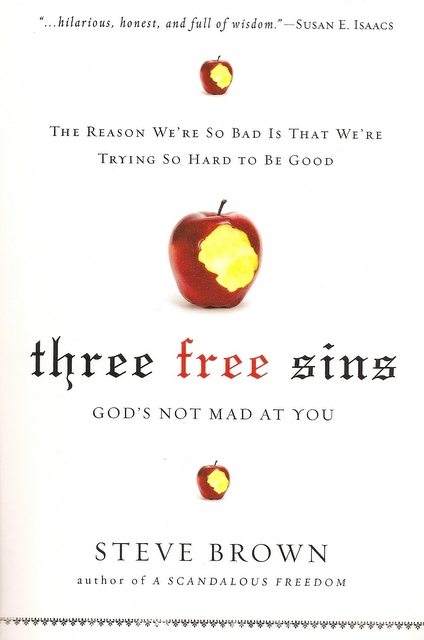
Book Review: Three Free Sins
This week, I read a book that at least a half dozen people
asked me about just by seeing the cover. Every one of them questioned the
title, which gave me a chance to talk about what a great book it is in spite of
the provocative title. So what is the
book? Three Free Sins: God’s Not Mad at You by Steve Brown.
Perhaps you, like many of my friends, hear me say that title
and you wince, but give me a moment. If you are at all familiar with Steve
Brown, he’s been around a long, long time. In fact, he refers to himself as “old
as dirt.” He is a conservative, Bible believing seminary professor who has been
telling people about Jesus for a very long time with his amazing baritone
voice. But in the introduction to the book, he tells his readers that he has
tried really hard to live in the “religious box” for a long time, a stiff
container of legalism and lovelessness. Although the title catches almost
everyone off guard, the message inside is pure gospel.
 Too often, you see, Christians use methods of discipleship
that don’t work. For example, we inflict guilt or we hold up stories of “Bible
heroes” without recognizing their dark sides. We present the Bible as a list of
rules to be followed rather than a story of a God pursuing sinners right in the
middle of their mess. We confuse law and gospel. What happens is not that we
sin less, but that we get better at hiding our junk. And then we get
self-righteous.
Too often, you see, Christians use methods of discipleship
that don’t work. For example, we inflict guilt or we hold up stories of “Bible
heroes” without recognizing their dark sides. We present the Bible as a list of
rules to be followed rather than a story of a God pursuing sinners right in the
middle of their mess. We confuse law and gospel. What happens is not that we
sin less, but that we get better at hiding our junk. And then we get
self-righteous.
Brown turns this whole approach to the Christian faith
(which is ineffective anyways) upside down. He asks the question “What if the
Christian faith isn’t about getting better?” Rather, what if the Christian
faith is developing a deeper and deeper recognition that God loves us in spite
of our sins—past, present and future. What if being a Christian really is about
freedom, recognition of our need for Jesus, and the beauty of forgiveness? On
page 87, Brown wrote, “I’ve found that the greatest need among Christian
leaders isn’t for more commitment, more ‘religion’, and more ‘making an impact
for Jesus’. What they need to be taught is that they are seriously sinful and
God loves them anyway.” Bingo!
When we begin to recognize God’s love, grace, and
forgiveness, something interesting happens. We begin to live as free people. We
live fearlessly. We will get better when we aren’t watching and trying so hard.
Three Free Sins is an amazing book. Don’t let the title
scare you off. If you are a Christian, God. Is. Not. Mad. At. You. You are his
beloved child. You are free. I’m Jason
Kanz for off the shelf.
27 May 2015
My Top 10 Favorite Sermon Jams Plus One
Are you needing encouragement? Check these out? In fact, bookmark this page and visit it often.
17 March 2015
Book Review: Ruthless Trust

Every page, every line of this book is a treasure. Here are a few precious jewels that I hope will encourage you to dig for Manning's treasures yourself.
- We can no more catch a hurricane in a shrimp net or Niagra Falls in a coffee cup than we can grasp the infinity of God's reality.
- Such a friend allows me to be myself, thoughtful one moment and silly the next. Between us, trust grows. If a word of fraternal correction is needed, the friend offers it directly, but the pained expression on his face tells me how difficult the reproof is for him. And yet he has the courage to tell me something unpleasant but necessary--something that others should tell me but do not. (They renege for fear that I will not like them anymore. Their emotional equilibrium is more important to them than my spiritual growth). With each interaction, trust of my friend grows deeper.
- I want neither a terrorist spirituality that keeps me in a perpetual state of fright about being in right relationship with my heavenly Father nor a sappy spirituality that portrays God as such a benign teddy bear that there is no aberrant behavior or desire of mine that he will not condone.
- The great weakness in the North American church at large, and certainly in my life, is our refusal to accept our brokenness. We hide it, evade it, gloss over it. We grab for the cosmetic kit and put on our virtuous face to make ourselves admirable to the public. Thus, we present to others a self that is spiritually together, superficially happy, and lacquered with a sense of self-deprecating humor that passes for humility. The irony is that while I do not want anyone to know that I am judgmental, lazy, vulnerable, screwed up, and afraid, for fear of losing face, the face that I fear losing is the mask of the impostor, not my own!
07 March 2015
Book Review: Dangerous Wonder

Yaconelli writes of curiosity, wonder, abandon, playfulness, quiet listening, passion, terror, and naivete as characteristics to cultivate and not destroy. We are Christians, not Pharisees.
I have now read two books by Yaconelli: Dangerous Wonder and Messy Spirituality and I have been deeply moved by both of them. One particular story in Dangerous Wonder brought me to tears. In the chapter, "naive grace", Yaconelli told the story of an alcoholic man and abusive father who was leveled by grace. I won't share particulars, because I want you to read this book and find what I did.
If you have grown up in the church or consider yourself a "good Christian", Yaconelli will make you uncomfortable. And that's a good thing.
16 February 2015
A Crooked Fence

Yet we fail to notice our crooked fence. When we took inventory of our own sins and examined our neighbors, the fence that was required to make our fields look good was tortuous. Twisted and jagged, it kept the sins of others at bay while pleasantly ignoring the perennial lust, anger, and pride that crops up moment by moment in our lives.
The Pharisee does not really seem to believe what Paul said in Romans 3:23, "for all have sinned and fall short of the glory of God." For them, or shall I say for us, we are quick to suggest to the person in the next field "you have sinned and fallen short of the glory of God but my sins are not that bad."
Friends, Jesus came to uproot them all. Your neighbor's murder, the adultery of the guy down the street, and your belief that your sins are not that bad and do not require forgiveness. Jesus' point in the Sermon on the Mount was to show us how deeply rooted our sins are. None of us are exempt. On our own merits, we are all fields of unrighteous weeds.
By His grace, he can uproot your sin and by His Spirit--and by His Spirit alone--He will walk your fields with you and enable you to bear fruit in keeping with your repentance.
30 January 2015

18 November 2014
Book Review: The Prodigal
The authors tell the story of Jack, a megachurch pastor, who has built a church and a huge following on a message of door more, try harder. At the beginning of the book, we discover that he has been caught in a moral failure. The rest of the book tells the story of his ailing father bringing him back home to small town Texas.
Although I suspect the text itself was largely constructed by Garrett, the story has the unmistakable fingerprints of Brennan, particularly in the character of Father Frank, the aging Catholic priest. If you have enjoyed Brennan's works, this book is for you. If you have lost hope in the church, this book is for you.
16 August 2014
Foundational Ideas: Grace/Forgiveness
My license plates read “GRCE ALN”, for grace alone. Over the last few years, there is probably no concept that has more deeply affected what I believe. Since becoming a Christian, I have given intellectual assent to the notion of grace, but I have not really felt its effects.
Subscribe to:
Posts (Atom)