Showing posts with label emotions. Show all posts

18 December 2017

Results of the Unscientific Emotion & church survey

Back in October, I created a brief "Emotions" survey on Survey Monkey. I was trying to get a handle on how people viewed emotions, especially as it came to church life. Someone recently asked me about it, and I thought this would be the easiest way to share the results:

There were 82 respondents (actually not bad) given where I shared it, etc.

1. Would you describe yourself as an emotional person? 

  • Yes definitely (44, 53.6%)
  • Yes, but only in certain circumstances (32, 39%)
  • No, I almost never become emotional (6, 7.3%)
  • I don't know (0, 0%)

2. Were your parents emotional?

  • Yes, they were both emotional (27, 33.3%)
  • My mother was emotional, but my father was not  [or was absent] (25, 30.8%)
  • Neither of them were emotional (22, 27%)
  • My father was emotional, but my mother was not [or was absent] (7, 8.6%)

3. Which of the following statements best describes your understanding of emotion? 

  • Emotional expression is a sign of healthy psychological functioning (74, 91.4%)
  • The world would be better off if fewer people expressed their emotions openly (5, 6.2%)
  • Emotions are a sign of weakness (2, 2.5%)

4. When other people express strong emotion around me...

  • I feel honored that they are willing to open up (54, 66.7%)
  • Other people's emotions make me mildly uncomfortable (17, 20.1%)
  • I don't feel any different than normal (7, 8.6%)
  • Other people's emotions make me extremely uncomfortable and I will escape the situation as soon as possible (3, 3.7%)

5. When I begin to feel strong emotion...
  • I am willing to share with those I trust (55, 68%)
  • I feel uncomfortable and try to set my mind on something else (16, 20%)
  • I am willing to share with anyone (9, 11.1%)
  • I don't experience strong emotion (1, 1.2%)
6. The more emotional a person is, the less capable of clear thinking he/she is.
  • False (56, 70%)
  • True (24, 30%)
7. A willingness to experience and express strong emotion can improve one's overall psychological health.

  • True (72, 90%)
  • False (8, 10%)

8. Which of the following statements do you think best described Jesus's earthly life? 
  • He experienced strong emotions that he paid attention to along with other psychological capacities (75, 92.6%)
  • He experienced some strong emotions, but mostly he paid little attention to his emotions (6, 7.4%)
  • He was never emotional (0, 0%)
  • He was overly emotional (0, 0%)
9. When I think of emotions, I think of them as...
  • Neither masculine nor feminine (66, 80.5%)
  • mostly feminine (16, 19.5%)
  • mostly masculine (0, 0%)
10. Most Christian churches...
  • Seem confused by emotions (32, 41%)
  • Don't pay enough attention to emotion (30, 38.5%)
  • Discourage emotional expression (10, 12.8%)
  • Pay too much attention to emotion (6, 7.7%)

21 October 2017

Ten Statements about emotion

Ten statements about emotion that one will have difficulty supporting biblically:
1) Emotions are a sign of weakness. 
2) Life would be better if we learned to suppress our emotion.
3) One cannot be logical and emotional at the same time. 
4) People who express emotion are not thinking clearly. 
5) Emotions are unnecessary.
6) Emotions are dangerous.
7) Just like Spock, Jesus was unemotional.
8) God the Father is unemotional.
9) In the process of sanctification, we will become less emotionally expressive.
10) Church is not the place for emotion.

17 February 2016

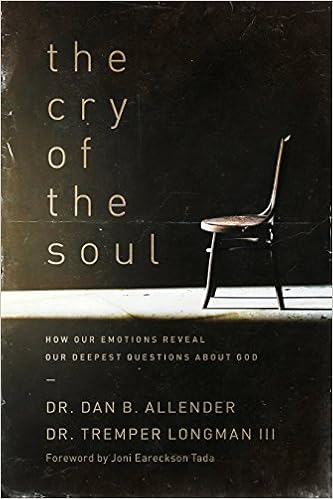
Book Review: Cry of the Soul

Talk of emotion often makes Christians squirm. We may give a nod to emotions, primarily to acknowledge our need to keep them under control. Whether stated or not, too many Christians operate from the assumption that a godly person is one who suppresses negative emotions. Positive emotions are accepted, but only if they are not too extreme.  In other words, for many, the Christian is to be a thinker, not a feeler. But the Bible is a book filled with emotion.

In their excellent book The Cry of the Soul: How Our Emotions Reveal Our Deepest Questions About God (1994), Dan Allender and Tremper Longman III have invited the readers to explore the language of emotion, in our own lives and through the words of Scripture, particularly in the Psalms. They encourage us to look into our shame, and fear, and sadness and ask what those emotions tell us about who God is.

Cry of the Soul is an excellent book. If you wish to develop a deeper understanding of your emotional life and of your relationship with God, this is a great place to begin.

26 February 2015

Book Review: The Happy Christian

I am not naturally a pessimist, though when I saw David Murray's latest book The Happy Christian: Ten Ways to be a Joyful Believer in a Gloomy World (Thomas Nelson, 2015), I was a bit skeptical. To be clear, I have a deep appreciation for Dr Murray and I am a committed fan to his blog. As a Christian psychologist and editor of the newsletter for the Society for Christian Psychology, I believe that Dr Murray is one of the bright lights of the movement. I have put his little book, Christians Get Depressed Too, into the hands of many people. Yet, when I read the the title, "The Happy Christian", I worried. To clarify, I do believe that the Christian faith leads to a joy and happiness that is unparalleled in other worldviews, yet to me, it seems too easy to communicate the message that one must be happy to be a Christian. I do not believe that the biblical record reflects happiness as a requirement for the believer. Still, Murray is a wise man and I was eager to read what he chose to share.

Murray presented 10 ways to be joyful:
  1. Happy Facts: Facts > Feelings
  2. Happy Media: Good News > Bad News
  3. Happy Salvation: Done > Do
  4. Happy Church: Christ > Christians
  5. Happy Future: Future > Past
  6. Happy World: Everywhere Grace > Everywhere Sin
  7. Happy Praise: Praise > Criticism
  8. Happy Giving: Giving > Getting
  9. Happy Work: Work > Play
  10. Happy Differences: Diversity > Uniformity
If I am honest, after the first chapter, my hopes for this book cooled, though in hindsight, I am not sure why. Murray essentially presented a way of examining how we think grounded in a cognitive behavioral model. I think my initial concern was that although extremely beneficial, an exclusively cognitive behavioral approach would be limited. I also had fears that this book would be a recycling of previous writers like Norman Vincent Peale, though Murray quickly set that fear to rest. 

As I continued to read, I was reminded why I like Dr Murray so much. He addresses a broad range of issues and how they can influence the life of the Christian. Briefly, for example, he shows the reader how too much immersion in negative news can be psychologically damaging, how focusing on the past can be problematic, and how giving freely is freedom giving.

Considering how I tend to think, I was particularly drawn to chapter 3, which has to do with Happy Salvation. Murray reminds us, as Christians, that when Jesus said from the cross that it is finished, that he meant it. That has very practical implications for our own happiness. In that chapter he wrote, "What are the ten most disbelieved letters in the Bible? N...O...T...O...F...W...O...R...K...S"  Amen.

Overall, I was very happy with Dr Murray's new book. I would gladly put it into the hands of any believer. It is biblical, practical, and wise.

In exchange for this review, I was provided with a free copy of this book by Thomas Nelson and the Book Look Bloggers Program. I was not required to submit a positive review of this book. 

10 December 2014

Book Review: Emotionally Healthy Spirituality

I had not heard of Peter Scazzero's Emotionally Healthy Spirituality (2006) until a few months ago when a pastor friend of mine mentioned it in passing. Since then, when I have shared that I was reading this book, many friends and acquaintances told me how excellent it was. I am not sure why they left me in the dark so long. 

As a pastor of a church, Scazzero was trying to lead through pure effort with no attention to his emotional life. Only when his relational life began to fray at the edges did he begin to take a closer look at emotion. At the outset of the book, he identified 10 symptoms of emotionally unhealthy spirituality that serve as a useful diagnostic tool.

Once we understand our emotional feebleness, Scazzero spends the later half of the book talking about what to do about. He encourages a deeper look inside, acknowledging the reality of emotions as a normal part of the Christian life. I particularly appreciated chapter 6, which dealt with the concept of a dark night of the soul, an issue too frequently ignored in the Christian life. For Scazzero, I think rightly, the dark night is a normative part of the Christian life, though too often, people run from it, rather than toward it, much to their detriment.

Near the end of the book, he encourages the practice of two specific disciplines--the daily office and the Sabbath--to grow in our understanding of God and understanding of self.  Attention to God and delighting in his creation are essential practices that we too often hurry past. 

On the whole, I think this is very beneficial book. It is a relatively easy read, but if you read it, take your time and ponder what the author has to say. He writes with lists and bullet points, which many people will find desirable, though don't believe that represents naive ideas that can be cast aside quickly. 

30 May 2014

Happy All the Time


Somewhere along the way, Christians have adopted the (what I believe to be mistaken) notion that emotions are bad, or at least that negative emotions are bad. If we are to believe the song above, we are to be "inright, upright, outright, downright happy all the time."  Is that true?

This morning, I was reading in John 13 where verse 21 says, "Jesus was troubled in his spirit." Don't skip over these words. Ponder what they mean.  When you read them, does it suggest to you that Jesus was "inright, upright, outright, downright happy all the time" or does it suggest something different? If you were one of the 12 others in the room and you looked at Jesus, what do you think you would have seen? Would he have looked happy?  How about peaceful, disconnected, or aloof?

Jesus was troubled.  He was bothered. Eugene Peterson suggests that he was "visibly upset." In other words, he was experiencing negative emotions. He knew he was about to die on the cross and bear his Father's wrath. He also knew that one of his friends and companions was about to betray him for a meager 30 pieces of silver. I even wonder if he was feeling sorrow over knowing the internal turmoil Judas would face when he came to his senses.

Christian, please do not be one who perpetuates the idea that Jesus--and by extension, Christians--are to be "happy all the time". Jesus wasn't. We won't be. Rather, be real with your emotions, with yourself, with others, and before the throne of grace.

PS, parents and Sunday school teachers, stop singing this song with your kids.

19 January 2014

God is More Passionate Than You Are

God is not a bored, tired gentleman of a grandfatherly nature sitting on his La-Z-Boy throne in heaven who shows only polite interest in your life. God is passionate.  In fact, He is more passionate than you are.  Much more passionate.

He loves you so much that He pursues you everywhere.  He pours forth blessing after blessing on you.  He loved you so much He sent His son to die and bear the penalty for your sin and He offers it as a free gift.  He allowed His son to be Killed. Gruesomely. So that He could have relationship with you.  He loves you passionately.

He also hates sin much more than you do. He despises sin.  When you are disappointed and angry with yourself for sinning, His hatred for that sin is infinitely larger than yours. He also hates the sins that others commit against you much more than you ever will.  He hates sin so much that He sent his son Jesus to do away with that sin once and forever. 

Never think of God as impassionate.  His desire for you, His hatred of sin, His passion will always supersede that of your own.  Praise God for that.

01 October 2011

A Father's Son

Ian has increasingly grown emotional.  Wednesday, before I left, Ian must have reminded me 10,000 times that I must give him a hug and a kiss before I left.  "Don't forget to give me a hug and a kiss before you leave."  Those words, oft repeated, are imprinted in my brain. And what a fine imprint!  He is also the first to make sure that I kiss him good-bye every day before work and he insists I pass those blessings along to his sisters as well--sometimes twice. 

So often, people downplay or minimize emotionality in boys.  We don't want them to be feelers.  We expect them to be "strong", whatever that means.  The older I get though, the more I learn that true masculinity includes an emotional side.  Jesus wept. Jesus experienced sorrow.  Jesus felt hope. Jesus became angry.  Jesus is the definition of true masculinity, and he was emotional. 

I cherish the emotions of my children.  I am increasingly learning that even the negative ones can serve a purpose and that as a father, I need to learn to respond to those with grace as well, rather than with irritation.  Christian parenting is not about creating automatons, but loving our children and encouraging their passionate emotions, reminding them that God created them as passionate, emotional creatures. 

May we all have a passionate love for God, deep sorrow over losses, and appropriate anger. May we all have a heart after God, who created us to feel.