Showing posts with label spiritual formation. Show all posts

21 August 2016

Daily prayer for transformation

In Romans 12:2, Paul admonishes us to avoid being conformed to the world, but to instead be transformed by the renewing of our mind. The difficulty for all of us is that we have to live in the world and are thus pressured into the world's mold. Passivity will not work; transformation takes intentional practice. Bible reading, silence and solitude, worship, and prayer are but a few examples. One of the practices I've more recently developed is that each morning, I try to pray through a list of traits I want to see growing in my life. The list started with Paul's description of the fruit of the Spirit from Galatians 5:22-23, but I have expanded it from there. Here is what I try to daily. Some days I am too distracted. Some days I only get part way through the list. Some days I simply forget. But God is gracious and patient.

I begin by spending a few moments trying to settle my mind. I am one of those people whose mind chases 10,000 thoughts and I have to purpose myself to be in the moment. It is so easy to find my mind wondering and wandering. Typically, I can calm my mind some before I begin this prayer, never perfectly, and sometimes not at all. On those days, quite frankly, I try to spend my time simply quieting my mind, which in and of itself is an important practice.

After I quiet my mind some, I begin to pray through a list of character qualities I want to develop in my life together with their opposites. As I am slowly inhaling, I will pray, for example, "make me more loving." As I exhale slowly, I will pray, "rid me of hate." I do that for each of the traits, or as many as the morning allows.

Here is my current master list.
  • Love--Hate
  • Joy--Pessimism 
  • Peace--Anxiety
  • Patience--Hurry
  • Kindness--Mean-spiritedness
  • Goodness--Evil
  • Faithfulness--Disloyalty
  • Gentleness--Harshness
  • Self-control--Impulsivity
  • Presence--Distraction
  • Truthfulness--Dishonesty
  • Humility--Pride
  • Other-Centeredness--Selfishness
  • Curiosity--Disinterest
  • Compassion--Cruelty
  • Wisdom--Foolishness
  • Justice--Unfairness
  • Passion--Indifference
  • Mercy--Callousness
  • Godliness--Ungodliness
  • Hope--Despair
  • Generosity--Selfishness
  • Beauty--Ugliness 
  • Thankfulness--Demandingness
  • Settledness--Frenzy
  • Perseverance--Apathy
This is a fairly long list and if you do not rush, it will take a while. In addition to taking a few moments to settle my mind, I have found a few other things helpful.
  1. Try to do this everyday, even if it is just a part of it. 
  2. Write down the list on a note card to reference as you are praying. The words will eventually begin to take root, but it takes some time and help. 
  3. Visualization can help. As I am praying each of the words, I will sometimes picture a color I would associate with each word. For example, peace may be white; cruelty, black. It can also be beneficial to picture plucking fruit from a tree associated with each word. 
  4. Listen.  If you are praying slowly enough, you can listen for and begin to hear the Holy Spirit. As you pray, what is He telling you? Sometimes, a certain word will trigger me and I will sit and ponder it for a bit--sometimes with curiosity, sometimes with confession. 
  5. Choose a word to bring with you for the day. If you are going to be interacting with difficult family, perhaps you meditate on patience. 
  6. As you conclude, thank God that He promises to sanctify you by His grace and ask Him to carry these characteristics forward into your day.
Finally, like all spiritual practices, you will not be perfect, but you will grow. Fruit does not appear on a tree fully grown. It takes time. Someone who is out of shape does not get up and immediately do an Ironman triathlon. He works up to it. We also train ourselves for spiritual growth. Dallas Willard introduced me to the concept of "training versus trying." Too many believers, myself included, try to do right and when we fail, we give up. Training expects failure as a part of growth. According to Proverbs 24:16, "the righteous falls seven times and rises again."

Train yourself for righteousness.
Train yourself to watch for the Spirit's movement.
And above all, thank God for His continual grace toward you.

If you want a Google Docs printout to put in your Bible, you can follow this link.

28 April 2016

Book Review: Wholeheartedness

Wholeheartedness: Busyness, Exhaustion, and Healing the Divided Self (2016) by Chuck DeGroat is the best non-fiction book I have read this year by far. (I have to say non-fiction because Andrew Peterson's Wingfeather Saga was also exceptionally good, but clearly different).

In Wholeheartedness, DeGroat explores how we too often live "divided" lives rather than the lives of wholeness we were created for. The typical Christian approach to the sense that something is not quite right is to do more and try harder all the while wondering what happened to the rest that Jesus promised. And we feel exhausted.

DeGroat takes a careful look at our dividedness, our failures, and our shame through the lenses of scriptural wisdom, psychology, neurobiology, and poetry to help us see, with greater clarity, God's shalom. On page 98, he wrote "those who are whole are ambassadors of God's shalom, of wholeness." In the final section of the book, he introduces us to how we might experience a growing wholeness. Here, I particularly appreciated his wisdom on union and communion.

Fans of such a broad range of authors such as Dan Siegel, Curt Thompson, Teresa of Avila, Gerard Manly Hopkins, Thomas Merton, and St Augustine will benefit deeply from this book. I have already eagerly recommended it to a patient along with Brene Brown's excellent Gift of Imperfection. Undoubtedly, this will be a book I will savor again and again.

08 January 2016

In all things, He is present

To see the hand of God upon the earth
and upon my friend;

To hear His whisper in the trees
and in attentive conversation; 

To feel His movement within the wind
and in lives made holy. 

In all things, 
God presents us with His presence. 

23 December 2015

One Word

In late 2014, I decided that I would carry with me one word or theme through all of 2015. I chose gentleness. I thought about gentleness. I prayed about gentleness. I taught about gentleness. I read about gentleness.  I routinely asked myself, "what does gentleness look like in this particular situation?" and then tried to act accordingly. I didn't always succeed, but I believe it was a worthwhile endeavor. Heather and I were talking about this yesterday and she asked me, "so do you think you are more gentle?" and I said, "yes, I think I am." Thankfully, she agreed.

My goal is to choose a word of the year and to soak in that word for 12 months. Much to our frustration, change comes slowly to us all. The biblical metaphors for sanctification support the gradual change process. Meditating for an extended period allows us to rest in the redeeming and transforming work of the Holy Spirit. We may not perceive day to day change, but over time, we grow.

I am praying about my word for 2016, but I haven't pinned it down quite yet. What about you? What would be your word?  Will you spend 2016 focusing on gentleness? If not gentleness, here are a few other suggestions: kindness, peace, joy, patience, self-control, humility, surrender, truth, or wisdom to name a few.

If you are interested, pray that the Spirit would reveal to you an area where He wants to take you deeper.  

Just prior to posting this, I found this website, My One Word, which looks to be promoting the same idea.

03 November 2015

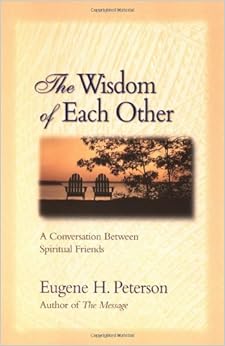
Book Review: The Wisdom of Ourselves

The Wisdom of Each Other: A Conversation Between Spiritual Friends (1998) by Eugene Peterson is a unique, though beneficial, book. It is unique because it contains a series of letters addressed to Gunnar Thorkildsson, whom Peterson described as "not an actual person with an existence documented by birth certificate and social security number", though Peterson insists that the details were grounded in actual encounters he had over the years.

In each of the several dozen letters Peterson penned, he responded to some actual circumstance of Gunnar's life--return to the faith, the poor quality of too much Christian literature, church politics, and the tranquility of canoeing. The unifying theme, as far as I am concerned, is a spirituality that does not exist above everyday life but rather enters into it and moves around in it. Peterson wisely showed us that. Although not my favorite book by Peterson, it is a welcome addition to my collection.

19 October 2015

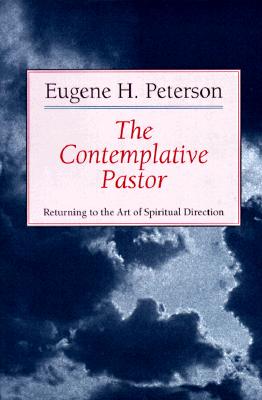
Book Review: The Contemplative Pastor

There are few writers I enjoy more than Eugene Peterson. His love for God, for people, and for language routinely meet on the pages of his books. His work should be tasted and savored, but I find it difficult not to binge on his writings. Not surprisingly, Peterson exploring "the Art of Spiritual Direction" in The Contemplative Pastor (1989) was a book that I had a hard time setting down.

The Contemplative Pastor is broken into three sections. In the first, "Redefinitions," Peterson explored three descriptors for a pastor: unbusy, subversive, and apocalyptic. I was recently moved by his description of the "unbusy pastor" in his later memoir The Pastor and had some familiarity with the idea of the apocalyptic pastor. Briefly, in Peterson's thoughts, pastors should be characterized by settledness, margin, and patience, working without frenzy in the day to day life of the church and of the world.

The second section--the longest--is called "Between Sundays". Peterson meaningfully argues that much, if not most, of the work of the pastor takes place from Monday to Saturday. The nine chapters here are built around the beatitudes with an eye toward soul care. Each chapter begins with a poem and then moves into the realities of spiritual direction, exploring themes such as creation, prayer, language, small talk, and suffering.

The final, albeit too brief, final section contains a number of poems about the incarnation. Peterson asked, "is it not significant that the biblical prophets and psalmists were all poets?" To answer his rhetorical question, yes, I believe it is significant. Words matter.Words convey truth, but they also convey beauty.

Like his previous works The Contemplative Pastor by Peterson is a joy to read, whether or not you are a pastor.

05 October 2015

Of Thinking Humbly of Ourselves-a'Kempis

I finally started reading The Imitation of Christ by Thomas a'Kempis (1380 - 1471). I only made it as far as chapter 2 before I stopped to ponder. These words captured my attention and convicted my spirit. I have updated and paraphrased the language from the version I have to improve readability so thou art not plagued with obfuscation.

All men naturally desire to know (Ecc 1:13); but what good is knowledge without the fear of God? Surely a humble husband that serves God is better than a proud philosopher that, neglecting himself, labors to understand the course of the heavens. The man who knows himself well is lowly in his own sight and does not delight in the praises of men. If I understood all things in the world, yet were not charitable what would that help me in the sight of God, who will judge me according to my deeds? [I have a theological quibble with this statement, a point I would want to clarify, but I will leave it aside for just now]

Stop obsessively trying to know so much, because when you do, you are distracted and deceived. Learned men are happy to be seen as smart to others and to be considered wise (1 Cor 8:1). There are many things that you can know about that do not profit your soul and the man who focuses upon those other things, but ignores his salvation, is very unwise. Reading many words does not satisfy the soul; but a good life comforts the mind and a pure conscience gives great assurance in the sight of God. 

The more you know and the better you understand, the more severely you will be judged, unless you also grow in holiness. Do not be proud for any art or science that you know, but rather let your knowledge make you more humble and cautious. If you think you know a lot, realize that there is a lot you don't know. Don't pretend you are smarter than you are; rather, acknowledge your ignorance (Rom 12:16). Why would you prefer yourself before others since there are many who are smarter and more skillful in the Scriptures than you are? If you want to profit from what you learn, desire to be unknown, to be little esteemed before man. 

The highest, most beneficial reading is to truly know ourselves. True wisdom and perfection are to know that of ourselves, we amount to nothing, but instead to think well of others. If you see someone else sin, don't think to highly of yourself because you don't know how long you will be able to remain in good estate. 

We are all frail (Gen 8:21), but you ought to hold none more frail than yourself. 

04 September 2015

Book Review: The Way of the Heart

Flee, be silent, pray always, for these are the sources of sinlessness.-Abba Arsenius

The Way of the Heart: The Spirituality of the Desert Fathers and Mothers (1981) by Henri Nouwen is a short book with deep impact. At just 96 short pages, Nouwen provides much to think about. In essence, Nouwen examined the importance of solitude, silence, and prayer through the lenses of the desert fathers, Christians who lived in the Egyptian desert during the 4th and 5th centuries.

Flee--In the first section, where Nouwen addressed the importance of solitude, he began by telling of St. Anthony who apparently lived in complete solitude in the desert for 20 years. Nouwen uses Anthony's experience as a call to solitude for the modern Christian. He contends that solitude is a direct key to developing compassion.

Be silent--Silence often goes hand in hand with solitude. Living in the 21st century, we are bombarded with noise, and sounds, and words. In our loquaciousness, words have been drained of their power. The person who practices silence guards his tongue and also learns to speak with meaning. Nouwen writes, "It is a good discipline in each new situation if people wouldn't be better served by our silence than by our words" (p. 65).

Pray always--In the final section, Nouwen addresses the pray of the heart, which he differentiates from prayers of the mind that dominate many of our prayer lives. Learning to enter the presence of God, to pray with our whole lives, flows from solitude and silence.

On the whole, I liked this book. I think there is a lot of wisdom to glean from this book. However, though I agree that there is much benefit to the practice of solitude, I do not believe that living in complete isolation, such as St. Anthony did for decades, is as God intended. We were created to relate, so seeking long term isolation seems contrary to God's Word.  With that modest caution, reading this book is definitely worthwhile. 

02 September 2015

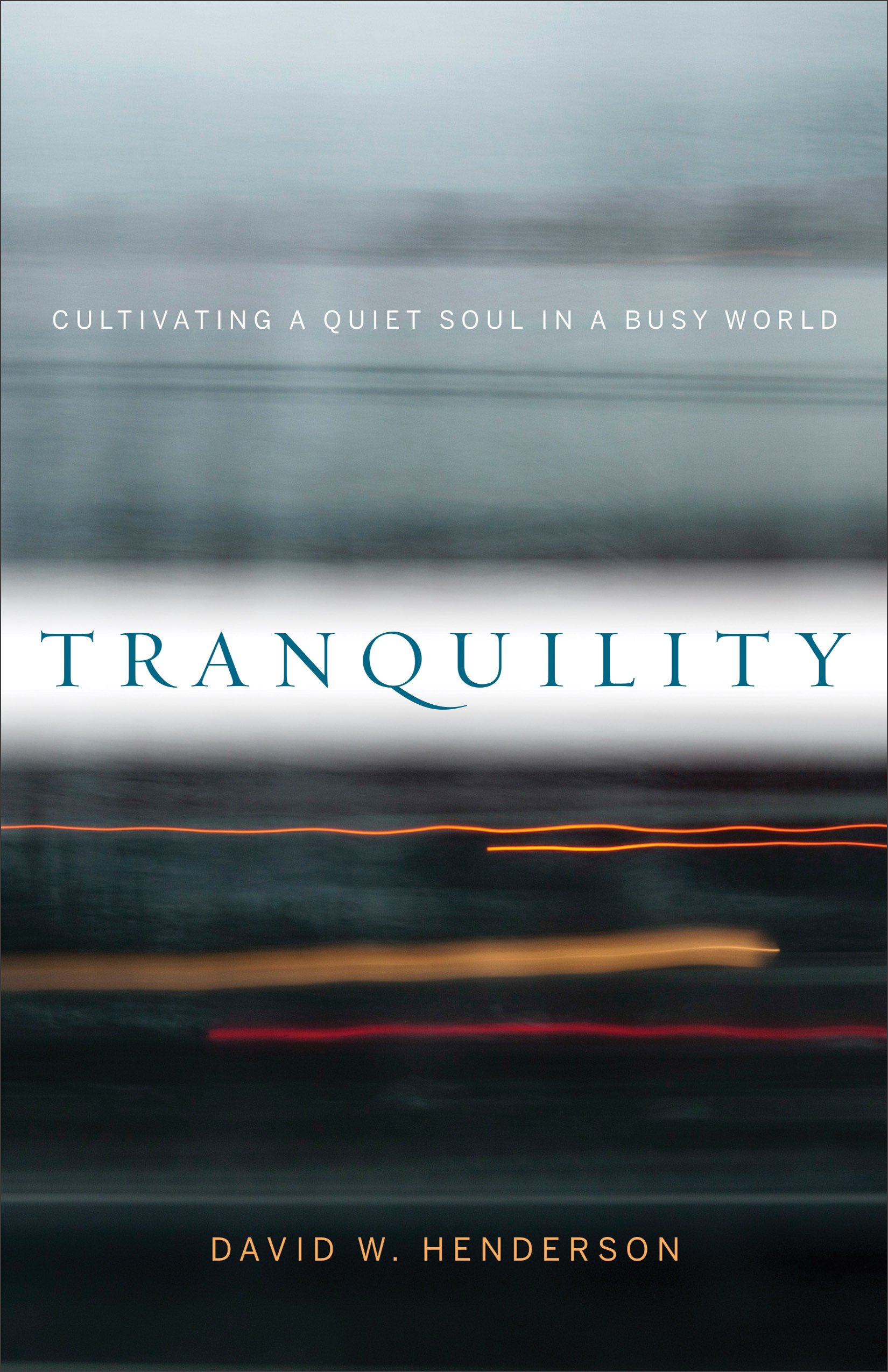
Book Review: Tranquility

Tranquility: Cultivating a Quiet Soul in a Busy World (Baker Books, 2015) by David W Henderson addresses an important topic, the noisiness of life that too often invades our souls. On page 3, he introduced the book in this way: "Instead of asking, 'How do we manage time?' this book asks, 'How do we manage ourselves as people who are ever in time's flow?' It is about perspective and focus, yieldedness and willingness, quiet and silence, putting first the things that should be first, waiting and trusting and resting."

For those of us living in Western cultures, busyness defines much of our lives. We race from one task to the next, seemingly eager to fit yet more activity into schedules. In fact, it is arguable that not only does busyness define our lives, it is often viewed as a personal strength. Efficiency, something I have long prided myself on, is seen only for its benefits. We are encouraged to do more faster and better. But what if busyness damages us and our relationships? In the beginning of the book, Henderson explores with the reader some of the problems with hurry which range from relational to medical (i.e., the "Type A" personality).

In the remainder of the book, he explores ways in which we can begin to redeem time, not by becoming more efficient, but by quieting our souls.  He helps the reader to see who we are in relation to God and others. He explores the biblical basis for sleep and rest, calling the reader to view the Sabbath as a gift.

On the whole, this is a readable, enjoyable and important addition to the growing spiritual formation literature. If you are someone who, like me, has struggled with quieting my soul, consider reading Tranquility.

I received a free copy of this book from Baker Books in exchange for this review. I was not required to submit a positive review. The views expressed above are my own.  

16 August 2015

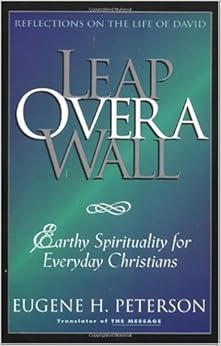
Book Review: Leap Over a Wall

As I was reading Eugene Peterson's Leap Over a Wall: Earthy Spirituality for Everyday Christians (1997) two thoughts kept resurfacing. First, I really think someone should seriously consider making a Braveheart style about the life of David. Second, I think more people need to read the writings of Eugene Peterson.

In Leap Over a Wall, Peterson explored the life of David, not as the model life, but as the normative life of a believer, at least in some regards. He wrote, "Life isn't an accumulation of abstractions such as love and truth, sin and salvation, atonement and holiness; life is the realization of details that all connect organically, personally, specifically: names and fingerprints, street numbers and local weather, lamb for supper and and a flat tire in the rain" (p. 3). The Bible is story--a true story to be sure, but a story that communicates truths about God and about us. The details of David's life provide one of the most extensive narratives to understand what life before God looks like.

One of the things I most appreciate about Peterson's writings is the way he is able to take a passage and wring out truths that map on to real life. He sees things in story that I miss. He cleans my interpretive lenses. He walks me into the story in a way that I can smell the air at Brook Besor and can feel the emotion of a kneeling Abigail. Leap Over a Wall is another strong addition to the Peterson corpus.

21 October 2014

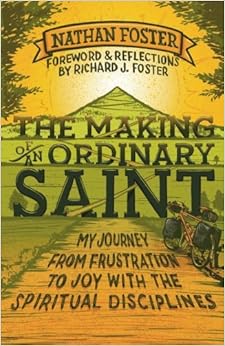
Book Review: The Making of an Ordinary Saint

The spiritual disciplines are a curious thing to me. I have read numerous books about them over the years, but I have never been quite sure what to do with them. The message that I seem to hear from the conservative side of evangelicalism with which I would align myself would suggest that spiritual disciplines can be a dangerous business if improperly understood. And yet, I have read many books about them. When I saw The Making of An Ordinary Saint: My Journey from Frustration to Joy with the Spiritual Disciplines (2014) by Nathan Foster, I was intrigued. Certainly, as a "Foster", the child of author Richard Foster, he has a regal lineage. Honestly, though, the book cover was just as inviting and a wise choice by the publisher.

In the book, Foster set out to explore twelve spiritual disciplines--those initially described by his father in the Celebration of Discipline--stitched to his everyday life. This approach allowed for an honest, autobiographical description of the spiritual disciplines in his life. Foster shared his challenges and new understandings in an engaging way.

As I read the book, I was deeply affected by some of his chapters, but with others, I was less engaged. The chapter on submission was my favorite. I could find myself easily connecting with what he was saying about some of the frustrations he experienced, but was drawn to his description of an Eskimo man who didn't fit the mold of the bike racers he was with. I also learned from the other chapters as well.

One of the criticisms that Foster anticipated was hearing from fundamentalists...like me, I suppose.  On page 143, he wrote "While I try to remain teachable and open to the insights of others, I'm finding I have little interest in learning from extreme fundamentalists whose lives and careers are based on criticizing others--you know, those people who call themselves Christians but seem to know nothing of love." I wonder if Foster cuts himself short. I share a concern for a lack of love, but I also share a concern for truth. There is an old proverb that says, "don't become so open minded that your brains fall out." I wonder if Foster's unwillingness to learn from those whom he considers unloving is actually an unloving thing to do.

On the whole, this is a good book and I would commend it. Foster is a captivating writer and tells his story well. 

A review copy of this book was provided to me by Baker Books in exchange for this review. I was not required to submit a positive review of this book.

09 August 2014

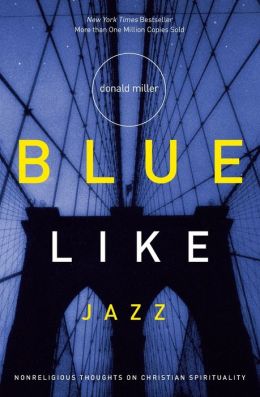
Book Review: Blue Like Jazz

I didn't want to like Donald Miller's Blue Like Jazz (2003). As a conservative, evangelical Christian, I had implicitly and explicitly heard over the last 10 years that this was a dangerous book and that it was probably best if I just avoided it. A few months ago, I finally gave in and picked up a copy at a thrift store in town. I left it on my shelf for a while, but last week, I decided to wade in.

Blue Like Jazz is a memoir of sorts, Miller's wrestlings with the fundamentalist tradition in which he was raised and the Christian Spirituality to which he was drawn. His focus was primarily upon the years of early adulthood, which are formative for all of us.  With paper and ink, he poignantly described his journey.

There were many things I liked about this book.  Miller appears to write with transparency, authenticity, and honesty.  He puts into print questions that many Christians ask of themselves and others. And then he wades through them. 

His commitment to the Gospel message and to following Jesus come through on nearly every page, yet he willingly admits his stumbling on the journey.  For example, on page 111, he wrote "Tony asked me one time if there was anything I would die for. I had to think about it for a long time, even after thinking about it for a couple of days, I had a short list. In the end there weren't very many principles I would die for. I would die for the gospel because I think it is the only revolutionary idea known to man." However, he also admits that it is difficult for him to evangelize. He is a man of apparent contrasts.

He also wrote a lot about spending time with sinners. Sinners! As a student at Reed College in Portland, apparently one of the most liberal colleges in the the United States, and afterwords living in the woods, he had friends who were pot-smoking, promiscuous hippies. And yet, he still hung around with them. What would Jesus say about someone who hung around with non-religious sinners?

I also appreciated his stance on the importance of community. He admits that he can be somewhat of a recluse, describing himself as a battery for a power tool that needs 20 hours to recharge for 10 minutes of use. And yet, he was intentional about community. (If I recall, he has more recently gone on record saying he doesn't really need church and I would like to ask him how this new stance fits with his previous thoughts).

I can also see where people have had concerns. For one thing, it appears that he is comfortable with faith being based upon feeling and downplaying the importance of cognition/logic. I am someone who believes that Christian theism is intellectually defensible, yet I agree with him that rarely will an intellectual defense get someone to the cross. Ravi Zacharias, a speaker Miller really appears to like, has described an intellectual defense of the faith as "brush clearing", getting arguments out of the way so that people can see the cross. For me personally, I do think feeling is important, but so is cognition and volition.

There also seemed to be glimpses of intellectual superiority. Miller would write about Republicans or fundamentalists with some veiled derision. I found myself wondering if he was aware of this tendency in himself. I suspect he is, and if I were to point it out to him, I suspect he would look at me and say, "Jason, you are right on."

In sum, I liked this book.  As Tim Challies wrote on his review 9 years ago, "Despite my misgivings, I found that I enjoyed this book more than I thought I might." For me, this book is a good reminder of why it is often beneficial for us to grapple with other people's works for ourselves rather than simply rely exclusively upon the insights of those who think like us. Despite some points of disagreement, Miller appears to love the Jesus of the Bible and shows him to us through this book. 

24 July 2014

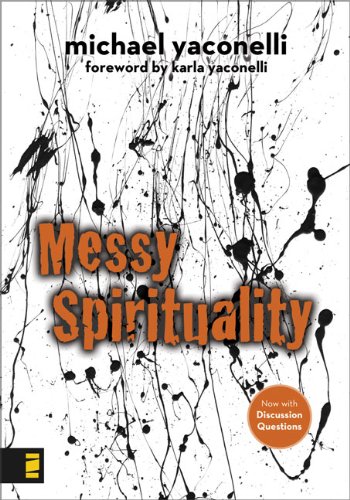
Book Review: Messy Spirituality

I heard my friend Mark mention Mike Yaconelli's Messy Spirituality (2002, Zondervan) a couple of times and I liked what he mentioned. I stumbled upon a basically new edition of the book in a local used bookstore, pulled out my 2 bucks, and went home with my purchase. It was 2 bucks well spent; even the listed cover price would be appropriate for this gem.

Messy Spirituality is not a book for those who have it together in their spiritual lives. It is not for those who are pretty good at Christianity. It is not for straight-laced, well-behaved people who like their Christianity easily definable and controllable. Rather, it is a book for sinners, wretches, and rogues who have no hope apart from Jesus who loves them and lavishes them with grace.

This book will make a lot of people uncomfortable, especially the new radical believer who thinks that now that they are saved it will be all good days ahead and sin won't really be a problem anymore. A few years ago, I suspect it may have unsettled me.  If I am honest, there are still parts of what Yaconelli writes that make think, "can that be true?" Regardless, reading this books message of amazing grace makes me want to dance with joy. Yaconelli demonstrates how radically loving Jesus is right in the midst of our mess.

04 July 2014

Book Review: Opening to God

If you're idea of prayer is that you bring a list of petitions to God during your morning devotions, Opening to God: Lectio Divina and Life as Prayer (2010) by David Benner may challenge your understanding of prayer.  Benner, a psychologist and spiritual guide, certainly acknowledges the necessity of petitionary prayer, but in this book, he presents an extended reflection on why prayer is not just that. 

Building upon the ancient practice of lectio divina (sacred reading), Benner suggests several different ways in which the Christian's prayer life may be transformed.  For those unfamiliar with lectio divina, it traditionally consists of 4 movements--lectio (reading), meditatio (meditation), oratio (prayer), and contemplatio (contemplation). It was developed as a way to engage holy scripture.  Benner has expanded this idea into the world of prayer. The pray-er may engage in several different practices including: prayer as attending, prayer as pondering, prayer as responding, and prayer as being.  As he describes how each of these approaches may be practiced, he shatters the notion of prayer simply as supplication. 

There is much to commend about this book.  I think many Christians, like me, have a stunted concept of prayer. Opening to God will assuredly push your boundaries of understanding what a life of prayer can look like. On the other hand, Benner's apparent full acceptance of the contemplative tradition including "emptying ourselves" seems at times to have more connection with Eastern spirituality than with orthodox Christianity.

On the whole, I would happily commend this book for those who feel stagnant in their prayer lives and hope to grow in relationship with God.

29 June 2014

Book Review: Water From a Deep Well

Water From a Deep Well: Christian Spirituality From Early Martyrs to Modern Missionaries (2007, IVP) by Gerald Sittser was an excellent book, but perhaps a bit difficult to classify.  It is part church history, part Christian spirituality, and part practical living. In engaging prose, Sittser explores the history of Christianity, stopping along the way to reflect on what lessons we have learned from those who have gone before. He effectively shows different movements over the history of the church: the witness of the early Christian martyrs, the belonging of early Christian community, the struggle of the desert saints, the rhythm of the monastics, the holy heroes celebrated in the eastern church through biography and iconagraphy, the importance of the sacraments during the Gothic period, the importance of ordinariness among medieval lay people, the importance of the Word to the reformers, the centrality of conversion to evangelicals, and the essence of risk to pioneer missionaries. As you can imagine this book is sweeping and ecumenical in its scope.  Though Sittser highlights components that featured centrally in different movements of the church, there is no doubt overlap. 

Sittser wisely not only identifies the positives that modern Christians can learn from each of these periods or modes of spirituality, but also points to their potential risks and abuses. For example, during certain movements of the church, it was considered more spiritual to abstain from sexual relations, and some couples would make vows of chastity within their marriages.  Broadly, it seems that any of these approaches, taken to the extreme, lead to rather significant legalism, which Sittser explicitly shows.

There is material here to challenge all. There are things here that will resonate deeply with most Christians and things that may unsettle them.  Regardless, there is much for all to learn. 

On the second to last page, Sittser wrote, "The church as a community, however, is capable of advancing the cause of the kingdom, if only just a little. Through sheer numbers alone that 'little' can amount to 'much.' There are well over 150 million Christians in America (out of some two billion in the world), though of course not all are serious about their faith. What if just one third of those--50 million--began in modest ways to live more earnestly and deliberately for the kingdom? What if these believers consecrated their lives to God, began to practice spiritual discipline and committed themselves to serve God's kingdom? Just one hundred extra dollars a year would provide 5 billion dollars to help fight AIDS in Africa and battle sex trafficking in Asia. Just one hundred extra hours a year (only two a week!) would provide 5 billion volunteer hours to man soup kitchens in cities and pound nails for Habitat for Humanity. Just ten letters a year would send five hundred million pieces of mail to Washington to lobby for worthy causes. What if ordinary Christians used a little less water every day, consumed less energy and ate healthier food, recycled more conscientiously, purchased fair trade products, rode buses more often, and invested in just one cause outside their normal routine? Churches move slowly, just like glaciers, which is why activists become so impatient. But when they do change, they can become as powerful as an advancing glacier that sweeps away everything in its path. In the end, slow, incremental, concrete change might be the most effective kind" (page 294). 

Read this book. I promise you won't agree with everything, but you will benefit.

03 April 2014

New Way Ministries School of Spiritual Direction

Dr Crabb and Me.  I am a giant.
Last week, I attended the School of Spiritual Direction in Asheville, North Carolina. This week long school is offered by Larry Crabb and New Way Ministries. Dr Crabb is a clinical psychologist who is a popular speaker and author. About 20 years ago, he had a significant change in his thinking about what constituted helping or "soul care."

Dr Crabb has shifted from a counselor/counselee model to a focus on "conversations that matter" that can, and should, occur between believers. He describes wise conversations between pilgrim's on the way. There are none who have arrived in and of themselves; each faces his or her own brokenness.  Along with about 30 other people, we learned about what it meant to have conversations that matter.

I wasn't sure what to expect, but it is fair to say that I have not experienced anything quite like this event. We were given a binder full of notes, but we rarely looked at it. Dr Crabb encouraged us not to get bogged down in taking notes. Rather, I would describe the week as a series of conversations--sometimes with the whole group and sometimes one on one.

Over the week, each day had a rhythm of sorts. After breakfast, we would meet as a group from 9 until noon. This time involved worship, devotional thoughts from Dr Crabb, and his explanation of how he envisions having these conversations. His approach is very conversational, engaging the class with his stories and ours. He was very good at drawing people out.

The afternoons consisted of work in small groups of 3 or 4 where we were able to share one another's stories on most days. One afternoon was dedicated to meeting with Dr Crabb or one of the other directors. I had the pleasure of meeting with Dr Crabb a couple of times, which was helpful in understanding how he approaches spiritual direction. Meeting with 3 others, though was equally useful.

In the evenings, Dr Crabb would spend some more time talking through his model.  Though I would get tired, I always looked forward to the next session. And I never skipped any, which was unique from any other conference that I have attended.

The in between times were spent walking in the woods, visiting with new friends, or resting and relaxing. The beauty of the mountains is unparalleled.

More personally, I wish it were possible to explain the shift in my soul that I experienced when I was there. Spending time meditating on what Dr Crabb shared with me individually and what he talked about in the group has shaken up my thinking, in a positive way. I am eager to see how it affects relationships. Dr Crabb said, "spiritual formation is relational formation."

If you want to talk specifically about the school, or if you have questions, let me know. I would be eager to sit down with you and have a conversation that matters.

24 March 2014

Book Review: The Gift of Being Yourself

The Gift of Being Yourself (2004) by David Benner is a useful little book for those interested in understanding themselves. Benner is a professor of psychology and spirituality who is interested in understanding more than just behavioral change. In this book, he explores John Calvin's dual maxim that as Christians we must come to know God and come to know ourselves. Although this book dedicates a chapter to the former as a necessary requisite for the latter, the majority of the book is committed to helping the reader explore issues of self understanding, which is best accomplished by knowing how we relate to God. In particular, there is a clear call to knowing yourself as one deeply loved by God. Once you realize yourself as one deeply loved, you can then begin to explore your true self--not the self you want others to see--but who you truly are.  This book provides some practical ways to begin this journey. It is readable, engaging, and important.

15 March 2014

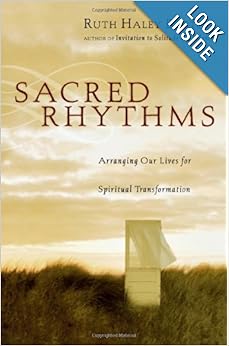
Book Review: Sacred Rhythms

As one who does most of his reading in the reformed tradition, I tend to prefer books that are more cognitively driven. Indeed, some of the new reformed folks seem to discourage the more emotional or mystical writers.  However, Sacred rhythms: Arranging our loves for spiritual transformation (2006) by Ruth Haley Barton was recommended by a colleague of mine who I consider an important mentor, so I took a chance.

Barton is a spiritual director who helps people on their spiritual journeys. In this book, the author helps the reader to explore some of the spiritual rhythms that may help order our spiritual lives. Although there are many spiritual disciplines she could have explored, she focused on: solitude, scripture, prayer, honoring the body, self-examination, discernment, and sabbath.

Every time I read a book like this I get challenged to look at my own "spiritual rhythms." Last fall, for example, I read The Attentive Life by Leighton Ford, another book that challenges one to think through their spiritual journeys.  In Barton's case, I particularly appreciated her description of the Lectio Divina, which is a specific way of reading and approaching Scripture. I am drawn to this method, but I fight against my tendency to want to make sure I am covering enough ground when I read. Ken Boa's description of the Lectio has also been challenging for me.

The chapters this time through that I most resonated with, however, were 5) Honoring the Body, and 6) Self-examination. These are often less discussed in other books on the disciplines. In particular, her recognition of embodied spirituality is an underheard message in modern Christianity, where we often lean toward gnostic tendencies. 

As with any book that veers outside of your typical line of thinking, this one challenged me in ways too.  I found myself wondering exactly where she was going at times, but for the most part, when I stopped to "listen", she would get to a place where what she was making made sense.

I would recommend this book to those interested in learning about things to put into place that might help order it in a Godward fashion.

04 March 2014

Pray for Larry Crabb

This week, a blog post came through from New Way Ministries written by Rachael Crabb, Larry's wife. He has a busy schedule coming up including leading a week long School of Spiritual Direction (that I am scheduled to go to).

Rachael writes,

Dear Prayer Partners,

It has been a long time since you’ve received a Prayer Initiative from NewWay—here is a short, very important one. I wanted to update you about Larry’s latest bout with the gastrinoma/cancer that has settled in his liver again—3 tumors in the liver, two in one lobe and 1 in the other lobe so no invasive surgery! If he had to go under the knife it would be three separate surgeries, with time between each for the resections to be restored. We did not want that invasion but love how God made us, a liver can regrow!

All this has lead up to Tuesday, March 4th, when Larry will have one of the newest procedures done by an interventional radiologist. Dr Stangle will go thru the groin into the liver with a catheter of chemo and inject it into the liver. The doctor trained at Mt Sinai in NYC in this fairly new treatment and said side effects are minimal (out of several 100 Dr S has done he has had 2 patients lose their hair (picturing Larry bald for a time is not a pretty sight). We are hopeful that unseen lesions will be wiped out and kept at bay for a bit with this concentrated chemo (the doctor also told us that he will always have this cancer and it’s not if it will return BUT where it will return). I guess after 17 and 1/2 yrs of dealing with this off and on we are realizing that we are involved in a unseen story being told all around us and are grateful.

A longer prayer initiative will be coming–we have a very busy schedule coming up for NewWay in the next several months (the doctor also told us that Larry needs a week after this procedure to recoup, so we’re giving him 2 weeks before he hits the road running on March 19th) We also like including the many prayer needs and praises you send to us. Know we are grateful for friends who hold up our arms!

With gratefulness to a BIG GOD,
Rachael for Larry and the little team

Pray for healing, but above all that God would be glorified.  

27 January 2014

Book Review: The Divine Conspiracy

If Dallas Willard had a work he was best known for, it was probably The Divine Conspiracy (1998), though he wrote many other books as well. This book is an extended treatise on the Christian life, not as some ethereal or future thing, but as something earthy and present. Willard compellingly looked to the life and teachings of Jesus Christ as informing an actual way to live.  He makes the argument that too often in modern evangelicalism, we look to Jesus as Savior, but have little hope that faith in him will produce any real sense of change.

The middle of the book is an extended treatment of the Sermon on the Mount, what Willard chose to re-title the "discourse on the hill."  Willard looked to Jesus teachings in Matthew 5-7 not as a series of new laws for the Christian to follow but representative of the lives of those who are growing in Christ.  In other words, those connected to the vine will increasingly manifest those things discussed in the discourse. 

The second to last chapter is entitled "A Curriculum for Christlikeness".  To me, this was the strongest part of the book.  Here, Willard took all that he had previously discussed and applied it more directly to the life of the Christian.  Known for his promotion of spiritual disciplines, it is here that he begins to discuss them with some detail, particularly the disciplines of silence, solitude, study, and worship.  He makes a compelling argument for them. 

The Divine Conspiracy is a good book.  Willard's thoughts on the sermon on the mount were informative and worth pondering deeply.  His defense of the disciplines too was useful.  Having said that, I am never quite sure what to make of Willard.  When I read his works or hear him speak, I often find myself wondering about his perspective on certain issues (e.g., is everyone saved?) because he never quite comes around to an answer.  I also worry that some who make it as far as chapter 9 may see a causative, rather than correlative, link between disciplines and holiness that may not be quite so clear.

For the more academically minded, The Divine Conspiracy is worth reading, but for many readers, it will be too much.  If you are interested in spiritual formation and growth in Christlikeness, but are not ready for a heavier work like this, it may be worth reading Willard's book Renovation of the Heart or even John Ortberg's The Life You've Always Wanted, which Ortberg himself referred to as Willard for Dummies, as both books are much more accessible.