I try so hard
To follow God
Hoping He’ll approve;
I fail and fail
Day after day
Condemned by this proof.
“You are welcome.
You are my child.”
Jesus says to me.
“You belong
No matter what.
I’m your identity.
I choose to live
For God above
Not to gain His praise,
I serve Him well
As oft I can
Because He’s given me grace.

Showing posts with label sanctification. Show all posts
Showing posts with label sanctification. Show all posts
18 September 2017

29 November 2016
Athletae Dei

What does it mean to be a Christian? What does it mean to be a disciple of Christ? What is sanctification? What does growth in Christlikeness involve? What is the link between salvation and works? These questions occupy a great deal of my day-to-day thought life. Let me offer a few rambling thoughts and conclude with a parable/metaphor that came to me on my morning commute.
First, I am utterly convinced that salvation is a free gift of God. There is nothing that anyone can do to earn salvation nor even to improve their standing with God. Ephesians 2:8-9 reminds us: "for it is by grace you have been saved, through faith, and this is not your own doing, it is the gift of God." Christ's favor is unmerited. Whoever places their faith in Christ will be saved. Period.
But, unlike the thief on the cross (Luke 23:43), most of us are not immediately headed for glory upon our good confession. God leaves most of us here for some time. In light of that, we are wise to ask, what shall we do with time we are given? How shall we live? These questions place us squarely in the domain of discipleship.
To be a disciple means that we seek to learn from a teacher, in the case of Christianity, Jesus. Disciples try to shape their lives to be more like Christ wants them to be, which he demonstrated by his life and teachings. In other words, they seek to grow in Christlikeness. Although stated above, this point is important enough to be restated: these attempts to grow in Christlikeness do not merit favor with God. Those who have placed their faith in Christ are as approved as they will ever be, which is to say fully approved.
However, even though salvation is by grace alone through faith alone, it does not mean that works are inherently bad or evil. Dallas Willard has famously said, "grace is opposed to earning, not to effort." Indeed, the words of the apostle Paul routinely commend us to to strive for growth in holiness. Why should we do this? Not to earn God's favor, but because it is the best way to live.
Let's see if this story clarifies this thought.
A Parable
Following up on their New Year's resolutions to get healthier, two men joined a gym. Taking advantage of New Year's offering, the first man signed up for the whole year, intent on becoming healthy and strong. The first few weeks, he showed up faithfully. Though he didn't really know what he was doing, he would run on the treadmill and do a few reps on the weight machines. After those first few weeks, life got in the way. His work was busy and after work, he just wanted to come home and crash in front of the TV for a few hours before going to bed.
Also wanting to be healthier, the second man signed up for the whole year. He had chosen his gym after doing quite a bit of research and weighing out the pros and cons. He knew that the gym he joined not only had a variety of exercise options, there were also staff and more experienced athletes who were able to help him to reach his goals. He knew that in order to be successful, he would need to prioritize his time at the gym. In the upcoming year, he developed strong habits. He consistently came to the gym several times a week. If he missed for any reason, he would get back at it, not shaming himself for missing, but keeping his goals in mind. He sought advice from a personal trainer who also helped him to stay motivated and reach his goals.
At the end of the year, the first man gained 15 pounds. He regularly complained of new aches and pains. He felt tired all the time. The second man lost 15 pounds. He felt healthier and better able to handle the daily stresses of life. In the Fall, he reached a long time goal of completing a 5K race. Others took notice of his improved health and he found himself instructing and encouraging others.
Both of these men remained gym members. They both had access to all of the rights and privileges of being a member of the gym. They could take advantage of any of the resources at any time.
But only one became a disciple.
Like most parables, the parallels to real life are imperfect and clumsy at times. Yet, they often make a larger point, in this case, the importance of being a disciple. Jesus was the only one to ever live his life perfectly. Dallas Willard argued that Jesus is the smartest, wisest man who ever lived. If we believe that, we believe that Jesus knows what constitutes the best life because he lived it. If then that is true, it would be unwise for us to merely give assent to his claims without also seeking to live a certain way, Jesus' way.
In 1 Corinthians 9, Paul encourages his readers to become Athletae Dei--athletes for God. Athletes, at least those who want to be successful, go into training. They begin to shape their lives to succeed at their sport. They know that progressive training will be essential to continued success. No one wakes up one Saturday morning and plans to win a marathon that day without training for it. No matter how hard they try, they won't succeed. Training is more essential than trying.
The same holds true for those of us who desire to grow in Christlikeness. We begin to train ourselves to be more and more like Jesus in our thought, word, and deed. We become his students. No one expects an overweight middle age guy to run a marathon, but knows that with training, he probably can. As our teacher, Jesus also knows that we are far from living perfectly, but he is eager to teach us his ways.
Do you not know that in a race all the runners run but only one receives the prize? So run that you may obtain it. Every athlete exercises self-control in all things. They do it to receive an imperishable wreath, but we an imperishable. So I do not run aimlessly; I do not box as one beating the air. But I discipline my body and keep it under control, lest after preaching to others I myself should be disqualified.-1 Corinthians 9:24-27 (ESV)
12 April 2016
We All Bear Growth Rings
I am grateful that the Bible is full of agricultural metaphors, stories, and parables. We read of mustard-seed faith, abiding in the vine, and bruised reeds. Why am I grateful? Agricultural metaphors capture the realities of the sanctification process. Farmers, florists, arborists, and botanists will tell you that plants take time to mature. There are seasons of flourishing, seasons of drought, and seasons of damage.
Have you ever looked at a cross section of a tree? The rings provide a striking visual representation of the tree's development. When you look, you can see seasons of great growth and flourishing. But you can also see seasons where there appears to be almost no appreciable growth. Indeed, there are seasons of disease and infestation and fire that permanently scar the tree, yet often it continues to grow.

Have you ever looked at a cross section of a tree? The rings provide a striking visual representation of the tree's development. When you look, you can see seasons of great growth and flourishing. But you can also see seasons where there appears to be almost no appreciable growth. Indeed, there are seasons of disease and infestation and fire that permanently scar the tree, yet often it continues to grow.

I think God gave us so much botanical imagery because he wanted us to understand that Christian growth is a lifelong process, marked by times of seemingly unrelenting growth, times of stagnation, and times of damage, but God, by His Spirit, continues to grow and mature His children.
I wrote this poem yesterday as I was thanking God for His persistence in my sanctification.
an acorn planted
becomes a mighty giant
...but not today
28 September 2015
A Case for Positive Behavior
Too often, it seems to me, that Christians ask the wrong questions about how to live. We rightly desire to follow Christ and live consistently with Scripture. Unfortunately, we often arrive at questionable conclusions about what is good and right. I want to share a few observations and thoughts.
First, I think we have a propensity to think only in terms of what behaviors are prohibited. We ask things like "does the Bible prohibit premarital sex, smoking marijuana, pornography, gambling, etc.?" We seem to approach God's word with an attitude that says, "just tell me what I can and cannot do and I will seek to live in those boundaries."
Second, we unfortunately think only in terms of behaviors. It seems to me this was one of the primary issues with the Pharisees and Scribes in Jesus' time. They were well-versed in the law and tried to shape their behaviors accordingly, but they ignored the heart and ignored relationships.
Third, we proof text. In other words, we try to build a behavioral code upon verses pulled out of context. Eisegesis is associated with proof-texting. Eisegesis is the process by which we read meaning and our own biases into a scriptural text as opposed to exegesis, which involves trying to arrive at the actual intent of what the Bible is saying.
Finally, we engage in mental gymnastics to justify behavior. We think or say things like "well, I may be looking at pornography, but at least I am not committing adultery." We also live with the attitude that says, "well, I'm saved anyway, so it is okay if I get drunk. God forgives."
So, if those are the wrong, or at least incomplete, approaches, how then shall we live? First, let's stop thinking just in terms of behaviors to avoid. It seems to me that was part of Jesus' point in the Sermon on the Mount. He was teaching his followers that we must go deeper than just avoiding negative behaviors. We must go to the heart. In Luke 10, we read a summary of the law, which tells us to "love the Lord with all of our heart, soul, mind, and strength and to love our neighbor as ourselves." We need to get into the habit of asking "am I being loving?" Another question to ask ourselves in this vein is "Am I living in a self-obsessed, self-centered way OR am I living in a God-obsessed, other-centered way?"
Second, it is important that we try to think not only in terms of isolated verses, but in terms of the whole biblical narrative. Plucking a verse out of Malachi to justify a position is not only unwise, but it can be dangerous. Rather, while considering what specific verses teach, think about it in terms of the whole biblical narrative that recognizes the realities of God's creation, our fallenness, Christ's redemption, and the ongoing work of the Holy Spirit through the body of believers.
Third, if you find yourself having to do all sorts of interpretive gymnastics to justify your position rather than a plain reading of the text, understand that you may be engaging in eisegesis rather than exegesis. Approach Scripture humbly and seek to grow in wisdom. Sit under God's holy word rather than standing above it.
Finally, and this is ultimately my goal, that we would start thinking in terms of positive behavior. In Galatians 5, we read of the fruit of the Spirit--love, joy, peace, patience, kindness, faithfulness, gentleness, self-control. Get into the habit of asking questions like: how can I be most loving in this situation? How can I act kindly? Rather than living from a mindset of finding what behaviors we must avoid, we should get into the habit of asking how can I be most loving toward others and is my behavior glorifying God? Am I seeking to put on the mind of Christ and living in the reality of the indwelling Spirit?
As we seek to grow in Christ let's learn to ask the right questions--not, "is this prohibited?" or "am I allowed to do this?" but rather "is the loving?" and "does this bring glory to God?"
First, I think we have a propensity to think only in terms of what behaviors are prohibited. We ask things like "does the Bible prohibit premarital sex, smoking marijuana, pornography, gambling, etc.?" We seem to approach God's word with an attitude that says, "just tell me what I can and cannot do and I will seek to live in those boundaries."
Second, we unfortunately think only in terms of behaviors. It seems to me this was one of the primary issues with the Pharisees and Scribes in Jesus' time. They were well-versed in the law and tried to shape their behaviors accordingly, but they ignored the heart and ignored relationships.
Third, we proof text. In other words, we try to build a behavioral code upon verses pulled out of context. Eisegesis is associated with proof-texting. Eisegesis is the process by which we read meaning and our own biases into a scriptural text as opposed to exegesis, which involves trying to arrive at the actual intent of what the Bible is saying.
Finally, we engage in mental gymnastics to justify behavior. We think or say things like "well, I may be looking at pornography, but at least I am not committing adultery." We also live with the attitude that says, "well, I'm saved anyway, so it is okay if I get drunk. God forgives."
So, if those are the wrong, or at least incomplete, approaches, how then shall we live? First, let's stop thinking just in terms of behaviors to avoid. It seems to me that was part of Jesus' point in the Sermon on the Mount. He was teaching his followers that we must go deeper than just avoiding negative behaviors. We must go to the heart. In Luke 10, we read a summary of the law, which tells us to "love the Lord with all of our heart, soul, mind, and strength and to love our neighbor as ourselves." We need to get into the habit of asking "am I being loving?" Another question to ask ourselves in this vein is "Am I living in a self-obsessed, self-centered way OR am I living in a God-obsessed, other-centered way?"
Second, it is important that we try to think not only in terms of isolated verses, but in terms of the whole biblical narrative. Plucking a verse out of Malachi to justify a position is not only unwise, but it can be dangerous. Rather, while considering what specific verses teach, think about it in terms of the whole biblical narrative that recognizes the realities of God's creation, our fallenness, Christ's redemption, and the ongoing work of the Holy Spirit through the body of believers.
Third, if you find yourself having to do all sorts of interpretive gymnastics to justify your position rather than a plain reading of the text, understand that you may be engaging in eisegesis rather than exegesis. Approach Scripture humbly and seek to grow in wisdom. Sit under God's holy word rather than standing above it.
Finally, and this is ultimately my goal, that we would start thinking in terms of positive behavior. In Galatians 5, we read of the fruit of the Spirit--love, joy, peace, patience, kindness, faithfulness, gentleness, self-control. Get into the habit of asking questions like: how can I be most loving in this situation? How can I act kindly? Rather than living from a mindset of finding what behaviors we must avoid, we should get into the habit of asking how can I be most loving toward others and is my behavior glorifying God? Am I seeking to put on the mind of Christ and living in the reality of the indwelling Spirit?
As we seek to grow in Christ let's learn to ask the right questions--not, "is this prohibited?" or "am I allowed to do this?" but rather "is the loving?" and "does this bring glory to God?"
05 March 2015
Book Review: Practice Resurrection
Practice Resurrection: A Conversation on Growing Up in Christ (2010) is the final book in the 5-volume spiritual theology series by Eugene Peterson. In the book, Peterson explores growth in Christ and character formation for the Christian by going slowly through Paul's letter to the Ephesians. In the introduction, Peterson wrote, "Evangelism is essential, critically essential. But is it not obvious that growth in Christ is equally essential?" In evangelical circles, I think we can become easily unbalanced in this way, and this book serves to "true the wheel" a bit.
The way in which Peterson writes reminds me of the pleasure of a slow stroll with a learned man. As we walk, he stops to point out things that he sees and those things may remind him of something else, which enriches the experience. His knowledge is broad and his insights welcome.
There is so much to commend about this book, though I would leave with just a few short words from the author himself.
"In fifty years of being a pastor, my most difficult assignment continues to be the task of developing a sense among the people I serve of the soul-transforming implications of grace--a comprehensive, foundational reorientation from living anxiously by my wits and muscle to living effortlessly in the world of God's active presence. The prevailing North American culture (not much different from the Assyrian, Babylonian, Egyptian, Persian, Greek, and Roman cultures in which our biblical ancestors lived) is, to all intents and purposes, a context of persistent denial of grace" (p. 96).
"'Be subject to one another.' Maturity is not analogous to a body-building regimen in which we lift weights to build our muscles to the max, and then periodically stand before a mirror to examine our progress. Maturity is not a solitary state; it is relational. Maturity does not come about by making the most of ourselves; it is making the most of personal relationships. We don't do that by becoming stronger than the other, overpowering him or her, dominating either emotionally or physically. We don't impose ourselves. We enter into another person's life sharing both weakness and strength. We enter the life of another, but we don't force the entrance. Mutuality is always involved in 'be subject.'" (p. 234)
"There is more to church than sermons and sacraments, theology and liturgy, Bible studies and prayer meetings, committee minutes and mission statements. There are names, meals, small talk, births, deaths. There is us. Conversation is the form that language takes when the persons of the Trinity and the persons of the congregation are in the same room. The 'everything' that Tychicus will have to say to the Ephesians is no insignificant part of what it means to be the church. And you and I are Tychicus" (p. 271).
If you have the time and are willing to put in some thought work, I would strongly recommend this excellent series of books. Practice Resurrection, however, is a great capstone on the series. A book by one of my favorite authors about my favorite book of the Bible is a welcome addition to my library and one I will no doubt reference often in the future.
The way in which Peterson writes reminds me of the pleasure of a slow stroll with a learned man. As we walk, he stops to point out things that he sees and those things may remind him of something else, which enriches the experience. His knowledge is broad and his insights welcome.
There is so much to commend about this book, though I would leave with just a few short words from the author himself.
"In fifty years of being a pastor, my most difficult assignment continues to be the task of developing a sense among the people I serve of the soul-transforming implications of grace--a comprehensive, foundational reorientation from living anxiously by my wits and muscle to living effortlessly in the world of God's active presence. The prevailing North American culture (not much different from the Assyrian, Babylonian, Egyptian, Persian, Greek, and Roman cultures in which our biblical ancestors lived) is, to all intents and purposes, a context of persistent denial of grace" (p. 96).
"'Be subject to one another.' Maturity is not analogous to a body-building regimen in which we lift weights to build our muscles to the max, and then periodically stand before a mirror to examine our progress. Maturity is not a solitary state; it is relational. Maturity does not come about by making the most of ourselves; it is making the most of personal relationships. We don't do that by becoming stronger than the other, overpowering him or her, dominating either emotionally or physically. We don't impose ourselves. We enter into another person's life sharing both weakness and strength. We enter the life of another, but we don't force the entrance. Mutuality is always involved in 'be subject.'" (p. 234)
"There is more to church than sermons and sacraments, theology and liturgy, Bible studies and prayer meetings, committee minutes and mission statements. There are names, meals, small talk, births, deaths. There is us. Conversation is the form that language takes when the persons of the Trinity and the persons of the congregation are in the same room. The 'everything' that Tychicus will have to say to the Ephesians is no insignificant part of what it means to be the church. And you and I are Tychicus" (p. 271).
If you have the time and are willing to put in some thought work, I would strongly recommend this excellent series of books. Practice Resurrection, however, is a great capstone on the series. A book by one of my favorite authors about my favorite book of the Bible is a welcome addition to my library and one I will no doubt reference often in the future.
24 January 2014
Book Review: Risky Gospel

In the opening chapter, Strachan diagnoses what he sees as the problem, a church that is scared of confrontation and desires above all to be safe. Having observed many believers, including myself, I think he is an astute diagnostician, though if we are to be honest, it is not a difficult diagnosis to make. Having pointed out our fear, he begins to lay groundwork for how Christians might begin to risk it all for the sake of the gospel. On page 29, he wrote, "we are saved not so we can hedge our bets. We are saved to put everything on the table for God"
I appreciated several things about this book. Throughout the book, but particularly in the chapter "Risky Identity", Strachan seeks to remind us who we are in Christ. We are not just forgiven, we are new creations in Christ who are more than conquerors. In that context, he offers a bold push-back against the view that even though we are saved, we are always going to be a mess, while at the same time acknowledging that we will always be sinners.
In the later two-thirds of the book, Strachan explores what this "risky identity" means for the Christian life. He examines risky spirituality, risky families, risky work, risky church, risky evangelism, risky citizenship, and risky failure. Each of these represent aspects of the Christian's life where being a bold gospel witness is important. In each of the chapters, Strachan briefly established the theology behind his thinking and provided poignant examples before he moved on to much more practical advice. For example, when he exhorts the reader to develop risky families, he provides a number of practical steps that people can implement to grow that area. This is one of the greatest strengths of the book. In fact, the practicality of his writing often brought to mind specific people that I know who would benefit from certain concepts, myself included.
Their is not much that detracts from this book. By the end, the notion of "risky" felt a bit overwrought much like John Piper's "future grace" in his book by the same name, but I understand how it becomes part of the branding and central theme flowing throughout.
Strachan is a strong writer and communicator. I have been blessed to read things he has written in the past and this book is equally engaging.
I received this book free from the publisher through the BookSneeze.com® book review bloggers program. I was not required to write a positive review. The opinions I have expressed are my own. I am disclosing this in accordance with the Federal Trade Commission’s 16 CFR, Part 255: “Guides Concerning the Use of Endorsements and Testimonials in Advertising.”
26 December 2013
Book Review: The Enemy Within
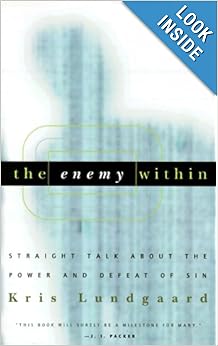 The Enemy Within: Straight Talk About the Power and Defeat of Sin (1998) by Kris Lundegaard is a remarkable little book. Channeling the wise Puritan John Owen, Lundegaard wrote 150 very practical pages on overcoming the power of sin in the life of the believer. He described the influence of John Owen in his life and thinking about sin but, like most of us, found Owen to be a cumbersome read. Owen is a lot of work; thankfully Lundegaard is not. He took the wonderful ideas of Owen and unabashedly re-worked them for the modern believer and did so commendably.
 He opened the preface with these words: "'If God has redeemed me from sin, and given me His Holy Spirit to sanctify me and give me strength against sin, why do I go on sinning?' This question has plagued me throughout my life of faith. In my lowest moments it has brought despair; it has even darkened the edges of my brightest times (p. 13). Who of us, if we take sin seriously, has not struggled with similar thoughts. Lundegaard takes the rest of the book to explore the hold that sin has over us and the power of Christ to help us to overcome. Lundegaard has provided a useful, readable volume that provides resources against sin and a simple introduction to Owen.
Now, to pull Owen off my shelf and try him again.
03 December 2013
Book Review--Christian Spirituality: 5 Views of Sanctification
A friend of mine, Eric Johnson, recommended the book Christian Spirituality: Five Views of Sanctification, which was edited by Donald Alexander (1988). Representatives from Lutheran (Gerhard Forde), Reformed (Sinclair Ferguson), Wesleyan (Laurence W Wood), Pentecostal (Russell P. Splitter), and Contemplative (E. Glenn Hinson) traditions were represented. Each author provided an explanation of how their tradition, from their viewpoint, understands the process of sanctification. Each of the other authors then offered a response to the primary essays.
 Unsurprisingly, I found myself resonating with both the Lutheran and Reformed viewpoints. I had already heard excellent things about Forde's chapter on the Lutheran view of sanctification. As I anticipated, his was a grace saturated chapter. He views sanctification as an issue of getting used to our justification and so, in the words of Luther, "to progress is to begin again" or as Jerry Bridges might say, "we need to preach the gospel to ourselves every day. Ferguson was clearly grounded in the Calvinist, reformed tradition. Strong emphases were placed upon the sacraments, the Word, and union with Christ.
The Wesleyan and Pentecostal traditions made much less sense to me, at least in terms of how I understand scripture. Both talk about a strong move toward holiness, which is a good thing, but they seem to be very man centered in their understanding. Further, each speaks about the notion of second blessing or a second filling of the Spirit, for which I see no scriptural support. To me, these viewpoints leave people feeling hopeless.
I need to spend more time contemplating the contemplative tradition. One of the things I have appreciated about the contemplative tradition is that there is a focus on the affective or "carditive" aspects of faith rather than just the cognitive aspects. We could all grow by understanding the emotional side of the faith better.
On the whole, this is a good book to help people think through what does sanctification mean. Several of the essays are compelling and allow the reader to think about what does sanctification actually mean, hopefully to make a biblically informed decision.
 Unsurprisingly, I found myself resonating with both the Lutheran and Reformed viewpoints. I had already heard excellent things about Forde's chapter on the Lutheran view of sanctification. As I anticipated, his was a grace saturated chapter. He views sanctification as an issue of getting used to our justification and so, in the words of Luther, "to progress is to begin again" or as Jerry Bridges might say, "we need to preach the gospel to ourselves every day. Ferguson was clearly grounded in the Calvinist, reformed tradition. Strong emphases were placed upon the sacraments, the Word, and union with Christ.
The Wesleyan and Pentecostal traditions made much less sense to me, at least in terms of how I understand scripture. Both talk about a strong move toward holiness, which is a good thing, but they seem to be very man centered in their understanding. Further, each speaks about the notion of second blessing or a second filling of the Spirit, for which I see no scriptural support. To me, these viewpoints leave people feeling hopeless.
I need to spend more time contemplating the contemplative tradition. One of the things I have appreciated about the contemplative tradition is that there is a focus on the affective or "carditive" aspects of faith rather than just the cognitive aspects. We could all grow by understanding the emotional side of the faith better.
On the whole, this is a good book to help people think through what does sanctification mean. Several of the essays are compelling and allow the reader to think about what does sanctification actually mean, hopefully to make a biblically informed decision.
24 May 2013
To be struggling is to be living
Comfort is a pursued virtue in most of our lives. We seek to avoid pain and displeasure as much as we possibly can. Anything the produces the least bit of discomfort in us must be rejected as bad. Christians also fall prey to this tendency. At least I do. It is very easy for me cozy up to my sinful behaviors because I presume that the ideal position is one of comfort or personal satisfaction. Whenever I have given in to overeating, lustful thoughts, or even impatience it is because that which I choose is immediately more comfortable and pleasurable. In fact, I would go so far as to say that when I am struggling against sin, particularly the lusts of the flesh, I find myself asking "why is this so hard? God behaving well shouldn't be this difficult. I must be doing something wrong."
 However, as I read the Bible, I think the struggle is a part of the normal experience. Fighting sin reminds us that we are alive. This morning, I was reading Romans 12 and verse 1 reads "I appeal to you therefore, brothers, by the mercies of God, to present your bodies as a living sacrifice, holy and acceptable to God, which is your spiritual worship." Present my body as a living sacrifice. It seems to me that a sacrifice involves giving of oneself, even painfully giving. This is spiritual worship.
Hebrews 12:4 is even more bold: "In your struggle against sin you have not yet resisted to the point of shedding your blood." I have never struggled against my sin to the point of shedding blood, so I have struggled hard enough. To be struggling is to be living. Never give up. Never, never, never give up, as Winston Churchill said.

Hebrews 12:4 is even more bold: "In your struggle against sin you have not yet resisted to the point of shedding your blood." I have never struggled against my sin to the point of shedding blood, so I have struggled hard enough. To be struggling is to be living. Never give up. Never, never, never give up, as Winston Churchill said.
27 April 2013
Perfect, yet growing
For by a single offering he has perfected for all time those who are being sanctified.-Hebrews 10:14
I love this verse. Look at what is going on here. Because of Christ's sacrifice on our behalf and our union with him, we have been perfected for all time. If you are in Christ, you are perfect. Do you see that here? You are perfect. That means no flaws in you. That means spotless. Why? Because of Christ's perfection given, or imputed, to you. If you are a Christian, when God looks on you, He sees Christ. He sees perfection.
Yet, we are also being sanctified. In other words, you are being made holy. You are growing in righteousness. So, in addition to having already been perfected in Christ, if you are a Christian, you continue to grow in holiness. You have not yet arrived at sinlessness in your deeds--you will not in this life--but you will continue to become more Christlike.
This is one of the Bible's mysteries. It is not an either/or, it is a both/and. You are both perfect and growing. Praise be to God.
For more, consider definitive versus progressive sanctification.
I love this verse. Look at what is going on here. Because of Christ's sacrifice on our behalf and our union with him, we have been perfected for all time. If you are in Christ, you are perfect. Do you see that here? You are perfect. That means no flaws in you. That means spotless. Why? Because of Christ's perfection given, or imputed, to you. If you are a Christian, when God looks on you, He sees Christ. He sees perfection.
Yet, we are also being sanctified. In other words, you are being made holy. You are growing in righteousness. So, in addition to having already been perfected in Christ, if you are a Christian, you continue to grow in holiness. You have not yet arrived at sinlessness in your deeds--you will not in this life--but you will continue to become more Christlike.
This is one of the Bible's mysteries. It is not an either/or, it is a both/and. You are both perfect and growing. Praise be to God.
For more, consider definitive versus progressive sanctification.
11 March 2013
Yes Grace, but What About All Those Commands?
Over the past couple of months, I have been chewing on the relationship between unmerited grace and the commandments that we see in the Bible. Let me lay some groundwork before proceeding.
Your standing with God does not depend on whether you keep these New (or Old) Testament commands. Your standing with God depends upon Christ and Christ alone. He alone is your righteousness, but that doesn't mean God has not shown you a better way to live.
- There are hundreds of commands given to the Israelites in the Old Testament. We see again and again that God's people fail to live up to those commands. God is perfectly holy and they are not, which leads to ongoing rebellion and God's anger at their sin.
- We also see in the Old Testament that God's ultimate plan is that He will save His people, not based on anything they have done, but because He is merciful. When you look for this message, it is everywhere in the Old Testament. One of the clearest places to see this in my opinion is in Genesis 15, where God establishes covenant with Abraham. In that passage (e.g., verse 17), it is evident that God passes between the animal pieces alone without Abraham, establishing that salvation is monergistic (e.g., God alone does it) rather than synergistic (God and Abraham do it together).
- In the Gospel accounts, we see this salvation come to fruition. God sends Jesus his only son to save His people. We read again and again that by his death and resurrection, he bore our sin and shame...all of it...and gave us his righteousness. In Christ our slates are clean, not because of anything we've done, but because of his mercy. No matter what we have done, or what we will do, those who are in Christ find forgiveness in him. Always.
- HOWEVER, there are many (hundreds!) commands in the New Testament as well as the Old Testament. What shall we do with those? Here comes my current thinking: God gave us these commands, these imperatives, because he knows what is best for us. These commands provide us with a view of what righteous living is all about. God wants good things for His children and so, through His inspired writers, he provided a lot of guidance about what that living looks like.
Your standing with God does not depend on whether you keep these New (or Old) Testament commands. Your standing with God depends upon Christ and Christ alone. He alone is your righteousness, but that doesn't mean God has not shown you a better way to live.
26 February 2013
Tullian on Christian Growth
I would commend this to you. Christianity is not about your behavior, but about your Savior.
06 February 2013
Be Imitators of God
Therefore be imitators of God, as beloved children.-Ephesians 5:1
If you have kids, you know that they love to do and be and think like their parents. Little boys follow their papas into the workshop and, with their tiny plastic hammers, pretend to build something while dad is fixing a lamp. Little girls follow their moms around and do the things that mom does. They want to put on make up or make a cake in their Little Tykes kitchen. (Its weird that most kids don't seem as interested in imitating cleaning). Regardless, kids follow their mamas and papas. In fact, imitation is one of the most effective ways that our children can learn.
In Ephesians 5:1, Paul reminds us that we are God's beloved children and then tells us to imitate Him. Just as my kids imitate my behaviors as a dad, so I am to imitate my Father. If I am truly His child, I will seek to be like Him because that's what kids do, not because I am afraid of His disapproval, but because He represents what I want to be. I learn to imitate Him by spending time with Him, talking with Him, and learning from Him. As a Father, He beams with pride upon me and gently corrects along the way so that I might grow more and more into His image.
Commit today to finding out what it means to be like Him and start imitating. In particular, look to the life of Jesus, the God-man, who is the only perfect example of a completely godly life we have.
If you have kids, you know that they love to do and be and think like their parents. Little boys follow their papas into the workshop and, with their tiny plastic hammers, pretend to build something while dad is fixing a lamp. Little girls follow their moms around and do the things that mom does. They want to put on make up or make a cake in their Little Tykes kitchen. (Its weird that most kids don't seem as interested in imitating cleaning). Regardless, kids follow their mamas and papas. In fact, imitation is one of the most effective ways that our children can learn.
In Ephesians 5:1, Paul reminds us that we are God's beloved children and then tells us to imitate Him. Just as my kids imitate my behaviors as a dad, so I am to imitate my Father. If I am truly His child, I will seek to be like Him because that's what kids do, not because I am afraid of His disapproval, but because He represents what I want to be. I learn to imitate Him by spending time with Him, talking with Him, and learning from Him. As a Father, He beams with pride upon me and gently corrects along the way so that I might grow more and more into His image.
Commit today to finding out what it means to be like Him and start imitating. In particular, look to the life of Jesus, the God-man, who is the only perfect example of a completely godly life we have.
14 November 2012
Patton on Overcoming Sin
Is it just me, or do some of the rest of you still struggle with sinning? Assuming that there are at least a few of you who continue to sin, let me offer this helpful word from Michael Patton:
A few words of advice:
I would strongly commend the rest of the article here.
A few words of advice:
- If you have the opportunity, make a big change. This could be moving, getting a new job, or going on a long vacation. Sometimes our ruts have more power because they are built in to such a habit which can be facilitated some by our surroundings.
- Make sure that you are surrounding yourself with the right people. This is not so they can ask you about your sin every day (as I said, this sometimes makes things worse), but so that you can be inspired by new examples. This could relate to #1 as you may have to get away from some bad examples.
- Don’t give yourself the opportunities to sin. Sometimes this comes in idle times. Being idle is the handmaiden of sin. Make sure you stay busy. If you don’t have a job, find ways to volunteer until you find one. Just make sure you are not sitting around staring at the wall. Stay busy.
- Run from those things that aggravate sin. Joseph ran from the wife of a man who wanted to sleep with him (Gen. 39:7). I don’t figure this was because he was so stong. It was probably because he knew he was so weak. Get rid of those things in your house or life that instigate this sin. Run from them. I had to run from my drinking buddies, whom I loved dearly, in order to even begin to recover. Some people need to get rid of friends too. Others need to get rid of cable, the internet, clear out their food pantry, or quit their job. It may seem drastic, but it’s the whole “If your hand causes you to stumble . . .” stuff Jesus talked about (Matt. 5:30).
- If possible, get involved at a deeper level at your local church. It is harder to sin when people are relying on you to stay strong. When you are the only one you disappoint when you fall into sin, it will be very hard to remain consistent. After all, it is easy to get used to letting ourselves down. It is harder to let the Body of Christ down.
- Never give up. One person has once said that the Christian life is a life of new beginnings every morning. You may live with this sin for a long time. It may plague you the rest of your life. But never give up the battle. Never quit bringing it to the Lord. He may allow it for a humbling weakness. I don’t know why he works the way he does, but I do know that giving up is not an option. If you have to pick yourself up off the ground and make a new beginning every morning for the rest of your life, join with me and do it!
- Finally, and most importantly, don’t quit accepting the grace and forgiveness of God. He forgives us an infinite amount of times (Matt. 18:22). I know how hard it get to accept God’s grace after the twenty-thousanth time I have fallen into the same sin. I know how you just want to say, “Just forget it. I am not asking for your grace again. I am too ashamed.” Don’t ever go there. God’s grace is enough to forgive you this time and the twenty-million times that follow. God’s grace is a radical, unbelievable, strange, and inexhaustible grace.
I would strongly commend the rest of the article here.
19 May 2012
How to backslide
Tim Challies reflects on John Bunyan, showing how to backslide in the Christian life in just 9 steps.
Step 1: Stop meditating on the gospel. “They draw off their thoughts, all that they may, from the remembrance of God, death, and judgment to come.”
Read the rest here.
Step 1: Stop meditating on the gospel. “They draw off their thoughts, all that they may, from the remembrance of God, death, and judgment to come.”
Read the rest here.
31 October 2011
When does the apple ripen?
Apple trees provide important lessons for us as Christians. Many of us believe that the moment we are saved, we will be suddenly and radically transformed. In a sense we are, but perhaps not in the way we think. Our fruit bearing may not be as quick or abundant as we would hope. We want bushels of fruit from season one until we come to glory. But what does the parable of the sower say?
As it is described in Luke, it says "As for that in the good soil, they are those who, hearing the word, hold it fast in an honest and good heart, and bear fruit with patience." Patience can also be translated perseverance. Our fruit takes time to grow. In fact, often when it springs up quickly, it burns out (Luke 8:13).
As Mark describes the parable, he reminds us that "other seeds fell into good soil and produced grain, growing up and increasing and yielding thirtyfold and sixtyfold and a hundredfold" (Mark 4:8). In other words, not every tree bears fruit in the same measure. We must be careful when we look at the fruit of others, or ourselves, assuming we are not bearing enough.
We have a patient vinedresser who loves us and is patient with us. If we abide in Him (John 15), at the proper time he will cause the right amount of fruit to grow on each tree.
20 September 2011
Growth through the Word.
Growth in grace doesn’t come by lightning bolts and
magical encounters but by humble, honest, obedient, and practical application
of God’s Word to the specifics of everyday experience.” (Instruments in the
Redeemer’s Hands, 326).
Many Christians, when they
think about personal change, expect magic from heaven. So often, when I am talking with others, it
seems that their concept of “waiting upon God” involves sitting nervously by, hoping
God will act without any movement on their part. When their lives do not change quickly or
completely they become discouraged, wondering why God has not brought desired
change.
Listening to a teaching
series this week from Greg Koukl on biblical decision making, I was reminded
that this magic from heaven does not find place in scripture as the typical
model for wisdom. Certainly, God can and
does intervene miraculously, but it was not the norm in the Bible. Rather, wise decision making and “growth in
grace” comes from applying God’s word to our particular circumstances. How do we do this?
First, in order to obey
God’s word, we need to know what it says.
So many today who proclaim to be Christians have no idea what God’s word
says. In fact, I think this is one of
the primary issues in the church today.
Christians face ten thousand distractions every day—television,
facebook, youtube—failing to realize that each of these things subtly
influences their view of themselves, God, and the world around them. Most of them, though, even if they may know
all the nuances of World of Warcraft, or can name all the characters of Glee,
have never read the Bible all the way through even once. How can one adequately apply God’s word when
they don’t even know what it says?
Second, in order to apply
God’s word humbly and honestly, we need to be in relationship with other
believers. Wise friends who hold us
accountable challenge our interpretations of Scripture, helping us to
understand God’s word accurately. This
biblical accountability also promotes our humility. It will promote the recognition that we do
not know everything and need the mutual encouragement and exhortation from
those who know us well.
Rather than praying for
thunder bolts, I hope to encourage others to study God’s word diligently, to
pray through the Scriptures, and to surround themselves with people who know
them well, through difficult situations and times of joy.
06 August 2009
Amongst Thorns
 Luke 8: 5-8 “A sower went out to sow his seed. And as he sowed, some fell along the path and was trampled underfoot, and the birds of the air devoured it. And some fell on the rock, and as it grew up, it withered away, because it had no moisture. And some fell among thorns, and the thorns grew up with it and choked it. And some fell into good soil and grew and yielded a hundredfold.”
In the Spring, at the urging of my daughter and perhaps out of a desire to connect with my agricultural roots, I planted a few tomato and pepper plants. Apart from a cursory hoeing, I made no effort to prepare the soil. I simply dug a hole and dropped them in. I had good intentions of tending to the plants, anticipating their bounty, but I ignored them. You can see what happened; they grew up among the weeds. The largest tomato plant has a single fruit, which is barely appreciable amidst the overgrowth. I am no longer able to discern the pepper plants.
In Crazy Love, Francis Chan exhorts "My caution to you is this: Do not assume you are good soil. I think most American churchgoers are the soil that chokes the seed because of all the thorns. Thorns are anything that distracts us from God. When we want God and a bunch of other stuff, then that means we have thorns in our soil. A relationship with God simply cannot grow when money, sins, activities, favorite sports teams, addictions, or commitments pile on top of it" (p. 66).
Thorny soil is not irreparable. When the thorns are removed, it becomes good soil once again, a place for seed to flourish. The soil cannot rid itself of weeds, however. It is only the Gardener who can root out the thorns, improving the soil for the seed to grow. We need to pray that God would reveal the weeds in our lives and then ask Him to remove them far from us, so that the Word of God may flourish. Further, we need to be attentive (I Peter 5:8), persevering in our prayers, as weeds have a way of quickly re-populating untended soil.
There is still hope for my tomatoes. If I attend to them, removing the weeds, improving the soil, and nurturing what is left, they have a chance to grow and bear much fruit. If I continue to neglect them, however, they will fade away and will be worthless. The same is true of my life.
Matthew 3:10-"Even now the axe is laid to the root of the trees. Every tree therefore that does not bear good fruit is cut down and thrown into the fire."
04 August 2009
Sin that clings
Hebrews 12: 1-2: Therefore, since we are surrounded by so great a cloud of witnesses, let us also lay aside every weight, and sin which clings so closely, and let us run with endurance the race that is set before us, looking to Jesus, the founder and perfecter of our faith.
Introspection, when guided by God's word, frequently illuminates pockets of sin in my life. Thoughts and behaviors once unrecognized as contrary to God's will enter my awareness and demand action. Sometimes, God allows me to deal with these sins quickly and decisively. I am able to confess them, recognize their negative effects in my life, seek forgiveness from the Father, and move on. Sometimes, though, when sins come into focus, I do not want to deal with them or even acknowledge them as sinful. These are sins that cling.

Consider this picture of ivy growing on our trellis. Notice how, even though it appears delicate and fragile, it accomplishes its amazing growth through repeatedly weaving itself in and out of the slats. If you have ever attempted to remove ivy, you understand the power that it has--it pervades. Even when you succeed at removing much of it, there can still be small tendrils, which initially go unnoticed, but when left can grow back as strong as before.
Although I could probably start a blog entitled A laundry list of Jason's sins, I will provide a single, but chronic sin from my life--my ivy--gluttony. Nearly as long as I can remember, I have struggled with food, specifically with eating too much of it. When I entered college, I gained weight rapidly for the single reason that I ate more than my body required, failing to respond to God's perfect design for me. After Grace was born, I lost weight through my own power. I maintained it for a few weeks. Then I gained some, lost some, gained some--always through a process of self-discipline contrasted with an utter lack of control. I have followed that same pattern for over 5 years. I still feel a lack of mastery over food.
In a broader context, I think we conceptualize big sins and little sins. For example, we may see murder as a "big" sin, but gossip as a "little" sin, though even our righteous actions are filthy rags to God (Isaiah 64:6). It is probably more relevant to our lives if we try to think about the sins which cling to us, because they reflect our heart and our relationship to God. As we read in Hebrews 12, the only way we will be able to deal decisively with these sins is to look to Jesus, the author and perfecter of our faith.
Moments after I wrote this, I read a prayer in Francis Chan's book, Crazy Love. "Jesus, I need to give myself up. I am not strong enough to love You and walk with You on my own. I can't do it, and I need you. I need You deeply and desperately. I believe You are worth it, that You are better than anything else I could have in this life or the next. I want You. And when I don't, I want to want You. Be all in me. Take all of me. Have Your way with me."
Introspection, when guided by God's word, frequently illuminates pockets of sin in my life. Thoughts and behaviors once unrecognized as contrary to God's will enter my awareness and demand action. Sometimes, God allows me to deal with these sins quickly and decisively. I am able to confess them, recognize their negative effects in my life, seek forgiveness from the Father, and move on. Sometimes, though, when sins come into focus, I do not want to deal with them or even acknowledge them as sinful. These are sins that cling.

Consider this picture of ivy growing on our trellis. Notice how, even though it appears delicate and fragile, it accomplishes its amazing growth through repeatedly weaving itself in and out of the slats. If you have ever attempted to remove ivy, you understand the power that it has--it pervades. Even when you succeed at removing much of it, there can still be small tendrils, which initially go unnoticed, but when left can grow back as strong as before.
Although I could probably start a blog entitled A laundry list of Jason's sins, I will provide a single, but chronic sin from my life--my ivy--gluttony. Nearly as long as I can remember, I have struggled with food, specifically with eating too much of it. When I entered college, I gained weight rapidly for the single reason that I ate more than my body required, failing to respond to God's perfect design for me. After Grace was born, I lost weight through my own power. I maintained it for a few weeks. Then I gained some, lost some, gained some--always through a process of self-discipline contrasted with an utter lack of control. I have followed that same pattern for over 5 years. I still feel a lack of mastery over food.
In a broader context, I think we conceptualize big sins and little sins. For example, we may see murder as a "big" sin, but gossip as a "little" sin, though even our righteous actions are filthy rags to God (Isaiah 64:6). It is probably more relevant to our lives if we try to think about the sins which cling to us, because they reflect our heart and our relationship to God. As we read in Hebrews 12, the only way we will be able to deal decisively with these sins is to look to Jesus, the author and perfecter of our faith.
Moments after I wrote this, I read a prayer in Francis Chan's book, Crazy Love. "Jesus, I need to give myself up. I am not strong enough to love You and walk with You on my own. I can't do it, and I need you. I need You deeply and desperately. I believe You are worth it, that You are better than anything else I could have in this life or the next. I want You. And when I don't, I want to want You. Be all in me. Take all of me. Have Your way with me."
Subscribe to:
Posts (Atom)