Norman Geisler, a pre-eminent apologist and clear thinker wrote 6 brief pages on trying to better understand the age of the universe. You can read them here. I thought this was perhaps the most important paragraph:
If the Young Earth view is true, then so be it. Let the biblical and scientific evidence be mustered to demonstrate it. Meanwhile, to make it a tacit test for orthodoxy will serve to undermine the faith of many who so closely tie it to orthodoxy that they will have to throw out the baby with the bathwater, should they ever become convinced the earth is Old. One should never tie his faith to how old the earth is.

Showing posts with label science. Show all posts
Showing posts with label science. Show all posts
11 February 2014

05 February 2014
Reflections on the Creation Debate
 Last night, at debatelive.org, Ken Ham of the Creation Museum and Bill Nye the science guy debated one another loosely regarding the question, "Is creation a viable model of origins in today’s modern, scientific era?" I wasn't going to watch it. I have spent a lot of time over the last several years exploring questions regarding the intersection of faith and science and whether Christians who hold to a creation model can in fact be scientists. Though I am assuredly interested in these questions, I anticipated that I would be more irritated than enlightened by this debate. My wife said she was going to watch and several people from our church also were planning to gather to watch the debate. Rather than watch re-runs of 7th Heaven, which is what I did during the Superbowl, I thought I would take in the debate. Turns out, I was one of over a half-million people who tuned in. Since last night, I have had a number of thoughts triggered by the debate that I want to share. This will probably turn out to be a long post, so bear with me.
First, I was pleasantly surprised with their willingness to treat one another rather cordially. Part of the reason I was reluctant to watch is that Ken Ham has developed an unfortunate reputation of being aggressively dogmatic, though last night I saw less of that than I typically have when I have seen or read his materials in the past. He clearly holds to a specific point of view, but he was generally engaging last night. Bill Nye too is dogmatic in his belief and yet he also engaged reasonably well. Closer to the end of the debate, they began to become a little more aggressive, but overall, it was reasonably peaceful.
Second, they were unfortunately talking past one another much of the time. Ham was attempting to make his point that historical science differs from observational science. Nye tried to assert that in order for the United States to stay competitive, they need people trained in science and engineering, but stayed away from the notion of whether Christians may fit there. The longer the debate proceeded, the less they were listening to each other, but were doubling down on their positions. When people only talk and don't listen, no real dialog can take place.
This relates to another point. Most people who watched the debate last night already hold a certain viewpoint on the issues that were discussed. I doubt that many people changed their minds, but I did pray for that last night. Before Jesus was crucified, he was mocked by a whole battalion of soldiers, which was about 500 men (Mark 15:16); however, when he was crucified, a centurion standing by (presumably a part of the battalion), said "Truly this man was the son of God" (Mark 15:39). One of the 500 turned. May it have been so last night.
Third, Christians hold to different viewpoints on the creation of the world. Ken Ham, Answers in Genesis, and his Creation Museum represent the young earth creationism viewpoint. However, there are other believers who believe the earth is quite old, but otherwise are biblical creationists. One example is Hugh Ross, an astrophysicist, who founded Reasons to Believe. A third subset include those who hold to theistic evolution, such as Francis Collins, head of the NIH and others in the Biologos community. There are other viewpoints as well that are often less discussed (e.g., framework hypothesis, gap theory). Science is complex. Hermeneutics, or biblical interpretation, is also complex. Simple answers will never suffice.
Unfortunately, it seems to me that many in the science community treat all Christians the same and vice versa. This can lead to the problem of talking past one another as I indicated above. The only way to know what viewpoint a person holds is to ask them and deal with their perspective, avoiding ad hominem attacks.
Fourth, there should have been a clearer acknowledgement of presuppositions. Christians operate from the perspective that God is true and therefore the supernatural is true. Because we believe in the supernatural, and an intervening God, miraculous events can occur. Materialists, by their worldview, reject the supernatural a priori and so do not allow for an intervening God, even when it explains their data better than their worldview can. They are more inclined to produce fanciful theories (e.g., the multiverse theory, directed panspermia) that also require faith, rather acknowledge God. Romans 1:18-32 actually predicts this suppression of the obvious.
Fifth, I have some specific criticisms of Bill Nye. Bill Nye clearly operates from a worldview of scientific naturalism. For him, science is king. Unfortunately, this leads to a gross denial of history and of reality. Nye failed to acknowledge that historically, science emerges from a Christian worldview. The God of the Bible is not an impetuous, ever changing deity, but a God of reason. Because early scientists believed that God ordered the universe, they were able to develop a system of experimentation and replication. Indeed, most scientists through history have been theists including some of the most influential in history. A strict reliance upon science also fails to account for the metaphysical realities of inquiry. Ham attempted to get Nye to address issues like meaning, morality and origins, but Nye could not respond well because these are not really under the purview of observational science. Not everything is scientifically provable and without a foundation in the philosophy of science, which is sorely lacking, it is impossible to consider some of these metaphysical realities. Just once, I would like to see a scientist acknowledge that though they understand science well, they are not philosophers. As just one example, Stephen Hawking and Leonard Mlodinow wrote a book a few years ago saying that philosophy is essentially dead, then they made philosophical assertions to try to make their point. I discussed that here.
Bill Nye also began to make assertions about biblical interpretation. In doing so, he was out of his element. One example is that he claimed the Bible is thousands of years old and has been interpreted over and over. English translations are made from the earliest texts available, not from existing English translations. It is not a game of telephone. There are existing texts dated within one generation of Jesus. Further, the number of early biblical manuscripts eclipses the number of any other writing of antiquity. We have very good manuscript evidence that is surprisingly consistent. The tenacity with which scientists approach their fields of inquiry is similarly held by biblical scholars and textual critics to make sure they get it right.
Another thing about Bill Nye that I disliked was his increasingly pejorative approach as the debate proceeded. He kept referring to things like "Ken Ham's model", though this was the model held by the majority of people through history. He also made off-handed references to the "people of Kentucky", which I think was an indirect jab at them. Alternatively, he kept referring to himself as a "man of reason". This is a common ploy among atheists. They characterize themselves as reasonable, with the unstated assertion that those who do not think like they do are by necessity, unreasonable. There are many theists who are able to reason quite well. Indeed, I would pit JP Moreland or William Lane Craig against Bill Nye any day when it comes to "reasoning" ability.
Bill Nye misstepped. when he talked about the Big Bang. Yes, the big bang is an accepted scientific fact; however, the Big Bang supports the notion of a creator. There was an absolute starting point to the universe. The typical response of scientists has often been that at some point in the finite past an infinitely small, infinitely hot point in the nothingness exploded expanding outward rapidly. Where did this come from? Theists confidently state this came from God, who is ever existent. William Lane Craig makes this argument compellingly in the Kalam Cosmological arugment. Or, as Greg Koukl would say, "the big bang needs a big banger."
I also had some criticisms of Ken Ham. One of the first things is his appeal to authority. He shared videos of several scientists who are young earth creationists. This may be one useful technique, but appeal to authority on its own merits is a shaky foundation. He is lucky that Bill Nye did not trot out the scientists who disagree with young earth creationism because then it would be an issue of my expert versus your expert. And they have a lot more. Unfortunately, appeal to authority does not indicate whether something is true or reasonable.
Ham also had a tendency to dodge questions, which I don't like. For example, he was asked a question that was something to the effect of "what would it take to change your mind?" He responded by saying something akin to "well, I'm a Christian and this is what I believe, so my mind won't be changed." I wish he would have taken a different tack. If I was asked that question, I hope I would have responded by saying, "if Christ had not been raised from the dead, I would consider changing my viewpoint." To my believing friends, 1 Corinthians 15 is so important here. As Paul is addressing them, he tells them that he delivered to them of first importance, that Jesus was crucified and resurrected in accordance with the scriptures. And then, he comes to this section:
For if the dead are not raised, not even Christ has been raised. And if Christ has not been raised, your faith is futile and you are still in your sins. Then those also who have fallen asleep in Christ have perished. If in Christ we have hope in this life only, we are of all people most to be pitied. But in fact Christ has been raised from the dead, the first fruits of those who have fallen asleep.-1 Corinthians 15:16-20
Do you see what is of first importance? It is not the age of the earth or by what means it was accomplished. It is that Christ died for our sins and was raised again from the dead, bearing the burden for our iniquities so that all who call upon him will be saved. Christ is the center. As Dietrich Bonhoeffer wrote, "Besides Jesus, nothing has any significance. He alone matters."
So perhaps the earth is young; perhaps the earth is old, but I believe the evidence for a Creator God is compelling.
Philosophically, it is hard to explain the beginning without Him.
Scientifically, there will be a struggle to explain life from non-life.
Morally, good and evil are meaningless without a moral law giver.
Anthropologically, your worth comes because you were created in the image of the One who made you. You are so much more than a self-aware blob of cells. You are an image bearer of the King and, regardless of your view of science, He wants you to come to Him.
For those who are further interested in this topic, may I also suggest the following videos:
Stephen Meyer and Eric Metaxas on Darwin's Doubt
14 January 2014
Book Review: The Adam Quest
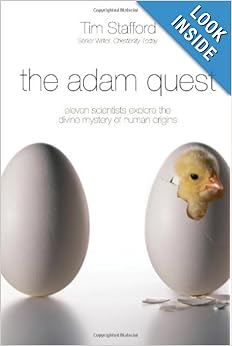
The Adam Quest (2013) by Tim Stafford is a unique book. Born out of his own experiences with his son getting "burned by the fight over Genesis" (p.2), Stafford set out to interview scientists who "held on to a strong Christian faith while wrestling with the mystery of human origins" (from the cover). In approaching the topic, Stafford intentionally sought well trained scientists who held strong opinions, but were not quick to condemn others (p. 7). In doing so, he presented compelling biological sketches of eleven scientists representing a variety of viewpoints.
This book has many strengths to its credit. Stafford as a senior writer for Christianity Today is a gifted communicator. He was able to craft excellent stories. In fact, I found it very difficult to set this book down. I had to lead a group last night, but I would have been thankful to stay home and keep devouring this volume.
Stafford is also intentionally careful not to show his hand too early. For the most part, he seemed to fairly present the positions held by young earth creationists, intelligent design advocates, and evolutionary creationists. For anyone who reads about how to interpret Genesis 1 to 11, this is an amazingly difficult task as opinions are routinely strong. There were certainly some strong opinions from the scientists here as well, but humility was a common thread in this book, which I appreciated because it is so often missing from our dialog.
Another thing that I appreciated was that Stafford not only represented a variety of viewpoints on creationism, but that the people he included represented a variety of denominational backgrounds--Anglican, Catholic, Nazarene, and Baptist to name a few. I wonder how often we make assumptions about which denominations will appropriately support scientists. Stafford interviewed a variety.
I did have concerns about this book as well. Stafford anticipates this argument, but for some who read it, they will be concerned that their positions are underrepresented or unfairly characterized. I would have appreciated it if he would have recruited an equal number of scientists from each of the main traditions, but evolutionary creationism is the most strongly represented among the scientists interviewed.
I also think it would have been beneficial for Stafford to explore the underlying worldview assumptions of the authors in greater depth. For example, many of the proponents of evolution see no problem with a "levels-of-explanation" point of view. Essentially, there are multiple ways of getting at truth and they need not integrate to any significant degree. I would like to explore this further, but unfortunately it is beyond the scope of this review. We all approach issues with basic assumptions about the way the world works and failure to account for those assumptions is detrimental, I believe.
There is much wisdom from the scientists presented. Though I essentially agree with Stafford's delineation of each positions strengths and weaknesses, I disagree with Stafford's final conclusions, yet I cannot fault his approach. This is a well written book written with humility. I suspect that Tim Stafford, all of the scientists presented, and I would agree on this: we hold to those things of first importance, that Jesus was crucified for our transgressions and that he rose again on the third day and that those who believed will be saved.
I received this book free from the publisher through the BookSneeze.com® book review bloggers program. I was not required to write a positive review. The opinions I have expressed are my own. I am disclosing this in accordance with the Federal Trade Commission’s 16 CFR, Part 255: “Guides Concerning the Use of Endorsements and Testimonials in Advertising.”
19 December 2013
Stephen Meyer and Eric Metaxas on Socrates on the City
This video was well worth the time to watch it.
11 December 2013
Book Review: A Reformed Approach to Science and Scripture

One of the important points that Mathieson makes is that we often make inaccurate assumptions about differences between Christians. When discussing a difference he had with some friends over eschatology, he wrote, "my friends there could not grasp the fact that my difference with them was a difference of interpretation, not a difference over the authority of God's word."
I appreciated how Mathieson referenced the earlier battle over geocentrism as a way to look at current controversies. Most Christians would agree that Luther and Calvin are within the pale when it comes to general orthodoxy on major issues. Most Christians would also deny that the sun revolves around the earth. Yet both of these men had very strong words for heliocentrists. In fact, Calvin described heliocentrists as "stark raving mad" and "possessed by the Devil." Mathieson rightly surmises, "the main point Dr Sproul was making by pointing out these past mistakes Christians have made in the interpretation of general and special revelation was to remind us of the possibility of contemporary mistakes."
I also agreed that "many scientists jump to the conclusion that if somebody is wrong it has to be the theologian" and that "many Christians jump to the opposite premature conclusion that if somebody is wrong it has to be the scientist, yet "both scientists and theologians are fallible." Humility is a necessity.
This was a good introduction to the issues. Even if you are not Reformed, this is a good discussion for anyone interested.
It is free on Amazon. Go get it.
25 May 2013
Science, philosophy, and selling bad cars
One of my fellow Centurions, Regis Nicoll has written an excellent little piece over at Breakpoint. The article begins, "On the floor of the Darwinian exchange, traders bark, 'Evolution is
fact, Fact, FACT!' But it’s a fact that has proven to be a hard sell.
"After 150 years of scientific 'evidence,' decades of inculcation in public education, and a raft of books, like The Dragons of Eden, The Selfish Gene, and The Blind Watchmaker, only 16 percent of Americans believe that humans developed from an unsupervised process of variation and natural selection. Belief that God had some part in the process has held steady over the last 30 years, at around 80 percent."
Nicoll discusses the consternation that these evolutionary evangelists have that it is not just us dumb Americans who believe this, but even some scientifically-minded individuals who just cannot reject that pesky problem of "apparent" design. One way they have responded is by switching tacks; they have started talking instead about how our death anxiety contributes to our continued belief in a higher power and how we must find meaning by "looking around". Our scientists are becoming philosophers and bad ones at that. (Does anyone remember the recent proclamation from Stephen Hawking and Leonard Mlodinow that "philosophy is dead?"). They have become car salesmen--if you can't sell them on the car, sell them on the image--then maybe people will buy in.
"After 150 years of scientific 'evidence,' decades of inculcation in public education, and a raft of books, like The Dragons of Eden, The Selfish Gene, and The Blind Watchmaker, only 16 percent of Americans believe that humans developed from an unsupervised process of variation and natural selection. Belief that God had some part in the process has held steady over the last 30 years, at around 80 percent."
Nicoll discusses the consternation that these evolutionary evangelists have that it is not just us dumb Americans who believe this, but even some scientifically-minded individuals who just cannot reject that pesky problem of "apparent" design. One way they have responded is by switching tacks; they have started talking instead about how our death anxiety contributes to our continued belief in a higher power and how we must find meaning by "looking around". Our scientists are becoming philosophers and bad ones at that. (Does anyone remember the recent proclamation from Stephen Hawking and Leonard Mlodinow that "philosophy is dead?"). They have become car salesmen--if you can't sell them on the car, sell them on the image--then maybe people will buy in.
10 April 2013
Explanation for DNA--ET is acceptable, but God is not
Discovery Channel News featured an interesting little story entitled "Is An Alien Message Embedded In Our Genetic Code?" From the opening:
So the hypothesis here is that if there is an intelligent signal embedded in the genetic code, then 1) it "could not be accounted for by Darwinian evolution" and 2) it would be an "indelible stamp of a master extraterrestrial civilization that preceded us by many millions or billions of years."
Moving on--
So, moving on from their hypothesis, their observations lead them to the conclusion that in fact an analysis of the genome reveals order and "precision logic." Looking back to their hypothesis, then, this DNA could 1) not be accounted for by Darwinian evolution and 2) must represent the stamp of an extraterrestrial civilization.
Indeed, the article discusses possible interpretations. The first possibility raised by the researchers was that DNA was invented outside the solar system and seeded earth billions of years ago. This view is known as "panspermia". The reporter offers his own hypothesis: "the universe we see was built inside of a computer program." Finally, the reporter notes, "Biological SETI inevitably smacks head-on into an idea that is completely antithetical to science: the concept of intelligent design (ID)."

Considering these possibilities together, how is it that aliens inseminating the planet and living inside the Matrix are reasonable options, but intelligent design is not? The reporter provides an answer: "To date, ID has been nothing more than biblical creationism in sheep’s clothing. Christian fundamentalists use it to push the teaching of creationism in schools as an alternative to 'secular' evolution." I must ask, however, what is science? If the observational data lead to certain conclusions, even if they are tentative, should those conclusions be tossed out if they do not fit the status quo? In other words, if the data point to an Intelligent Designer (which they seem to), why reject Intelligent Design simply because that Designer may be God? If nothing else, why not include ID as one possible explanation for origins if the data seem to fit?
In the reporters conclusion, he asks even if the data point to a grand designer, who "designed the designer?" That question must be answered by all, whether religious or not. We all must answer the question of ultimate beginnings and what ultimately came first. For my money, the question of who designed the designer is best defended by William Lane Craig in the Kalam Argument. The interested reader is also encouraged to consider the work of Stephen Meyers, who wrote Signature in the Cell.
"Could our genes have an intelligently designed 'manufacturer’s stamp' inside them, written eons ago elsewhere in our galaxy? Such a 'designer label' would be an indelible stamp of a master extraterrestrial civilization that preceded us by many millions or billions of years. As their ultimate legacy, they recast the Milky Way in their own biological image.
"Vladimir I. shCherbak of al-Farabi Kazakh National University of Kazakhstan, and Maxim A. Makukov of the Fesenkov Astrophysical Institute, hypothesize that an intelligent signal embedded in our genetic code would be a mathematical and semantic message that cannot be accounted for by Darwinian evolution. They call it 'biological SETI.' What’s more, they argue that the scheme has much greater longevity and chance of detecting E.T. than a transient extraterrestrial radio transmission."
So the hypothesis here is that if there is an intelligent signal embedded in the genetic code, then 1) it "could not be accounted for by Darwinian evolution" and 2) it would be an "indelible stamp of a master extraterrestrial civilization that preceded us by many millions or billions of years."
Moving on--
"They go on to argue that their detailed analysis that the human genome displays a thorough precision-type orderliness in the mapping between DNA’s nucleotides and amino acids. 'Simple arrangements of the code reveal an ensemble of arithmetical and ideographical patterns of symbolic language.' They say this includes the use of decimal notation, logical transformations, and the use of the abstract symbol of zero. 'Accurate and systematic, these underlying patterns appear as a product of precision logic and nontrivial computing,' they assert."
So, moving on from their hypothesis, their observations lead them to the conclusion that in fact an analysis of the genome reveals order and "precision logic." Looking back to their hypothesis, then, this DNA could 1) not be accounted for by Darwinian evolution and 2) must represent the stamp of an extraterrestrial civilization.
Indeed, the article discusses possible interpretations. The first possibility raised by the researchers was that DNA was invented outside the solar system and seeded earth billions of years ago. This view is known as "panspermia". The reporter offers his own hypothesis: "the universe we see was built inside of a computer program." Finally, the reporter notes, "Biological SETI inevitably smacks head-on into an idea that is completely antithetical to science: the concept of intelligent design (ID)."
Considering these possibilities together, how is it that aliens inseminating the planet and living inside the Matrix are reasonable options, but intelligent design is not? The reporter provides an answer: "To date, ID has been nothing more than biblical creationism in sheep’s clothing. Christian fundamentalists use it to push the teaching of creationism in schools as an alternative to 'secular' evolution." I must ask, however, what is science? If the observational data lead to certain conclusions, even if they are tentative, should those conclusions be tossed out if they do not fit the status quo? In other words, if the data point to an Intelligent Designer (which they seem to), why reject Intelligent Design simply because that Designer may be God? If nothing else, why not include ID as one possible explanation for origins if the data seem to fit?
In the reporters conclusion, he asks even if the data point to a grand designer, who "designed the designer?" That question must be answered by all, whether religious or not. We all must answer the question of ultimate beginnings and what ultimately came first. For my money, the question of who designed the designer is best defended by William Lane Craig in the Kalam Argument. The interested reader is also encouraged to consider the work of Stephen Meyers, who wrote Signature in the Cell.
28 April 2012
Stop capitulating on science
Christians must stop capitulating to the idea that Christianity is only about faith/values. Christianity is about faith and values, but it is not only about faith and values. Christianity is also grounded in reason and truth--it presents a full-orbed, robust worldview.
In a similar vein, most modern science is also involved in the pursuit of truth, yet it requires faith--faith in philosophical naturalism. As atheist Michael Ruse has said, "I must admit in this one complaint that the biblical literalists are absolutely right. Evolution is a religion. This was true of evolution in the beginning, and it is true of evolution still today."
Unfortunately, philosophical materialists have continually worked to recast religion as subjective feeling, but evolution as objective truth. Most materialists would flatly reject the idea that they hold religious beliefs.
Historian Jacques Barzun wrote, the so-called warfare between science and religion should really be seen as the warfare between two philosophies and perhaps two faiths."
Perhaps the question we all should be asking is which worldview system--which religion as it were--best accounts for all of life.
In a similar vein, most modern science is also involved in the pursuit of truth, yet it requires faith--faith in philosophical naturalism. As atheist Michael Ruse has said, "I must admit in this one complaint that the biblical literalists are absolutely right. Evolution is a religion. This was true of evolution in the beginning, and it is true of evolution still today."
Unfortunately, philosophical materialists have continually worked to recast religion as subjective feeling, but evolution as objective truth. Most materialists would flatly reject the idea that they hold religious beliefs.
Historian Jacques Barzun wrote, the so-called warfare between science and religion should really be seen as the warfare between two philosophies and perhaps two faiths."
Perhaps the question we all should be asking is which worldview system--which religion as it were--best accounts for all of life.
23 April 2012
What happened to critical thinking in science?
Marvin Olasky, writing at World Magazine, discusses the recent controversies in Tennessee over evolution. He writes, "The sky is falling! Many interest groups and journalists raced to tell
that to the public when a modest but important bill became law in
Tennessee early in April. The law instructs teachers and administrators
to 'create an environment within public elementary and secondary schools
that encourages students to explore scientific questions, learn about
scientific evidence, develop critical thinking skills, and respond
appropriately and respectfully to differences of opinion about
controversial issues.'
"What's not to like? The law, similar to one in Louisiana, also protects teachers who help students (I'm quoting from the official legislative summary) 'understand, analyze, critique, and review in an objective manner the scientific strengths and scientific weaknesses of existing scientific theories covered in the course being taught. ...' Oh, here's the problem: Evolution is one of the theories that can now be analyzed and critiqued."
I have been saying for years that children are not taught to think critically. Logic is sorely missing from education. They learn facts, trivia if you will, to then regurgitate on examinations. Even most doctor of philosophy (i.e., PhD.) have no training in philosophy or logic. This is law proposes that children should "develop critical thinking skills." I agree with Olasky, what's not to like. Perhaps more to the point, what are organizations like the American Association for the Advancement of Science afraid of? That it will be discovered that the emperor is wearing no clothes?
Read the rest here.
"What's not to like? The law, similar to one in Louisiana, also protects teachers who help students (I'm quoting from the official legislative summary) 'understand, analyze, critique, and review in an objective manner the scientific strengths and scientific weaknesses of existing scientific theories covered in the course being taught. ...' Oh, here's the problem: Evolution is one of the theories that can now be analyzed and critiqued."
I have been saying for years that children are not taught to think critically. Logic is sorely missing from education. They learn facts, trivia if you will, to then regurgitate on examinations. Even most doctor of philosophy (i.e., PhD.) have no training in philosophy or logic. This is law proposes that children should "develop critical thinking skills." I agree with Olasky, what's not to like. Perhaps more to the point, what are organizations like the American Association for the Advancement of Science afraid of? That it will be discovered that the emperor is wearing no clothes?
Read the rest here.
13 July 2010
Psychological "Science" and the Art of Spin
There are three types of lies: lies, damned lies, and statistics--Benjamin Disraeli
Yesterday, I was listening to a podcast of the White Horse Inn. Michael Horton and friends were interviewing Os Guinness, who shared that when he was raising his children, he developed a game called "spot the lie." He trained his children to spot non-sequitirs and lies as they consumed the media. I made a mental note to incorporate this concept into my own parenting.
Today, I was able to spot the lie. On a listserv I frequent, someone asked about the American Psychological Association's policy regarding adolescents' ability to consent to abortion and I curiously wanted to know as well. In 1990, the APA filed an amicus brief (Hodgson v. Minnesota) making clear their position that minors were developmentally mature enough to consent to abortion without parental consent. As I read further, however, in 2005 the APA filed another amicus brief with the supreme court (Roper v. Simmons) stating that adolescents were developmentally immature and, therefore, should be exempt from the death penalty. This drew swift criticism from Justice Scalia and many others as well who spotted the lie. In October 2009, an article was published in the American Psychologist by Steinberg, Cauffman, Woolard, Graham, and Banich that attempted to scientifically reconcile these two apparently inconsistent viewpoints. Despite their use of statistical methodology, they, like the APA, began with politically-biased assumptions--that the death penalty is wrong and abortion is right.
I hope the publication of an article in the APAs flagship journal supporting inconsistent viewpoints with science disavows you of the notion that science can be objective and value free. The stance that we should not kill kids who kill others but that we should allow kids to kill their own kids without parental consent is yet another reason why I am no longer a member of APA and why, on days like today, I struggle to even self-identify as a psychologist.
Yesterday, I was listening to a podcast of the White Horse Inn. Michael Horton and friends were interviewing Os Guinness, who shared that when he was raising his children, he developed a game called "spot the lie." He trained his children to spot non-sequitirs and lies as they consumed the media. I made a mental note to incorporate this concept into my own parenting.
Today, I was able to spot the lie. On a listserv I frequent, someone asked about the American Psychological Association's policy regarding adolescents' ability to consent to abortion and I curiously wanted to know as well. In 1990, the APA filed an amicus brief (Hodgson v. Minnesota) making clear their position that minors were developmentally mature enough to consent to abortion without parental consent. As I read further, however, in 2005 the APA filed another amicus brief with the supreme court (Roper v. Simmons) stating that adolescents were developmentally immature and, therefore, should be exempt from the death penalty. This drew swift criticism from Justice Scalia and many others as well who spotted the lie. In October 2009, an article was published in the American Psychologist by Steinberg, Cauffman, Woolard, Graham, and Banich that attempted to scientifically reconcile these two apparently inconsistent viewpoints. Despite their use of statistical methodology, they, like the APA, began with politically-biased assumptions--that the death penalty is wrong and abortion is right.
I hope the publication of an article in the APAs flagship journal supporting inconsistent viewpoints with science disavows you of the notion that science can be objective and value free. The stance that we should not kill kids who kill others but that we should allow kids to kill their own kids without parental consent is yet another reason why I am no longer a member of APA and why, on days like today, I struggle to even self-identify as a psychologist.
23 March 2010
Christianity and Psychology: 5 views
This weekend, I attended an excellent symposium, Christianity and Psychology: Five Views. Representatives from each of five major schools of thought in “Christian psychology” shared their approach. Although billed as a psychology conference, it was really more of philosophy of science, or even philosophy of religion and science, conference. Diverse perspectives were offered by Warren Brown of Fuller Seminary (levels-of-explanation), Stanton Jones of Wheaton College (integration), Paul Watson of UT Chattanooga (Christian Psychology), John Coe of Rosemead School of Psychology (Transformational Psychology), and Dave Powlison of Westminster Theological Seminary (Biblical Counseling). A panel discussion between them concluded the weekend.
I took something away from each of the presenters. Dr Brown, for example, spoke of a “compassionate ministry,” a great model for his work in neuropsychology and something I hope to bring to my practice. John Coe pointed back to the history of science and asked whether what is currently being done in psychology is “science” in the historic sense of the word. Dave Powlison was, well, Dave Powlison. If I were to pick someone from the group as my counselor, Powlison would be the guy. Hands down.
As the men each had different views about interpreting psychology, they also had different views on interpreting scripture. Perhaps why I liked Dr Powlison so much (and Drs Jones and Coe, to an extent) was his high view of scripture. It was apparent that to them, scripture was supreme.
Conversely, Dr Brown seemed to hold a high view of science and a low view of scripture. From this perspective, science is supreme in understanding people and scripture offers little. Dr Brown stated that exegesis faces many obstacles and that people may arrive at different interpretations based upon history, faith tradition, and so forth. I am not sure he would apply the same standard to science.
18 March 2010
Scopes in reverse

I am sitting in a hotel room in Dayton, Tennessee where I will be attending a conference tomorrow. In 1925, Dayton provided the backdrop for the Scopes Monkey Trial. In March of that year, the Tennessee legislature made it illegal to teach evolution in the school. John Scopes, Dayton's biology teacher at the time, was convinced by two local leaders to challenge the law by teaching evolution. Apparently, the plan was initially hatched as a publicity stunt, to bring some attention to Rhea County. The case ended up becoming one of the most well-known trials in American history. Scopes was prosecuted by former presidential candidate William Jennings Bryan and was defended by Clarence Darrow. The defense was funded by the American Civil Liberties Union. The media coverage reportedly exceeded any event up to that time. Scopes was convicted and fined, though the fine was overturned by the supreme court on a technicality.
The Scopes case was, in many ways, about academic freedom. The restrictions on academic freedom were set forth by a government relying upon distinctly Christian values. After Scopes, however, American society gradually switched to an increasingly secular approach to education. Over time, several landmark court cases made teaching creation or intelligent design either difficult or illegal.
The freedoms that the ACLU were trying to protect have now come full circle. Individuals who even allow for the possibility of intelligent design are excluded from academia. For example, Richard Sternberg, former editor of the Proceedings of the Biological Society of Washington, authorized an article authored by Stephen Meyer that had been favorably peer reviewed. Because this article discussed intelligent design, Sternberg was marginalized and defamed by his colleagues--not based upon the merits of the article, but rather, because it allowed for a supernatural explanation.
I heard of a recent similar example of limiting academic freedom. Greg Koukl was recently asked to give a talk entitled, "Is it intolerant to say Jesus is the only way?", as part of a sanctioned event at a college in Calgary. The posters were removed by the university and not allowed to be re-posted because the title was considered divisive and negative. Even more striking was the fact that administrators concluded the posters had racial overtones because a subtitle read, "Is choosing a religion merely a matter of preference, like chocolate vs. vanilla? Or is it about something much more serious?" This line of reasoning (claiming racism) is inane. One does not need to look far to identify many more examples of this sort of academic exclusion.
The groups that were once fighting to be heard are now employing the same restrictions that were once leveled against them. Now that their voice dominates, they refuse to allow dissenting voices to be heard. So much for civil liberty.
20 July 2009
I-monk on creationism/Genesis
I-monk posts about Creationism with some very interesting comments. The interesting thing is that I was just thinking about astrophysicist Hugh Ross, old earth/young earth creationism, and how to present science to my children as we home school them.
What do others think?
What do others think?
Subscribe to:
Posts (Atom)