19 August 2015

Book Review: Becoming Human

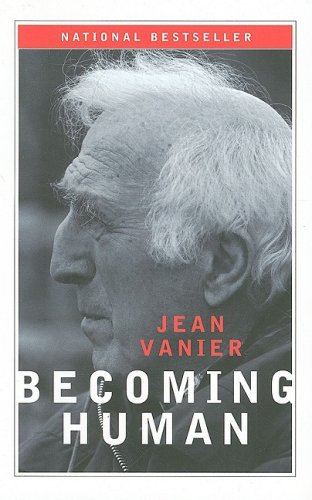
Becoming Human (1998)  is a short book and international bestseller by Jean Vanier, "the founder of L'Arche, an international network of communities for people with intellectual disabilities." The book consists of five chapters entitled: loneliness, belonging, from exclusion to inclusion: a path of healing, the path to freedom, and forgiveness.

There is much to commend about this book. It is essentially a manifesto on what true humanity looks like, a humanity that values all people, seeks good for others, and lives to serve, love, and forgive. In this book, Vanier recognizes the essential importance of attachment, though I am not sure he ever actually used that word. Rather, he writes things like, "deep inner healing comes about mainly when people feel loved, when they have a sense of belonging." He pushes back gently on the fallen tendency to separate and isolate, whether as individuals or as groups. When we focus primarily on our differences from other people, we fail to acknowledge our common brokenness and need for love.

As with most books, there are things I would quibble with him about. Although I strongly agree with his view that all humanity shares a common brokenness and need to belong, there are times when intergroup differences are not only real, but important.  I would characterize it as a minimization (bordering on an absence) of objective truth as a way to promote love. I think in this regard, caution is necessary.

On the whole, however, I thought this was a wise, humble book about the importance of love, relationships, and forgiveness.

Self-denial as a Path to Our True Selves

Then Jesus told his disciples, "If anyone would come after me, let him deny himself and take up his cross and follow me. For whoever would save his life will lose it, but whoever loses his life for my sake will find it."-Matthew 16:24-25

Jesus called his followers to a life of self-denial, but have you ever asked yourself, what does self-denial look like in practice? I suspect that for many Christians and non-Christians alike, they hear the term self-denial and they assume that it means a loss of self. The path to self-denial is a path of becoming a bland automaton, incapable of free thought or expression of one's unique personality.

But what if the process of self-denial involves not a loss of the self, but rather a dawning discovery of who we truly were meant to be? What if denying ourselves, as Jesus taught, leads to becoming more fully human? In fact, I think Jesus' words in verse 25 tell us that it is impossible to become fully alive without this process of self-denial. "Whoever would save his life will lose it, but whoever loses his life for my sake will find it." In other words, if we cling to our own ideas about who we are, our growth will be incomplete, but if we are willing to let go and allow God to work in and through us, we will become fully who God intends us to be.

I think of the 4 gospel accounts, each fully inspired by God, yet each retaining the personalities of the writers. The fact that they penned the very words of God did not negate their true selves. In a certain way, the same is true for us. Though our lives are by no means inerrant, when we set the self aside and allow the Spirit to work in and through us, we become more deeply and uniquely who we were intended to be.

18 August 2015

Book Review: The Solitary Tales

At a party last Friday night, I was telling a friend of mine that I was on the hunt for what to read next. Earlier in the day, I had pulled about 10 different books off my shelf, read the introductions, and reshelved. Not that they were bad books, they just weren’t what I was looking for. My friend asked if I had ever read The Solitary Tales by Travis Thrasher and when I told him no, he put the 4 book series in my hand and sent me on my way.

If Thrasher’s name sounds familiar, it may be because he wrote the novel based upon the new movie Do You Believe? from the makers of God’s Not Dead. But if you are like me, you’ve never even heard of The Solitary Tales.  The 4 books—Solitary, Gravestone, Temptation, and Hurt—tell the story of a young man, Chris Buckley, who moves with his mother to a small town in the mountains of North Carolina. An outsider in a close knit community, he doesn’t know where he fits, except on the outside. He is drawn to a mysterious girl, Jocelyn, whom he can never quite make sense of. There is also a lot of mystery to discover in Solitary, the town itself.

I don’t want to say much more because I don’t want to give the story away. My daughter is currently reading the series and I find myself eager to hear where she is so we can talk about it. I found the books nearly impossible to set down; in fact, I read over 1700 pages in less than 6 days which is even more than I normally read. I found myself talking to the characters in the books and at times yelling at them. There were some weird idiosyncrasies, like occasionally switching between 1st, 2nd, and 3rd person, but overall it did not detract significantly from this compelling story. 


If you are looking for something captivating and mysterious, you may want to consider The Solitary Tales by Travis Thrasher. 

17 August 2015

Satan is a Cunning Tempter

At the outset of his ministry, Jesus spent 40 days in the wilderness fasting (Matthew 4). At the end of that time, Satan showed up on the scene to tempt Jesus to abandon his mission. Satan is cunning. He used three different approaches to appeal to Jesus.

The first thing the tempter did was appeal to Jesus' biology. Jesus had not eaten for 40 days and he was hungry (v. 2). Verse 3 reads, "And the tempter came and said to him, 'If you are the Son of God, command these stones to become loves of bread.'" He appealed to Jesus' physical desires, in this case the desire to eat. 

The appeal to biology is still a primary way we justify sin. Particularly regarding sexuality, people talk about how they have certain biological drives which impel them to engage in sexual sin. The feelings of arousal or attraction are seen as permission. Although sexuality is the most obvious area people appeal to biology, they could talk about biological underpinnings of anger, gluttony, laziness, you name it.

The second thing the devil did was to appeal to the Word of God. In verse 6, he quoted two passages of Scripture to Jesus, taken grossly out of context to encourage Jesus to abandon his messianic mission, yet Jesus did not lose sight of what God had called him to do.

Taking the Word of God out of context remains all too common. People preemptively decide what they want to believe and then look for Scriptures that can be used to support that perspective, which is called proof texting. One of the best examples I heard of this came from Greg Koukl who tells of a woman who left her husband for another man when she read a verse that said "put off the old man." Clearly, this is an extreme example, but if we leave out the grand story of the Bible, it becomes too easy to twist Scripture to justify whatever we want. Rather, we should let the whole counsel of God, all of Scripture, shape who we are becoming, rather than vice versa.


Finally, Satan appeals to worldly desire. In verse 8, he basically says to Jesus "I will give you everything you see. These are the things the world says are good, and right, and important." Jesus responds, "be gone!"

This appeal to what the world says is good remains pervasive. We hear messages that it is okay to be dishonest so long as it gives you riches. It's okay to sleep with whoever you want because that is what the world says is good and right. It's okay to abort your child because the world says it is fine to do so. 

Satan tempted Jesus by appealing to biology, Scripture, and worldly desire. He continues to do so today. He will do or say anything to tempt us away from following God. We must remain attentive to these temptations and run to Christ who not only recognized them, but overcame them on our behalf.

16 August 2015

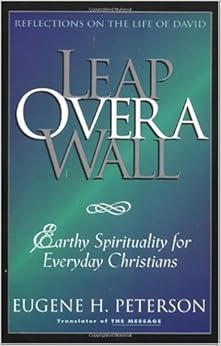
Book Review: Leap Over a Wall

As I was reading Eugene Peterson's Leap Over a Wall: Earthy Spirituality for Everyday Christians (1997) two thoughts kept resurfacing. First, I really think someone should seriously consider making a Braveheart style about the life of David. Second, I think more people need to read the writings of Eugene Peterson.

In Leap Over a Wall, Peterson explored the life of David, not as the model life, but as the normative life of a believer, at least in some regards. He wrote, "Life isn't an accumulation of abstractions such as love and truth, sin and salvation, atonement and holiness; life is the realization of details that all connect organically, personally, specifically: names and fingerprints, street numbers and local weather, lamb for supper and and a flat tire in the rain" (p. 3). The Bible is story--a true story to be sure, but a story that communicates truths about God and about us. The details of David's life provide one of the most extensive narratives to understand what life before God looks like.

One of the things I most appreciate about Peterson's writings is the way he is able to take a passage and wring out truths that map on to real life. He sees things in story that I miss. He cleans my interpretive lenses. He walks me into the story in a way that I can smell the air at Brook Besor and can feel the emotion of a kneeling Abigail. Leap Over a Wall is another strong addition to the Peterson corpus.

Book Review: Reading the Bible with Heart and Mind

I think many Christians recognize the importance of reading the Bible, but many times, they have a hard time making heads or tails of what the Bible is all about. There are a number of great resources that help people to navigate like How to Read the Bible for All Its Worth by Gordon Fee and Douglas Stuart, Dig Deeper by Nigel Benyon and Andrew Sach, or 40 Questions About Interpreting the Bible by Robert Plummer and Benjamin Merkle. Reading the Bible with Heart and Mind (1997) by Tremper Longman III is another great addition to the genre.

Longman divided the book into four parts--the Bible's transforming power, the receptive heart, the understanding mind, and the literary cornucopia. One of the best things about this book is that Longman addresses the whole perhaps, just as the Bible does. He reminds the reader that Scripture is not to be read just in the abstract, but in the real ruddiness of life.

Chapter 7 is an important chapter. Longman presented the reader with several application principles:
  • Look for the author's intended meaning. 
  • Read the passage in context. 
  • Identify the genre of the passage. 
  • Consider the historical and cultural background of the Bible. 
  • Pay attention to the grammar and structure within the passage. 
  • Interpret experience in the light of Scripture, not vice versa. 
  • Always seek the full counsel of Scripture. 
The final section, comprising the majority of the book, explores the major genres of the Bible: History, Law, Poetry, Wisdom, The Prophets, The Gospels, The Epistles, and Apocalypse.  Understanding the difference between each of these literary types will go a long way to making sense of what the Bible means. 

Having read each of the books above, I think this is the one I am most likely to recommend now. It is accessible and wise.

15 August 2015

Book Review: hand in Hand

I grew up attending a Reformed church (RCA) and went to an RCA college, so Calvinism, which is often seen to stress God's sovereignty, is a part of my religious DNA. As I moved around for school, I subsequently attended Baptist, Evangelical Free, Lutheran, and non-denominational churches who each placed different levels of stress on God's sovereignty and human choice, respectively.

A few years ago, I more fully embraced a Calvinistic identity. I frequented reformed blogs (e.g., Challies, Desiring God), read books by reformed writers (e.g., John Piper, John MacArthur, RC Sproul), and even attended reformed conferences. In fact, I would go so far as to say everyone else (e.g., Arminians) were wrong, though admittedly, I never bothered to actually read what they were writing.

 In fact, the Internet breeds a religious subculture of people who spend innumerable hours debating Calvinism versus Arminianism. A year or two ago, I began to recognize the ugliness Christian brethren can have for one another when they hold different theological viewpoints. I stopped actively referring to myself as "reformed" in my thinking because I think the terms "Calvinist", "reformed", and "Arminian" carry too much baggage.

I suspect Randy Alcorn had similar feelings, so he wrote hand in Hand: The beauty of God's sovereignty and meaningful human choice (2014) to attempt to explore this difficult topic. Alcorn grew up in an Arminian church but now has more Calvinist leanings and he recognizes that in each camp, there are God fearing, Bible believing Christians though their sense of balance may be different. He argues that the Bible teaches both God's sovereignty and what he calls meaningful human choice and we cannot sacrifice one at the cause of another.

Although the whole book was well researched, humble, and engaging, I particularly enjoyed his chapter "Voices from the past share timeless truths." In this chapter, he references numerous theologians through the history of the church, identifying their common ground--Arminians talking about God's sovereignty, and Calvinists talking about human choice. 

hand in Hand is an important book regardless of your theological frame of reference. It is a call to faith grounded in God's Word rather than a theological system. It is also a call to unity between believers. Regardless of your viewpoint, I would strongly recommend this book.

13 August 2015

Why Do We Bypass Each Other?

This morning, my good friend Mark shared this devotion on his radio show on WWIB. I asked him to send it to me because I wanted to think about it more.

"Why is it that we keep that great gift of care so deeply hidden? Why is it that we keep giving dimes without daring to look into the face of the beggar? Why is it that we do not join the lonely eater in the dining hall but look for those we know so well? Why is it that we so seldom knock on a door or grab a phone, just to say hello, just to show that we have been thinking about each other? Why are smiles still hard to get and words of comfort so difficult to come by? Why is it so hard to express thanks to a teacher, admiration to a student, and appreciation to the men and women who cook, clean, and garden? Why do we keep bypassing each other always on the way to something or someone more important?

"Maybe simply because we ourselves are so concerned to be different from the others that we do not even allow ourselves to lay down our heavy armor and come together in a mutual vulnerability. Maybe we are so full of our own opinions, ideas and convictions that we have no space left to listen to the other and learn from him or her."-Henri Nouwen

08 August 2015

You Matter


Here were some words I shared today from the roof of the Living Room. 
 
About a week ago, Mark Halvorsen emailed me and told me about this event and asked if I would be interested in saying a few words as the Spirit led. I immediately jumped at the chance. You see my passion, my burden, is to get the word out that Jesus loves sinners.  But then, as the week went on, I began to doubt. I began to think, I don’t have anything to offer. I’m just going to get in the way. So, I texted Mark and said, are you sure you want me there? Are you sure Ron wants me there?  I’m willing to speak, but I don’t want to be there just to take up space. 

Mark said, “I am going to speak truth to you. Your worry that you are just here to fill space is a lie from Satan.”  Immediately, I felt unburdened. I felt the conviction to speak and the fire to speak rekindled. You see, Mark is right.  Satan does not like people to hear that Jesus loves sinners.  So, let me say a few words before Mark comes up.

02 August 2015

Becoming a Both/And Christian

Over the years, one of the topics that I have given the most thought to has been the balance of truth and love. In my experience, most Christians don't do it well. On the one hand, there are those who are crusaders for truth. They know their Bibles well--at least parts of it.  They are prophetic voices, speaking with conviction and clarity about issues facing the church and the world--abortion, sanctity of marriage, and religious freedom, to name a few. The church, the world, needs these prophets.

But too often, they fail to recognize that the Bible tells us that we should let everything we do be done in love (1 Corinthians 16:14). They use their words as weapons. Their primary goal is to win the argument, not love the person. And in so doing, they become clanging cymbals.

On the other hand, there are those who fail to take a stand for seemingly hard biblical truths. They know their Bibles well--at least parts of it. They assume that to be loving, they should not speak difficult truths to people and so they say nothing. Their desire is to bring comfort and hope to a hurting world. They promote a feet on the ground ministry of mercy, binding up wounds and feeding the hungry. 

But too often, in their desire to be loving, they promote a soft, convictionless tolerance. They are content when the church conforms to culture, so long as they don't take hard stands.

But, the church needs more both/and Christians. We need the truth crusaders to continue to speak prophetically, but who recognize that words can harm. They need to act with gentleness and respect. They need to understand that a failure to control the tongue can ultimately harm the cause of Christ.

We need the other group to understand that failure to speak is ultimately a failure to love. They need to know that truth matters in real, tangible ways in the lives of every person they seek to love. They need to learn that a failure to use the tongue can ultimately harm the cause of Christ.

We need both/and Christians. Truth and love. Prophets and priests. We need Christians to do what is right (stand for truth), to do so with mercy, all with a spirit of godly humility.

No, O people, the Lord has told you what is good,
    and this is what he requires of you:
to do what is right, to love mercy,
    and to walk humbly with your God.

-Micah 6:8 (NLT)