Pride goes before destruction, and a haughty spirit before a fall.-Proverbs 16:18
If someone is described as haughty, it means that they are arrogantly proud and in ways feel superior to others. The Bible warns against treating others with haughtiness and arrogance, but too often Christians do. In light of God's graciousness toward us, we should be amongst the most humble and loving people, but we are not. We look down upon nonbelievers who don't really understand the way the world works. We also feel smugly superior to other believers who don't understand the depths and the nuances of the faith quite like we do. I recently scanned a couple of articles criticizing a popular Christian movie that was recently released. One was titled "I'm a Christian and I hate Christian movies."
In some ways, I understand the sentiment. The longer I am a Christian, the more I desire to see beauty expressed artistically, including through movies. Christian fiction often lacks grit, is too black and white, and is subpar entertainment. I am glad for conversations that explore truth through various fields, not the least of which is art. I am glad for conversations that explore the redemptive themes of "secular" movies, books, and music.
However, as believers, I think we need to be thoughtful, humble, and cautious about how we respond to how other believers who do things differently than we do. When we look down our noses at other believers, it has the potential of showing the non-believing world that we are much more interested in squabbling than in loving other-centeredness.
1 Peter 3:15 tells us to be prepared to give an answer to anyone who asks, but to do so with gentleness and respect. Haughtiness towards others--believers or not--lacks gentleness and respect. We need to think humbly and lovingly about how to discuss these concerns when they arise. Christ told his disciples that the world has the right to judge Christians based upon how we love one another (see Francis Schaeffer's Mark of the Christian).
So when you differ, make sure to check your pride at the door.

03 April 2016

09 March 2016
Dancing at the edge of expectation
More than half my life has been lived as a Christian and, Lord willing, I will have many years yet to explore the vistas of God's grace. I am filled with anxious wonder about what God will reveal next. I have frequently said that in the nearly 30 years since "I was ambushed by Jesus", to steal a phrase from Brennan Manning, I have learned much more about the Bible and yet I know much less about God. His vastness is never ending. The boxes in which I previously tried to contain Him I keep finding too small.
Over the years, I have been interested in the development of Christians. How is it that we come to believe certain things? How do our beliefs mature over our lives? God knows.
Today I came upon a few paragraphs in Eugene Peterson's book Travelling Light (1988). He wrote, "The word Christian means different things to different people. To one person, it means a stiff, uptight, inflexible way of life, colorless and unbending. To another it means a risky, surprise filled venture, lived tiptoe at the edge of expectation.
"Either of these pictures can be supported with evidence. There are numberless illustrations for either position in congregations all over the world. But if we restrict ourselves to biblical evidence, only the second image can be supported: the image of a person living zestfully, exploring every experience--pain and joy, enigma and insight, fulfillment and frustration--as a dimension of human freedom, searching through each for sense and grace. If we get our information from the biblical material, there is no doubt that the Christian life is a dancing, leaping, daring life" (p. 57).
In my experience and observation, the early Christian life often represents the former, inflexible way. The focus is often on sinfulness, and particularly the sinfulness of others who do not seem to be pursuing righteousness quite as zealously as the young believer thinks is appropriate. They stay far from the edge of the cliff and cast critical gazes at those who do not.
But with life lived and daily infusions of God's unending grace, we begin to discover the robustness of the Christian life for all circumstances and that the Spirit goes with us as we go. When we begin to understand that he will never leave or forsake us, our feet start tapping and we begin to dare to dance at the edge of expectation.
07 March 2016
Believer, you still need the gospel
Beginning on page 20 of his book The Discipline of Grace, Jerry Bridges wrote the following few paragraphs. I have abbreviated some, though the gist remains the same.
What one word describes the message you most needed to hear as an unbeliever? I suggest that the word is gospel. It is the gospel that is the power of God for salvation. We need to hear that Jesus died for sinners and that if we come to him in faith, we will receive the forgiveness of our sins and the gift of eternal life.
What one word describes the message we most need to hear as believers? I get a lot of different answers to that question, but most of them can be summed up with one word, discipleship.
But there is something more basic than discipleship, something that actually provides the necessary atmosphere in which discipleship can be practiced. The one word that describes what we must continue to hear is gospel.
We need to continue to hear the gospel every day of our Christian lives. Only a continuous reminder of the gospel of God's grace through Christ will keep us from falling into good day--bad day thinking, wherein we think our daily relationship with God is based on how good we've been.
It is only the joy of hearing the gospel and being reminded that our sins are forgiven in Christ that will keep the demands of discipleship from becoming drudgery. It is only gratitude and love to God that comes from knowing that He no longer counts our sins against us that provides the proper motive for responding to the claims of discipleship.
29 February 2016
Flying into the sunshine
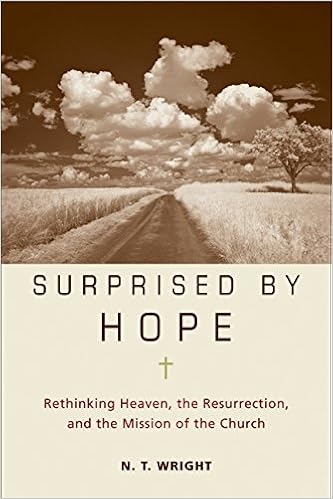
I just finished NT Wright's book, Surprised by Hope. His final paragraph is worth reproducing here.
In our incomplete world God's gentle offer and demand press upon us as fearful things, almost threatening. God in his gentle love longs to set us free from the prison we have stumbled into--the loveless prison where we refuse both the offer and the demand of forgiveness. We are like a frightened bird before him, shrinking away lest this demand crush us completely. But when we eventually yield--when he corners us and finally takes us in his hand--we find to our astonishment that he is infinitely gentle and that his only aim is to release us from our prison, to set us free to be the people he made us to be. But when we fly out into the sunshine, how can we not then offer the same gentle gift of freedom, of forgiveness, to those around us? That is the truth of the resurrection, turned into prayer, turned into forgiveness and remission of debts, turned into love. It is constantly surprising, constantly full of hope, constantly coming back to us from God's future to shape us into the people through whom God can carry out the work in the world.--NT Wright, Surprised by Hope, page 289.
This also calls to mind a verse upon which I have been meditating today: "As a prisoner of the Lord, I urge you: Live a life that is worthy of the calling He has graciously extended to you. Be humble. Be gentle. Be patient. Tolerate one another in an atmosphere thick with love.-Ephesians 4:1-2 (The Voice)
17 February 2016
Book Review: Cry of the Soul
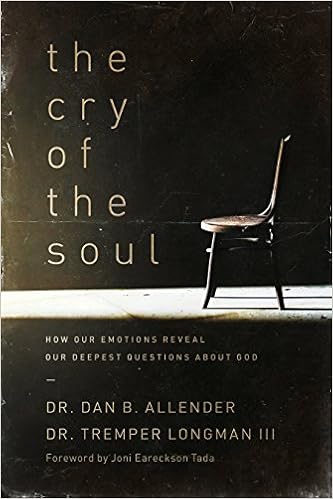
In their excellent book The Cry of the Soul: How Our Emotions Reveal Our Deepest Questions About God (1994), Dan Allender and Tremper Longman III have invited the readers to explore the language of emotion, in our own lives and through the words of Scripture, particularly in the Psalms. They encourage us to look into our shame, and fear, and sadness and ask what those emotions tell us about who God is.
Cry of the Soul is an excellent book. If you wish to develop a deeper understanding of your emotional life and of your relationship with God, this is a great place to begin.
04 February 2016
Relational sin in women
I'm in the process of reading through Larry Crabb's excellent book Fully Alive: A Biblical Vision of Gender that Frees Men and Women to Live Beyond Stereotypes. This book is striking me much more deeply this time around than the last.
Beginning on page 133, there is section entitled "Relational Sin in Women." I was struck by the apparent truth of these few paragraphs (from my perspective as a man).
Feminine words from one woman draw another woman into noncompetitive rest that overcomes the second woman's need to display or protect herself. And a woman's feminine words arouse a man, not to use her for his own pleasure, but to move toward her as a woman of value and worth. He sees her and wants to know her.
But unfeminine words, words that are energized by a demand to be seen and known, create either relational distance or counterfeit intimacy (my underline). When one woman relates to another woman in the energy of control or defense, their two souls never connect. Competition, jealousy, snubs, and threats create distance. Some kindhearted woman might respond to the pull of a needy female friend and provide affirmation that creates the illusion of closeness, but in fact she only deepens fragile dependency.
Men respond to unfeminine words with irritable stiffness ("Will you stop trying to control me?"), stubborn retreat ("I don't want to talk about it!"), defensive challenge ("You might want to try accepting me once in a while."), or selfish exploitation ("C'mon, let's go to bed.").
It comes down to this: a woman's words will draw others to her or distance others from her. She will speak either with the feminine power of an openness that invites the best from another and embraces when it comes or with unfeminine power designed to protect herself from another through control that drives her from people.
I would like more men and women to read this book to understand the gendered nature of relational sin.
29 January 2016
Book Review: Idols of the Heart

Like so many of her books, Idols is filled with biblical wisdom shared from a seasoned counselors heart. Humans were created to adore and glorify God completely, but in the fall, our affections were divided. No longer did we cherish God as our supreme treasure. Rather, we began to seek after and, yes worship, other things.
Too often, Christians have a small view of idolatry. When we hear the word, what comes to mind is a small metal statue to which people pay homage. To be sure, around the world, there are still those types of idols. However, Fitzpatrick reminds us that idolatry is more all encompassing. Idolatry really deals with anything that takes away from God as our supreme treasure. On page 194-195, she wrote, "I hope that by now you've begun to identify the thoughts and desires that function as idols in your heart. Although they might seem godly, perhaps their prominence in your affections has made them idolatrous. Perhaps they are part of God's created order, but they've been distorted in some way; perhaps the world has told you that you cannot be happy without them; or perhaps, like Aaron, you've been frightened or enticed to to believe that a little idolatry, just in this case, is acceptable. But wherever these thoughts and desires have come from, if they've taken the place of God in your affections, they've got to go." So what is included? Status, relationships, money, comfort, power, activities; really anything that competes with God for your heart.
I fear that too few of us are aware of the depths of our idolatry. I catch glimpses of mine, though quite honestly, I am more deeply aware of the idolatry of others. We minimize it, or suggest that what's going on is not idolatry, but something else. We must pray for eyes to see our false worship and continually fall upon the grace of our savior Jesus Christ who saves us from ourselves.
On the whole, I am quite happy with this book. Fitzpatrick writes in the tradition of the puritans, which for those unfamiliar with them, that is a welcome attribute.
I received a copy of this book from P&R Publishing in exchange for this review. I was not required to write a positive review. The opinions expressed here are my own.
26 January 2016
Sticks and stones, remastered
Sticks and stones,
may break my bones,
but the tongue's a blazing coal.
The former leaves
a deep blue stain
the latter scars a soul.
Light Your Children on Fire
What are Christian parents to do? What does Christian parenting even look like? There are nearly as many theories about how to raise children as there are parents. Should they spank or not spank? If they spank, are they supposed to use a switch or just their hand? Are they supposed to discipline or train or ignore? Are they expected to positively reinforce or punish? Does birth order matter or not? Is it essential to homeschool, or should they send them to Christian school, or public school or a mix? It is easy to get overwhelmed by the amount of information that is out there.
As a subculture, we are not short on theories and so my specific thoughts here will probably just add more noise to the cacophony. So read on, or don't. Its up to you.
Let me state my concern, and then I will flesh it out a bit. I have serious reservations about a certain brand of Christian parenting that seeks to break the will of a child, through physical discipline. The goal is apparently to create children of total obedience who unquestioningly follow the directives of their parents, I suppose the theory being that they will then unquestioningly submit to God. Like a good dog or horse, a child whose spirit is broken is well behaved.
But listen, our goal as parents is not primarily to produce well behaved children. Our goal is not to come to church on Sunday morning and have people tell us how well mannered our children are. No where in the Bible does it say that we are to raise automatons. Yes, we are to discipline. Yes, we are to encourage kindness, and self control, and humility, and other-centeredness, but that is not our principle goal and my fear is that the form of parenting that I am talking about loses sight of the balance, seeking to raise Pharisees, but not Christians.
So what is our goal? Let me suggest that our goal is to light our kids on fire. As parents, let's kindle a desire for Jesus. Don't squelch their passions, fuel them. Point out God's creative work in blazing sunsets, the sound of a symphony, and the smell of fresh baked bread. God is everywhere present; help them to see Him. Let's teach them about how radical, how amazing God's grace and mercy really are. But let's not only teach them, let's show them by the ways in which we love them and forgive them when they mess up. Let's not just give lip service to the truth that God's work in us is a life-long process when in reality we expect them to be perfect. When we see evidences of the Spirit's fruit in their lives, talk with them about His work, and when they sin, remind them of grace.
For my part, I will take a quirky, creative, misbehaving child who knows her status as Jesus' beloved over a Pharisaical, anesthetized child whose only goal is to obey his parents, but knows nothing of the blazing fire of God's grace.
21 January 2016
To Book or Not to Book, That is the Question
On several occasions, I have heard people (almost exclusively young men) say that they only read the Bible and that it is the only book for which they have any use. But that led me to wonder, is it wise to pride oneself on only reading Scripture?
On the positive side, it is only the Bible which is infallible. Through the history of the church, Christians have shaped their lives by the Bible. And we should. The Bible contains the words of God, what He deemed important for us to know. So perhaps these young men who read only the Bible are right, we have no need for other books. Or are they?
Let me suggest a few reasons why such a view may be shortsighted. First, through common grace, God has given many men and women the ability to write about God's creation. He has endowed scientists, and mathematicians, and poets, and historians to observe the world and write about the world around us. In many cases, these books address issues that the Bible never specifically does. I've heard people respond by saying, "well the Bible gives me everything I need for life and godliness", but in actuality, the passage says "His divine power [not the Bible specifically] has granted to us all things that pertain to life and godliness" (2 Peter 1:3). Perhaps Peter was referring to Holy Scriptures, but I do not think he was referring to only Scriptures.
Second, we have the privilege of access to 2000 years of church history. Over the millenia, godly men and women have wrestled with many of the same issues that today's Christians wrestle with. The wealth of knowledge available to us is abundant. There is much we can learn from others who have gone before. In a similar way that one might ask a wise elder questions about the Bible, we can ask those questions of generations of men and women, both dead and alive.
Third, reading extra-biblical sources allows us to sharpen our thinking. Too many people today lack the capacity for critical thinking. One of the reasons is that they don't read and so are not required to deal with a sustained argument. One of the most important ways one develops logic and critical thinking skills is through exposure to the written word.
Finally, such an approach often suggests pride. It implies that a young man, often without having lived much real life, possesses the wisdom and knowledge to interpret Scripture correctly. To be sure, I believe that everyone should swim in the pages of Scripture, but the assumption that I can figure it all out on my own can be dangerous. In many cases, we benefit substantially from the guidance of others.
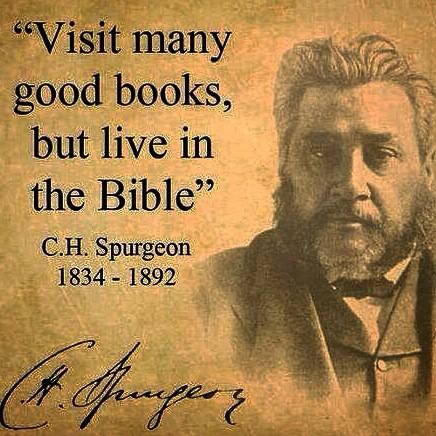
In sum, I agree with Spurgeon who said, "visit many good books, but live in the Bible." Make the Bible your home. Eat the Word. Drink it deeply. Read it over and over and over again until it becomes a part of your DNA. I would even say that if you aren't really a reader and only have 15 minutes a day, spend them in the Bible. On the other hand, if you get the chance, go visit other books. It just may enrich your understanding of the world and the Bible itself.
Subscribe to:
Posts (Atom)