10 December 2013

Book Review: The Spiritual Mentor


In his book, The Spiritual Mentor (2013), Jim Grassi lays out a model for disciple building, specifically as it applies to men, though many of the lessons he shares could be applied in ways to women.  At the outset, he addresses the downfall of masculinity within the church and within the world and issues a clarion call for men to step up and be men.  Having established the existing problems with modern masculinity, he moves on to provide suggestions for how the church might step up and raise up a new generation of leaders. 

The Positives

First, Grassi is an effective communicator of important biblical truth. I agree wholeheartedly with his assessment that the lack of male presence within the church is concerning. We further see this with the continued redefinition of masculinity in the world.  The call he issues is much needed and cannot be heard often enough.

Second, the book is laid out well and Grassi is an effective communicator. He speaks plainly and provides a number of practical examples to bolster the points he is trying to make. He gave a nod to several people whom he has learned from, one of whom was Charles Swindoll and the influence is evident. 

Third, the ideas he shares are grounded in biblical truth. He ensures that the ideas are not just his own, but are grounded in the Bible.  

The negatives

On the whole, this was a good book, but there were a couple of concerns. The first, which is relatively minor, is that that the book is subtitled “A Romans 12 Disciple,” but I saw very little mention of Romans 12 until halfway through the book. In fact, I made a note on page 109 reading, “finally Romans 12.”  It is possible that he gave a nod to Romans 12 earlier, but it certainly did not seem to be a prominent theme as I anticipated from the cover.

Second, like so many of the books on discipleship, there is a tendency to focus on following the imperatives—in other words, what we must do.  He appears to view the Beatitudes as a to-do list, but it is so much more. In some ways, Christ shared the Beatitudes to convincingly establish our inability to live out all that he would call us to. For example, Matthew 5:48 says that we must be perfect as our Father in heaven is perfect.  Viewing that as a command will lead to a lot of hopeless disciples. We must get the indicatives—who we are as believers in Christ—before the imperatives. 

Finally, it the fishing metaphors seemed overwrought to me. Grassi was a professional bass fisherman and so these metaphors are unsurprising and no doubt provide a framework for thinking through discipleship, but I did not find it helpful.  On the other hand, I have several friends who would very much appreciate his presentation.
 
On the whole, The Spiritual Mentor will be a useful, practical book for men.  I can already think of several men to whom I will recommend it.  I pray that more men like Grassi will step up and heed the call to “go and make disciples.”  

I received this book free from the publisher through the BookSneeze.com® book review bloggers program. I was not required to write a positive review. The opinions I have expressed are my own. I am disclosing this in accordance with the Federal Trade Commission’s 16 CFR, Part 255: “Guides Concerning the Use of Endorsements and Testimonials in Advertising.”

09 December 2013

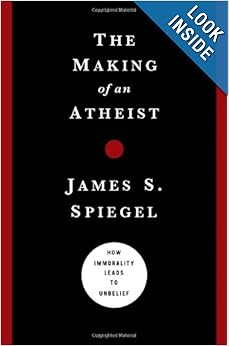
Book Review: The Making of an Atheist

The Making of an Atheist: How Immorality Leads to Unbelief (2010) is an interesting apologetic text by philosopher James Spiegel. Typically, apologetics books deal with arguments themselves whereas Spiegel's book examines atheism from the perspective of morality. Working from biblical evidence such as Romans 1, he contends that the reason individuals reject God is because of their immorality, which causes them to reject the clear evidence for God.

He begins by referencing the atheists themselves, such as Thomas Nagel who has said that he doesn't want God to exist. They are willing to accept wild theories rather than accepting the evidence for God. For example, both Francis Crick and and Richard Dawkins are open to the notion of directed panspermia, which is that life appeared because aliens planted it here.

He also argued that certain factors, specifically fatherlessness and immorality, predispose people to reject God.  I suspect that these factors led to significant resistance to Spiegel's hypotheses, though probably for emotional, rather than logical reasons.

At the end of the book, he concludes with a short chapter on The Blessings of Theism. A common ploy from many of the new atheists is to talk about how theism is bad for society.  Reality proves otherwise. 

If you have an interest in why people think the way they do, this may be a good read for. 

The Messianic symbolism of Braveheart

This weekend, I watched my favorite movie, Braveheart. I first saw it in the theater in 1995 when it came out. My wife and I were dating at the time and we went together. I remember being deeply moved by the movie, though my wife couldn't get past the realistic portrayal of the violence. As I watched it this weekend, the messianic symbolism hit me in a way that I have not experienced before. I am certainly not the first person to notice this and I will not be the last. However, here are a few observations. I have interspersed Bible verses to make my point.  Please look them up. (spoilers after the jump).

07 December 2013

Book Review: Tale of the Toboggans

Just over four years ago, my wife was diagnosed with breast cancer.  Prior to that, I had been reading John Piper's excellent book Desiring God and when I came to his chapter on suffering, I wondered why we didn't.  Though soon we did. Cancer is a life changing experience whether your own or in the life of a loved one.

That background brings me to this book, Tale of the Toboggans.  I don't even know how I came to it, except that it was a free offering on Kindle.  I just said the other day that it is unlikely that I will ever read all of the free Kindle books I have downloaded, but I am so glad that I opened this one. This book is an autobiographical account of Christian Schmidt's battle with a rare form of cancer, rhabdomyosarcoma. 

Quite plainly, this is one of the most moving, engaging books I have had the pleasure to read. Schmidt's descriptions of the treatment process and the ensuing physical, mental, and spiritual struggles is all too right.  I find myself torn. On the one hand, there are few books I have read that I think are more important for my wife to read and yet, I am not sure what she might encounter.  I have no doubt that this book will generate emotions she has not had for a long time.  Schmidt is brutally honest, which is a thing of rare beauty.  What was even more beautiful to me was the increasing thirst to bring glory to God through his battle. 

Here are the people to whom I would recommend this book.  Those with cancer. Those who know someone with cancer. Those who experience the pain of longing in some area of their life. Those who want to understand what cancer is like.  Those with a heart. Those without one. 

This book is nothing short of remarkable.  The Kindle price is 99 cents, which is much lower than its value.  Take advantage before the price goes up. 

Book Review: Grace--More than we deserve, greater than we imagine

I still remember one of the first "Christian" books I read.  Perhaps it was just the first one that was memorable. Max Lucado's Six Hours One Friday moved me. His writing was passionate and drew me right into the story of Christ's crucifixion. That descriptive writing has become a hallmark characteristic of Lucado's writing.

Lucado has written about a number of topics, but Grace: More than we deserve, Greater than we imagine, focuses on a common thread in his writing, which now compromises 100 books and over 80 million copies in print. 

I loved this book.  I agree with Sinclair Ferguson who said "we need to fill the world with books on grace."  This is a welcome addition.  In his typically descriptive style, he ruminates on the beauty of God's graciousness toward us.  At one point in the book, he mentioned a wall hanging reading, "Grace Practiced Here".  Indeed. 

06 December 2013

Book Review: The Physical Nature of the Christian Life


Brown and Strawn's short book, The Physical Nature of the Christian Life, is a good little volume. I have had the pleasure of hearing Dr Brown speak on similar issues on the past. First, let me state the positives of this book. Part III of the book, which deals with the embodied Christian life and the church was excellent. The authors did a commendable job of examining church life and our embeddedness within the community. I also appreciated the way in which they tied together themes of attachment theory and neuroscience in their observations. It was reminiscent of Curt Thompson's excellent "Anatom of the Soul" in that regard. I found their commitment to growth in community to be such an important thing that is often missing in the modern church. Additionally, their review of the neuroscience literature was was well-written and accessible, even to a non-neuroscientist.

I did have concerns however. I agree with another Amazon reviewer who mentioned that the authors have trouble arriving at their conclusions by asserting that a monistic viewpoint is the only way to get there. I am probably a rarity, but I am neuropsychologist and a dualist, in part because I find the philosophical and biblical arguments more compelling, and relevant here, do not negate the importance of church life. Many of the suggestions that they make do not require a monistic point of view. Furthermore, they seemed to tie together too closely dualism and gnosticism, a leap that I fear they made too blindly.

As an aside, there seemed to be a hint of social constructivism informing their view of church, such that truth is constructed by the group itself, rather than being an objective entity outside of the group. This leans toward postmodernism and I believe is in error. Perhaps that was not the authorial intent, but it did seem in places to come through.

Finally, I wish they would have acknowledged some of the limitations of their own position and provided responses to them. There are compelling arguments from a philosophical perspective in favor of dualism. They failed to deal with the work of people like JP Moreland or Keith Ward. It seems that too often, when people disagree with some aspect of orthodox theology, they revert to the idea that the church fathers were simply too much influenced by the Greeks, Romans, etc. and then go on to say what the biblical authors really meant. I do not think they can make that leap.

On the whole this is a well written, accessible book, but I am afraid their excellent conclusions do not match their weaker presuppositions.

03 December 2013

Book Review--Christian Spirituality: 5 Views of Sanctification

A friend of mine, Eric Johnson, recommended the book Christian Spirituality: Five Views of Sanctification, which was edited by Donald Alexander (1988). Representatives from Lutheran (Gerhard Forde), Reformed (Sinclair Ferguson), Wesleyan (Laurence W Wood), Pentecostal (Russell P. Splitter), and Contemplative (E. Glenn Hinson) traditions were represented. Each author provided an explanation of how their tradition, from their viewpoint, understands the process of sanctification. Each of the other authors then offered a response to the primary essays. 

Unsurprisingly, I found myself resonating with both the Lutheran and Reformed viewpoints.  I had already heard excellent things about Forde's chapter on the Lutheran view of sanctification. As I anticipated, his was a grace saturated chapter. He views sanctification as an issue of getting used to our justification and so, in the words of Luther, "to progress is to begin again" or as Jerry Bridges might say, "we need to preach the gospel to ourselves every day.  Ferguson was clearly grounded in the Calvinist, reformed tradition. Strong emphases were placed upon the sacraments, the Word, and union with Christ.

The Wesleyan and Pentecostal traditions made much less sense to me, at least in terms of how I understand scripture. Both talk about a strong move toward holiness, which is a good thing, but they seem to be very man centered in their understanding. Further, each speaks about the notion of second blessing or a second filling of the Spirit, for which I see no scriptural support.  To me, these viewpoints leave people feeling hopeless. 

I need to spend more time contemplating the contemplative tradition. One of the things I have appreciated about the contemplative tradition is that there is a focus on the affective or "carditive" aspects of faith rather than just the cognitive aspects.  We could all grow by understanding the emotional side of the faith better.

On the whole, this is a good book to help people think through what does sanctification mean.  Several of the essays are compelling and allow the reader to think about what does sanctification actually mean, hopefully to make a biblically informed decision.


02 December 2013

Book Review: Soul Talk

As I prepare for the School of Spiritual Direction, I have been working my way through several of Larry Crabb's books. Soul Talk (2003), the final required book prior to attending, was a good read. Another prerequisite for the school was to complete 4 online courses in spiritual direction. Soul Talk appears to be the clearest exposition of the model Crabb developed in the 4 courses.

A common theme that wends its way through Crabb's books is that too often, we replace first things with second things in our affections. Indeed, much of modern Christianity is built upon the pursuit of material blessings rather than the pursuit of God. Specific to this book, Crabb contrasted "self-talk" with "Soul talk." Although we speak to one another, our speech is too often filled with solutions or religious platitudes rather than words that come from the center of our soul. Crabb wrote, "We almost never speak words that are formed in the center of our soul and pour out from our very being with power and a sense of life. And we almost never hear words that stir life within us, that pour hope into those empty spaces deep inside filled only with fear and fury and frustration." Crabb has high hopes that we might begin to engage in conversations where the Spirit can dance.

He recommends a number of "steps", though perhaps steps is the wrong word.  He is clear that he is not recommending something akin to "6 steps to a happy marriage."  However, he does suggest a process for engaging with others. When people share with us something going on in their lives, we need to "think beneath" resisting the temptation to speak too quickly or provide band-aid answers. We then must "think vision"--not in terms of the immediate situation, but in terms of what could happen if the person focused on God first.  I particularly appreciated his notion of "thinking passion" because we are encouraged to think about what is going on in our own hearts. Next we "think story", where we listen to hear the hidden story shaping the events of their lives. Finally, we "think movement" toward brokenness, repentance, trust, and release of the true self.

On the whole, this was a good book. I have appreciated Crabb's understanding of walking in brokenness with others. I did not get as much out of this book as I did out of Inside Out or The Pressure's Off, but this is a foundational book in his thinking.  I would recommend it.

[2015 edit] I re-read this book in October 2015 and I was much more deeply taken with this book than I was initially.  I am not sure if this response was due to an increased familiarity with the concept of SoulTalk or something else. Regardless, this book remains foundational, but it is not just good, it is excellent. 

L'Abri Library

I just came across a link to the L'Abri Ideas Library. If you know of my love for Francis Schaeffer, you will know that this will likely be a huge blessing to me.  I hope it is to you as well.  It says at the top of the page, "The ideas library has grown over the last 50 years as an attempt to provide honest answers to honest questions about the reality and relevance of the Christian faith." From the looks of it, there are links to hundreds of lectures conducted through the L'Abri institutes around the world including many from Schaeffer himself. 

Gift Ideas-Christmas 2013

Thanksgiving is past, so we are officially into the Christmas season. I thought I would offer some recommendations, most related to books.

Look for a gift book for a believer
One Way Love by Tullian Tchvidjian is a great book focused on God's radical grace toward believers.  This is, so far, Tullian's best book. 


Is your believer a bit of an intellectual egghead (in the greatest possible way, of course)
Doug Groothuis's Christian Apologetics remains an excellent resource for the Christian wanting to defend their faith. 


How about a gift book for a nonbeliever
Tim Keller's Prodigal God is a short, deeply engaging book exploring God's extravagant grace toward sinners.


Christmas CD
Natalie Grant's Believe remains my favorite Christmas CD.  It has a big band feel to it. 


Looking for a ministry to support?
How about Teamwork Africa? Their mission: Teamwork Africa plants and resources African churches to meet the vital spiritual, physical and social needs of their local communities.


Want a bigger ticket item? 
How about Logos 5 Bible Software?


Want a bigger ticket item for me?  
How about an all expenses paid trip to Liberate 2014.