18 January 2016

Christlike Breathing Room

Sometimes, I am too busy. I find myself running from one activity to another. If I am not running then I am thinking about what is coming next. Work, church, friendships, family, speaking, writing, radio, board of directors involvement, time to myself.

Oh yeah, and time with God.

Often, it seems like there is more work than week. If I am not careful to set margin, it can lead to burn out. I can find myself resenting any of a number of things...or worse, people...and I don't like that feeling. I have had to try to be intentional about setting up boundaries around my time and, though I am not always successful, I wanted to share a few thoughts for others who may struggle with the same thing.

First, I have to intentionally order my priorities. God must be first, or else nothing else works. After that: Heather, my children, close friends/family, and then others. Unfortunately, too often, my order of priority becomes imbalanced. My times with God get squeezed because of work responsibilities. Time with my children becomes a quick hello over dinner while I am off to be with or serve someone else. On occasion, this imbalance is necessary, but it will not be sustainable over the long haul.

My wife and I have spoken that life sometimes feels like we are firefighters putting out relational fires all over the place. Both of us value that God allows friendships with others where we can "go deep". We seek them out. But like fighting real fires, it can be exhausting and when those activities become too much, the energy that remains for our marriage and our children dwindles. We feel it. Our children feel it.

Keeping this balance is difficult for a few reasons. For example, some needs feel more pressing than others. Frantic phone calls often supersede a child who needs lap time. There is a certain pride in feeling needed by others. It is also difficult to say no to people because I do not want to disappoint them. I once asked Larry Crabb about how to kindly say no to people who ask for time with me. It made me feel better that he also struggles with it. He has developed the skill of saying:"yes, I would love that", "I simply do not have time" or "I sure would like to, but now is not a good time." It is hard to figure out that balance.

Second, if I tell someone that I do not have time to meet with them, or if I do not meet as often as they would like to, I want them to know that it is not a rejection of them, though for many people it may feel that way. I suppose this comes back to the issue of priority. I know men who commit to meeting with other men several nights a week to fellowship, or play sports, or pray together, leaving their wives and children alone. Though all of those may be good activities, it can lead to imbalance in priorities. I have to intentionally guard against that.

Third, when I am acting from wisdom, I make decisions together with my wife. She has a better pulse on my commitments and emotional energy than anyone, including me. I need her to speak into my schedule. I have two men I have breakfast with once a week who also speak into my priorities. Too often, I am not smart enough to make those decisions by myself--my pride and my fear of disappointing others gets in the way.

Fourth, it is essential for me to keep sacred set aside times.  When I started my master's degree, a mentor and a friend told me that I would be wise to zealously
guard a day a week when I didn't work on school.  That served my family well through many years of graduate school. I accomplish that now by waking up early every morning and spending time with God: reading, writing, and praying. I also try to protect time each week when I am with my family and not "with" others. In other words, I don't answer my phone. I avoid chatting and texting. We aren't doing anything special, just living in the same space. An area that I want to grow in is to set aside more extended times each year when I can get away for a silent retreat, away from the worldly cacophony in which we live.

I think my need for margin in a busy world is one of the reasons I love Mark's gospel.  If you read Mark, you will discover the contrasting themes of immediacy and Jesus seeking to be alone with the Father. Perhaps my favorite passage is in the first chapter. Beginning at verse 32, it reads "That evening at sundown they brought to him all who were sick or oppressed by demons. and the whole city was gathered together at the door. And he healed many who were sick with various disease, and cast out many demons. And he would not permit the demons to speak, because they knew him. And rising very early in the morning, while it was still dark, he departed and went out to a desolate place, and there he prayed. And Simon and those who were with him searched for him, and they found him and said to him, "Everyone is looking for you" (Mark 1:32-37). I think part of the reason God gave us Mark's gospel is to show us how Jesus faced time pressures and how he handled them, which wasn't by always being available to everyone.

Every one of us, whether intensely introverted, or extremely extroverted, or somewhere else on the spectrum, must be intentional about setting margin, establishing priorities, and learning to say no.


12 January 2016

Diotrephean Self-Centeredness

I have written something to the church, but Diotrephes, who likes to put himself first, does not acknowledge our authority. So if I come, I will bring up what he is doing, talking wicked nonsense against us. And not content with that, he refuses to welcome the brothers, and also stops those who want to and puts them out of the church.- 3 John 9-10

At 15 verses, 3 John is one of the shortest books of the Bible. Written to Gaius, by John, it is pregnant with pastoral wisdom. Midway through, John wrote about Diotrephes, whom context would suggest was a part of the early Christian church, though we know nothing else about him apart from these two verses. 

What resounds about Diotrephes is that he was self-centered, presumably proud, arrogant, and unteachable. We can surmise that he lacks humility, patience, and other-centeredness.

Those words sting.  In part what makes them sting is that I can be Diotrephes. I do like to put myself first. Many of us do, but Diotrephean self-centeredness is the antithesis of the gospel and Christian maturity. 

May we grow in other-centeredness. 


08 January 2016

In all things, He is present

To see the hand of God upon the earth
and upon my friend;

To hear His whisper in the trees
and in attentive conversation; 

To feel His movement within the wind
and in lives made holy. 

In all things, 
God presents us with His presence. 

04 January 2016

Longing for Greener Lawns

We live in a celebrity culture. A trip to the local library, a button pushed on the television remote, or logging in to Twitter gives any one of us access to famous people. The free access to the words and images of politicians, singers, actors, and writers provides a false sense of familiarity.  As a reader, at times it is easy for me to believe that I "know" men like John Piper, Eugene Peterson, and Tullian Tchvidjian. But I don't. Even Larry Crabb, Curt Thompson, and Eric Johnson--Christian authors with whom I interact more regularly--I do not know with the same level of intimacy with which I know my family, my friends, and my home church.

I am afraid that the celebrity culture in which we live promotes a false hope. We hang on the words these people share with us, often forgetting that what they choose to share is carefully measured. They let us see what they want us to see. Even when controversy hits the information we receive is filtered.

But real people, the people with whom you live real life, are messy.  They sin against you.  You sin against them. We are often unkind, unforgiving, negligent, and downright mean.  That's not the way it is supposed to be, but that is the way it is this side of heaven. These are the communities in which God has placed us.  So the next time you see someone from afar and wish you could be closer to them, remember they too are messy.

Real life isn't living above the mess, but learning to live with hope in the middle of it.

24 December 2015

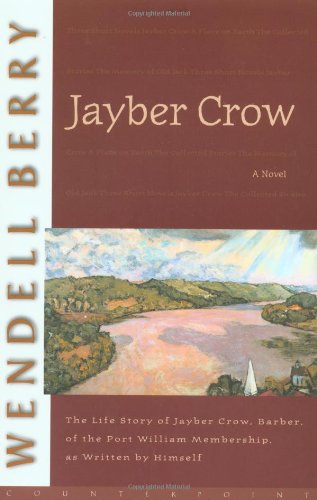
Book Review: Jayber Crow

Two of my favorite writers--artists really--with the last name Peterson (Andrew and Eugene) have each mentioned the importance of Wendell Berry upon them. Intrigued, I sent for his book Jayber Crow (2000), one of the many titles set in the fictional Port William, Kentucky.

The novel tells the story of Jonah Crow, known to most as "Jayber"--the barber, grave digger, and church custodian in the small town from the depression era through the middle of the Vietnam War. Written from the first person perspective, the reader is given wonderful insight into the psyche of an intriguing man.

I look forward to exploring more of Port William. Having grown up in a small town, I was strangely attracted to Berry's vision. His indirect call to simplicity was refreshing too.

A Christmas Poem

Did the stars open their eyes widely?
     Did the trees tremble with excitement?
     Did the clouds crowd in
          to get a glimpse of the newborn Savior?

Did the rocks cry out?
     Did the grasses whisper and wave?
     Did the streams and falls and rivers
          sing in harmony at the sound of the baby's cry?

All of creation echoes the psalmist
     "Blessed be the Lord, the God of Israel
      who alone does wondrous things.
      blessed be his glorious name forever;
      may the whole earth be filled with his glory!"

Meanwhile,
     We turn our eyes upon the latest gadgets
     We tremble at the newest hit song
     We crowd in to get a glimpse of pre-Chrismtas deals.

Meanwhile,
     We cry out, in anger, that a clerk failed to wish us a "Merry Christmas"
     We murmur and grumble about unfair treatment
     We sing not worship, but discord.

Meanwhile, meanwhile
     we lose sight
     of the One who sets all things right

This Christmas
     open your eyes widely
     tremble with excitement
     crowd around the manger

     cry out with joy
     whisper thanksgiving
     sing a lullaby to the One who makes all things well.

23 December 2015

One Word

In late 2014, I decided that I would carry with me one word or theme through all of 2015. I chose gentleness. I thought about gentleness. I prayed about gentleness. I taught about gentleness. I read about gentleness.  I routinely asked myself, "what does gentleness look like in this particular situation?" and then tried to act accordingly. I didn't always succeed, but I believe it was a worthwhile endeavor. Heather and I were talking about this yesterday and she asked me, "so do you think you are more gentle?" and I said, "yes, I think I am." Thankfully, she agreed.

My goal is to choose a word of the year and to soak in that word for 12 months. Much to our frustration, change comes slowly to us all. The biblical metaphors for sanctification support the gradual change process. Meditating for an extended period allows us to rest in the redeeming and transforming work of the Holy Spirit. We may not perceive day to day change, but over time, we grow.

I am praying about my word for 2016, but I haven't pinned it down quite yet. What about you? What would be your word?  Will you spend 2016 focusing on gentleness? If not gentleness, here are a few other suggestions: kindness, peace, joy, patience, self-control, humility, surrender, truth, or wisdom to name a few.

If you are interested, pray that the Spirit would reveal to you an area where He wants to take you deeper.  

Just prior to posting this, I found this website, My One Word, which looks to be promoting the same idea.

17 December 2015

Book Review: The Great Divorce

CS Lewis is one of my favorite authors and his 1946 book The Great Divorce is my favorite book of his. I just finished my third (or fourth) reading and I have liked it better with each reading. If you are unfamiliar with the story, Lewis wrote an allegorical story of ghosts taking a bus trip from a perpetually grey city to a beautiful land.

Each of the ghosts who make the trip share the common feature of self-centeredness, though it manifests in different ways. They encounter bright Spirits who live in perpetual joy in the presence of the Trinity. Describing one of the beings at the end of the book, Lewis wrote "The Happy Trinity is her home; nothing can trouble her joy."

I think that in addition to being a well-written, deeply engaging story, another reason I am drawn to The Great Divorce is that it seems to present a fictional account of what may become in a community centered on God rather than on self. As a student of Larry Crabb's work, The Great Divorce reminds me in ways of Shattered Dreams, which interestingly relies significantly upon Lewis's idea that if you put first things first, you will get second things thrown in, but if you put second things first, you lose both first and second things. 

I cannot recommend this book highly enough.

10 December 2015

My Top Ten Books of 2015

As we near the middle of December, it is time again to put out my "best books" list. I have read well over 100 books this year and so my field of choices is large. I chose to exclude books from my 2015 list that were re-reads for me.

If you are looking for yourself or someone else for Christmas, you can find some solid options on this list.

10) Hand in Hand: The Beauty of God's Sovereignty and Meaningful Human Choice by Randy Alcorn (2014). As someone who has wrestled with the implications of Calvinism, God's sovereignty, and our ability to choose, Alcorn's book was a welcome read. The author went to great lengths to find areas of common ground between various camps (e.g., Arminianism, Calvinism) in a way that wrestles humbly and meaningfully with the biblical text.

9) The Solitary Tales (2010 to 2013)--These 4 books by Travis Thrasher tell the story of a young man with baggage who moves to an unusual community in North Carolina. The story line is compelling  and mysterious and the short, accessible chapters lead the reader to say, "just one more page."  I read the 1700 pages in just under a week because I couldn't set them down.

8) Prodigal Church (2015)--Jared Wilson offered up another gospel-drenched book in the Prodigal Church. He issues a call to the church to move away from legalism and the attractional model to the Gospel that glorifies God and revels in God's graciousness and forgiveness.

7) Reversed Thunder (1988)--If two years ago was the year of Francis Schaeffer, and last year the year of Larry Crabb, 2015 was probably the year of Eugene Peterson. I read many of his books this year. He writes with a pastor's heart, a theologians mind, and a poet's soul. Reversed Thunder explored the imaginative language used by St John in Revelation.  This book celebrates the beauty of language rather than trying to read the apocalyptic tea leaves.

6) Relational Soul: Moving From False Self to Deep Connection (2015). Rich Plass and Jim Cofield wrote an excellent book exploring the importance of human connection to our overall well being by referencing interpersonal neurobiology, attachment, and Christian spirituality. As a fan of Larry Crabb's, this book was almost like reading fan non-fiction.

5) A Loving Life (2014). Looking back through my notes, I was a bit surprised to see that I had never written a review of this book.  Paul Miller, who a few years back wrote the excellent book A Praying Life, explored the themes of love and other-centeredness through the story of Ruth. He also wrote a wonderful book, Love Walked Among Us, a few years back that was equally edifying as are most books by Miller.

4) A Grace Disguised: How the Soul Grows Through Loss (2004). A Grace Disguised by Jerry Sittser was one of the most beautifully gut-wrenching books I have ever read. With each page, I was on the verge of tears, drawn in to the author's story.  I actually wrote to the author after reading this thanking him for writing it.

3) The Pastor: A Memoir (2011).  The Pastor is the second book in my list from Eugene Peterson. In this memoir, Peterson explores his own development as a pastor and along the way, invites the reader to look in on his journey, which he described with beauty.

2) The Allure of Gentleness (2015). I waited for this book, written by Dallas Willard and published posthumously. I have long enjoyed Willard's insightful, yet humble writing. He was an important contributor to the spiritual formation landscape for many years. In addition, for well over a year, I have really tried to focus on understanding gentleness because too many of us (myself included) lack it. Willard's book was a wonderful look into this Spiritual fruit.

1) Love Does (2012). Much like Barbara Duguid's Extravagant Grace from 2014, I didn't have to struggle long with my top book choice for the year.  Bob Goff's Love Does was a fun, whimsical, highly engaging book that demonstrated through several brief vignettes the effect of love upon others. I loved Love Does.

N.B. --I review most of the books I read. If you click on "BOOKS" on the right panel, it will bring you to all of my book reviews.

04 December 2015

A few of my favorite audio resources

Most people know that I read a lot, but I also listen a lot. Every Tuesday, I drive the hour to Rice Lake and I sit in my car (and whenever I am going anywhere) and I typically listen to different teachings. Some I may listen to once, but there are some that I listen to over and over again. Unsurprisingly, I have a "Larry Crabb" playlist that is perhaps over a day long that I listen to frequently. But of all of the teachings, here are some of my favorites.

Ambassador Basic Curriculum: Course 1--Although all 3 courses are very well done, Greg Koukl's course 1 are very well done. Koukl is an engaging communicator and these lectures provide a great foundation for communicating with others about the faith. ~5 hours.

Crisis of Care in the Christian Community--"Crisis of Care" presents one of the more comprehensive overviews of Larry Crabb's work in a series of lectures that were given at Regent College in Vancouver. I am not sure of the date that these lectures were given, but by the way he talks, it may be a bit earlier in his professional work, shortly after his thinking began to shift. 7.7 hours.

Eat This Book--In a series of 3 lectures given at Regent College, Eugene Peterson offers one of the finest introductions to absorbing Holy Scripture that I have heard. He has since wrote an excellent book with the same title, but these 3 lectures provide an engaging and important introduction. 3.6 hours.

The Freedom Series--Larry Crabb gave a series of 4 sermons at Valley Springs Fellowship regarding our Freedom in Christ based upon Romans 7:6, the foundational verse for New Way Ministries. ~2 hours.

Solving the Problem of Evil--When I was working on the apologetics certificate through Biola University, one of the many required lectures was entitled, "Solving the Problem of Evil" by Garrett DeWeese. Although DeWeese is a philosopher, he speaks with a pastor's heart and this lecture is one of the finest treatments of the problem of evil I have ever heard, not because DeWeese solved it, but because he was willing to wrestle with it well. 2 hours.

2 Bonus Recommendations
66 Love Letters Audio Book--I am putting this one in here for my wife. She listens to this over and over and over and over again. She also reads along in the book.  It is a full, unabridged version of Dr Crabb's excellent 66 Love Letters and until December 18, 2015, it is only $7.49.  14 hours.

The New Covenant--I just found these 15 lectures by Dwight Edwards on the New Covenant. I really liked his book Revolution Within and so far, these lectures have been great.  In addition to great material, Edward's voice is wonderful. ~8 hours.